
Fashion Photography for Myntra: 11-Step Complete Guide for Clothing Brands & Sellers in 2026–27
A practical, seller-focused guide from Uniqs Studio Delhi NCR — covering requirements, models, poses, workflow, pricing and QC for marketplace-ready fashion catalogues.
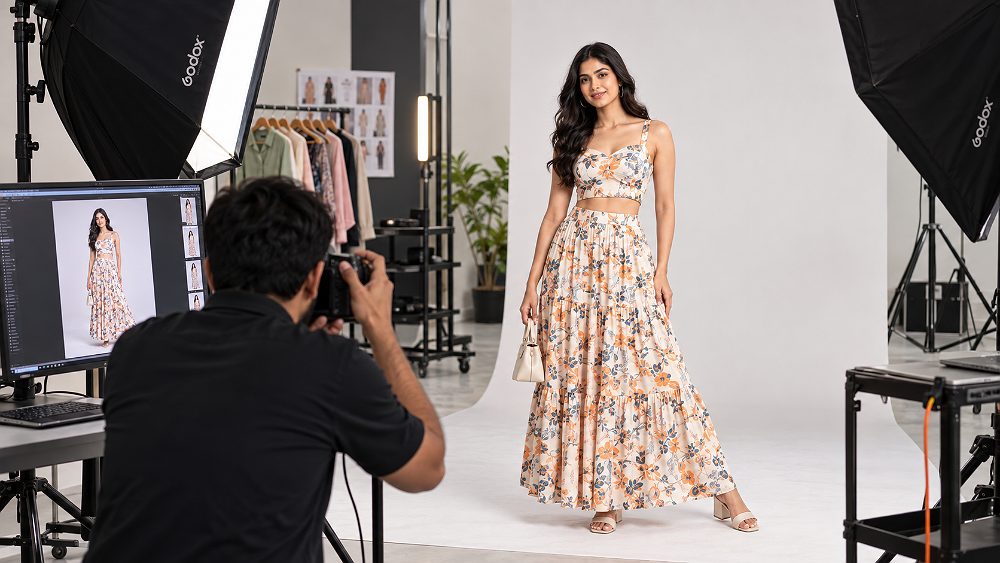
Selling clothing on Myntra is a very different game from running an Instagram-first D2C label. The marketplace rewards consistency, product clarity and accurate garment representation — and that begins with Fashion Photography for Myntra that is planned, structured and repeatable across every SKU you upload.
At Uniqs Studio, Satyam and the team have shot thousands of apparel SKUs for clothing brands, garment manufacturers and D2C fashion labels selling on Myntra, Ajio and other fashion marketplaces. This guide brings together everything a seller should know — from image requirements, model casting and styling to poses, the 11-step production workflow, pricing structure, common mistakes, and a final go-live checklist. For production-ready catalogue images, brands can explore our professional Fashion Photography services along with our dedicated garment photography workflows built for high-volume ecommerce production.
- What Is Fashion Photography for Myntra?
- Myntra Fashion Photography Requirements
- Fashion Photography With Myntra Models
- Best Myntra Poses & Shot List
- 11-Step Myntra Photography Workflow
- Model vs Flat Lay vs Ghost Mannequin
- Myntra Fashion Photoshoot Cost in India
- Photography & Conversion
- Common Mistakes to Avoid
- Choosing a Myntra Studio
- Go-Live Checklist
- FAQs
- Plan Your Myntra Shoot
- Fashion Photography for Myntra is product-first catalogue photography, not editorial campaign work.
- Consistent front, back, side and detail poses across every SKU build customer trust and reduce returns.
- Model casting, garment fitting and styling directly influence how customers judge fit on the product detail page.
- A repeatable 11-step workflow — from SKU intake to final QC — is what makes high-volume Myntra shoots reliable.
- Always verify current Myntra category-specific image guidelines before finalising specs; requirements evolve.
What Is Fashion Photography for Myntra and Why Does It Matter for Sellers?
Fashion Photography for Myntra refers to marketplace-focused apparel photography designed specifically for how customers browse, compare and buy clothing on the Myntra platform. Unlike editorial fashion work, the goal is not creative expression — it is clear, accurate, consistent product presentation across every listing a Myntra seller uploads.
On a fashion marketplace, shoppers scan thumbnails in seconds and swipe through 4–6 images on the product detail page before deciding. If your garment photography shows the fit, fabric and styling correctly, the customer trusts the listing. If images look inconsistent, over-edited or amateur, the brand loses the sale before the price is even considered. Sellers building a real catalogue business on Myntra treat photography as ecommerce product images customers actually trust — not a one-off creative exercise.
At Uniqs Studio, our approach treats every Myntra shoot as a production line — repeatable framing, consistent lighting, colour-accurate garment reproduction, and disciplined SKU tracking. That discipline is what separates a marketplace-ready fashion catalogue from a pretty-looking Instagram gallery.
Myntra Fashion Photography vs Regular Fashion Photography
Regular fashion photography leans into mood, storytelling and location. Myntra fashion photography, by contrast, is engineered for the product detail page. Framing, backdrop and pose repeat across the entire catalogue so customers can compare a red kurta to a blue kurta without visual confusion.
Editorial shoots celebrate a single hero look. Ecommerce fashion photography for Myntra celebrates 500 SKUs behaving predictably — same crop, same lighting, same model scale. Brands that understand this difference save money on reshoots and get catalogue approvals faster. It’s the same principle we cover in our fashion photography for ecommerce playbook.
When Should a Clothing Brand Use Models Instead of Product-Only Images?
Model photography is essential when fit, silhouette, drape or styling drives the buying decision — which applies to almost every Myntra fashion category. Dresses, kurta sets, sarees, western wear, activewear and menswear all convert better when a real body shows how the garment falls.
Product-only images — flat lay photography and ghost mannequin photography — are excellent supporting assets that show construction, fabric texture or hidden design details. Our recommendation to sellers is simple: lead with a fashion model, support with flat lay or ghost mannequin, and let each image do the job it does best.
Fashion Photography for Myntra Requirements: What Brands Should Prepare Before Shooting
Myntra publishes category-specific image and content guidelines for sellers, and these evolve. Rather than treating any single spec as permanent, treat this section as a preparation framework and always cross-check the current requirements on the Myntra Partner Portal before your production day.
Solid preparation is what separates a smooth two-day shoot from a chaotic one that overshoots the budget. Uniqs Studio typically runs a pre-production call with the brand a week before the shoot to lock SKUs, sizes, model requirements and styling references — the same discipline we describe in our fashion catalogue photography guide. For high-volume brands we also lean on the shot-list logic from our apparel shot list per SKU framework.
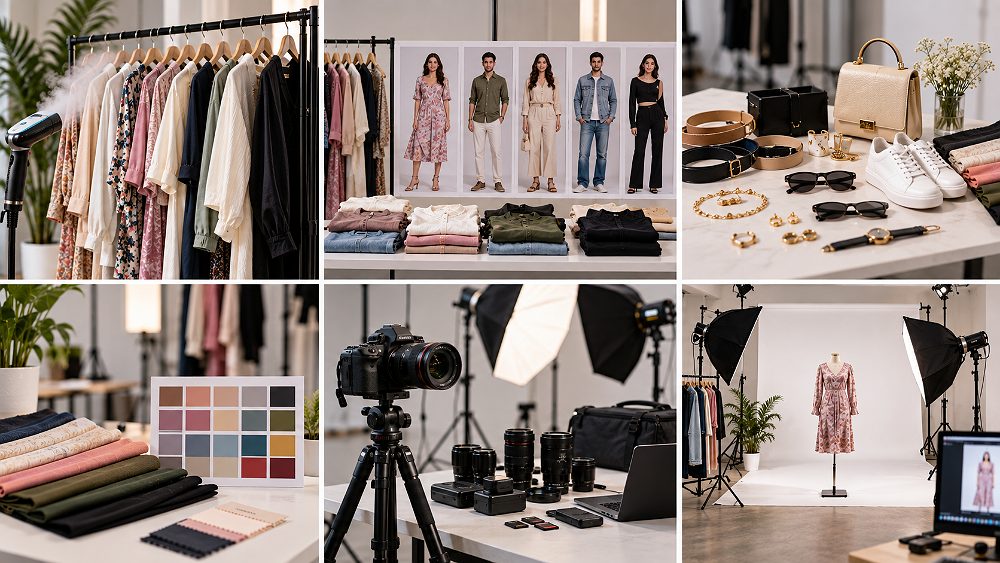
Main Product Image and Catalogue Presentation
The main product image is your listing’s first impression on Myntra thumbnails, search results and category pages. It must show the full garment cleanly, with accurate garment colour accuracy, sharp focus and correct proportions. Avoid distracting props, over-styling or extreme poses — the outfit is the hero.
Consistent framing across every SKU makes a category page look like a legitimate brand rather than a random reseller. That’s the exact discipline we build into every Uniqs Studio fashion photography setup for clothing brands.
Supporting Images and Product Angles
Beyond the main image, Myntra listings typically benefit from a well-planned set of supporting product angles covering back view, three-quarter, styling context and fabric detail. Each additional image should answer a question the customer would ask: How does it look from behind? How does the fabric feel? What’s the neckline like?
Recommended shot coverage across most fashion categories:
- Full front view
- Full back view
- Side or three-quarter view
- Styling / full-length lifestyle view
- Fabric or detail close-up (macro)
- Key design-feature image (embroidery, print, neckline)
- Additional category-specific image when required
Image Quality and Technical QC Checklist
Poor product image quality is one of the biggest reasons catalogues get held up on Myntra. Sharp focus, correct exposure, honest colour and clean backgrounds are non-negotiable. A dedicated QC pass — done separately from editing — catches problems before files go to the seller panel.
Check Before Upload
- Correct crop and framing across the SKU set
- Sharp focus, no motion blur
- Accurate garment colour vs the physical sample
- Clean background, no shadows bleeding into the product
- No unwanted objects, hangers or tags visible
- No excessive skin or fabric retouching
- Consistent model scale across every SKU
- Visible product details — buttons, prints, embroidery
- Correct file format, colour space and export settings
- Current Myntra category-specific image guidelines rechecked
Common Photography Problems That Can Delay Catalogue Approval
Sellers often lose 3–5 days on avoidable issues — inconsistent framing between SKUs, missing angles, wrong colour representation, wrinkled garments, over-retouched fabric that no longer matches the product, or wildly different image dimensions across a single collection.
At Uniqs Studio we treat these as production discipline problems, not creative ones. Tight SKU tracking, tethered shooting and structured retouching prevent them from ever reaching QC. Many are the same pitfalls we cover in our clothing product photography mistakes breakdown.
Fashion Photography With Myntra Models: Casting, Styling and Preparation
Once a brand commits to fashion photography with Myntra model imagery, casting becomes the single biggest quality lever. The right model makes a mid-range kurta look premium; the wrong model can make an expensive dress look cheap. Fit, proportion, natural posing ability and category appropriateness matter far more than pure aesthetics.
Uniqs Studio maintains an internal roster of tested ecommerce models across body types and categories, and we cast specifically for the brand — not the other way around. Our detailed model photography workflow is built around ecommerce needs, and we’ve documented the deeper thinking in our editorial vs commercial vs catalogue fashion photography guide.
How to Choose the Right Model for a Myntra Photoshoot
Model casting for a Myntra photoshoot starts with the target customer and the garment category. A streetwear label needs a different fashion model than a bridal wear brand. Fit is critical — the model should wear the brand’s actual size grade cleanly, without heavy pinning that distorts the silhouette.
Consistency also matters: sticking with one or two models across a large SKU set gives the category page a coherent brand feel. Sellers can dig deeper in our model portfolio guide and the practical model photoshoot preparation checklist.
Garment Styling, Fitting and Steaming
Garment fitting and steaming are the unglamorous 40% of a good Myntra shoot day. Every piece should be steamed, correctly sized, and pinned invisibly only if needed. Sleeves, hems and dupatta placement must repeat identically across colour variants of the same style so the customer sees the garment, not the styling drift.
Symmetry, neckline alignment and consistent accessorising are what make a fashion catalogue look professional. The full preparation logic — from tag removal to lint rolling — is covered in our garment preparation for fashion photography guide.
Hair, Makeup and Grooming for Ecommerce Catalogue Photography
Hair and makeup for ecommerce fashion photography should be commercial and neutral — not editorial. The goal is to keep the customer’s attention on the garment, not the model’s smokey eye. Consistent grooming across SKUs prevents the catalogue from looking like it was shot on ten different days by ten different teams.
Category-appropriate styling still matters: ethnic wear benefits from softer, more traditional grooming; western streetwear can carry a slightly bolder look. But even then, restraint wins on a marketplace product page.
Best Myntra Photoshoot Poses and Image Shot List for Clothing Brands
Great Myntra photoshoot poses are simple, repeatable and product-forward. Editorial gymnastics look great in a lookbook and terrible on a marketplace thumbnail. The winning formula is a small, disciplined pose vocabulary — front pose, three-quarter, side pose, back pose, one relaxed movement pose, and a detail-focused pose — repeated cleanly across the entire SKU list.
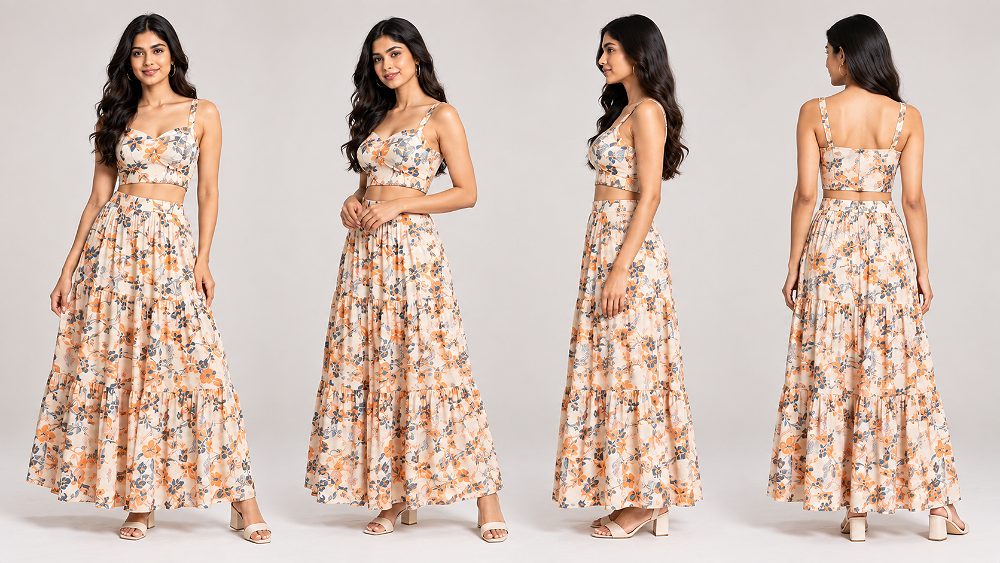
Essential Front, Side, Three-Quarter and Back Poses
The four core model poses — neutral front, three-quarter turn, clean side profile and full back — should appear in almost every listing. Add one natural movement pose (a subtle walk or garment interaction) and one detail-focused pose (looking down at a neckline or sleeve) to complete the set.
Keeping this vocabulary tight makes shooting 40–60 SKUs a day realistic without quality dropping. It’s the same repeatable approach we recommend in our how-many-images-per-SKU guidance.
Shot List for Dresses, Tops, Shirts and Western Wear
For western wear and apparel photography, the standard shot list covers:
- Full front — arms neutral, garment falling naturally
- Full back — showing zipper, closure or back design
- Three-quarter — best angle for silhouette
- Side profile — shows length and drape
- Detail shot — buttons, print, embellishment
- Fabric texture — macro on weave or knit
- Key design feature — neckline, sleeve, hemline
Shot List for Kurtas, Kurta Sets, Sarees and Ethnic Wear
Ethnic wear on Myntra needs a slightly richer shot set because customers are buying the outfit, not just one garment. A kurta set needs the full outfit shot, a bottom-garment view, and a dupatta drape moment. Sarees need pallu detail, blouse detail and the drape flow.
Recommended coverage:
- Full outfit — head to hem
- Front silhouette
- Back design and closure
- Dupatta or drape moment
- Bottom garment on its own
- Embroidery / detail shot close-up
- Sleeve and neckline detail
- Fabric texture macro
Shot List for Menswear and Kidswear
Menswear listings on Myntra reward clean, confident, straight-on poses — customers want to see fit, shoulder line and length. Kidswear shifts to natural movement, softer expressions and playful (but controlled) posing that still keeps the garment fully visible.
Both categories still need the standard four angles plus fabric and detail shots. What changes is the model direction and grooming style — not the underlying catalogue shoot discipline.
11-Step Fashion Photography for Myntra Workflow
Every reliable Fashion Photography for Myntra production runs on a repeatable 11-step workflow. This is the exact structure Uniqs Studio uses for clothing brands shooting 50 to 500+ SKUs per collection — and it’s what makes marketplace-ready output possible without last-minute chaos.
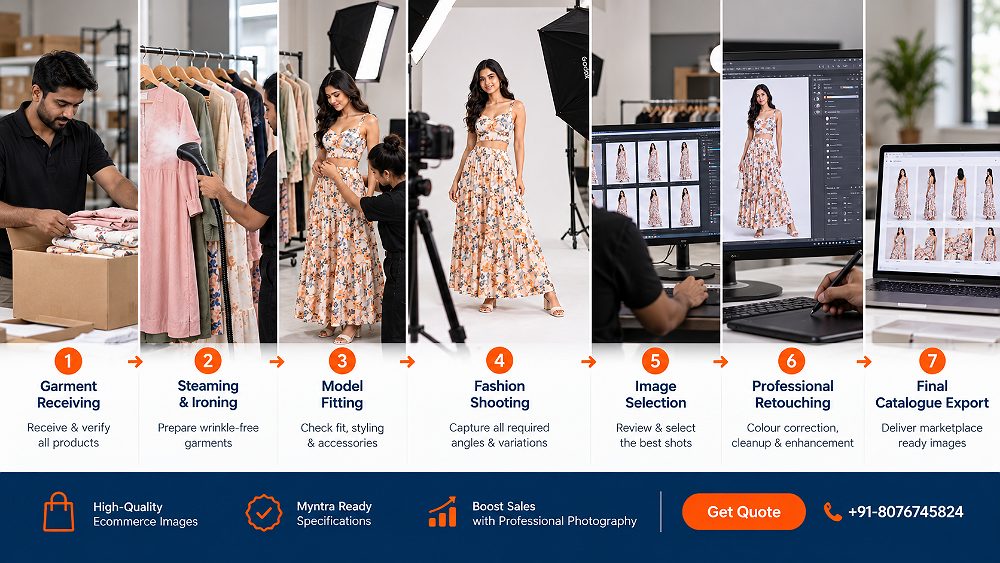
Step-by-Step Myntra Photoshoot Process
Here is the full 11-step production workflow the Uniqs Studio team follows for every Myntra fashion catalogue project — each step designed to protect consistency, colour accuracy and turnaround.
- Receive SKUs and product information — physical samples, size run, colour codes, product IDs.
- Categorise garments and colour variants — group by style, category and shoot order.
- Prepare shot list — angles per SKU, styling notes, priority order.
- Cast and confirm the right ecommerce model — based on fit, category and brand feel.
- Steam and style garments — pre-shoot preparation, accessorising, size checks.
- Set consistent lighting and framing — locked camera height, marks on floor, colour targets.
- Shoot required angles — front, back, three-quarter, side, detail, movement.
- Review images during production — tethered monitoring to catch issues live.
- Select final images — one clean take per angle per SKU.
- Retouch and colour-check — natural cleanup, colour match against physical sample.
- Export and perform final QC — file naming, dimensions, format, dedicated QC pass.
This structure lets us deliver even 300+ SKU shoots inside a predictable timeline. Brands running big drops often pair the shoot with our ecommerce video production service on the same day, using the same model and set-up — closer to how our one-shoot-multiple-assets reels workflow is designed.
Pre-Shoot Checklist for Clothing Brands
Send this checklist to your team a week before your Myntra shoot — it eliminates 90% of day-of surprises.
- Final SKU list locked
- Product codes labelled on every garment
- Correct sizes confirmed for the model
- Garments steamed and production-ready
- Model requirements approved
- Styling references shared
- Required angles per SKU confirmed
- Colour variants organised
- Accessories sorted per outfit
- Delivery deadline aligned
- File naming convention agreed
- Current Myntra marketplace requirements re-verified
Post-Production and Retouching Workflow
Fashion retouching for Myntra is deliberately restrained. The goal is image editing that corrects exposure, white balance and background cleanup — not fantasy-level skin work that misrepresents the product. Excessive retouching also triggers returns because customers receive something that doesn’t match the listing.
Our typical retouching pass includes exposure correction, white balance lock, colour match against the physical garment, background cleanup, gentle skin cleanup, wrinkle cleanup that respects garment construction, final crop, export in the correct colour space, and a separate QC review. Deeper detail is in our garment photography editing workflow.
Myntra Product Photography: Model Shoot vs Flat Lay vs Ghost Mannequin
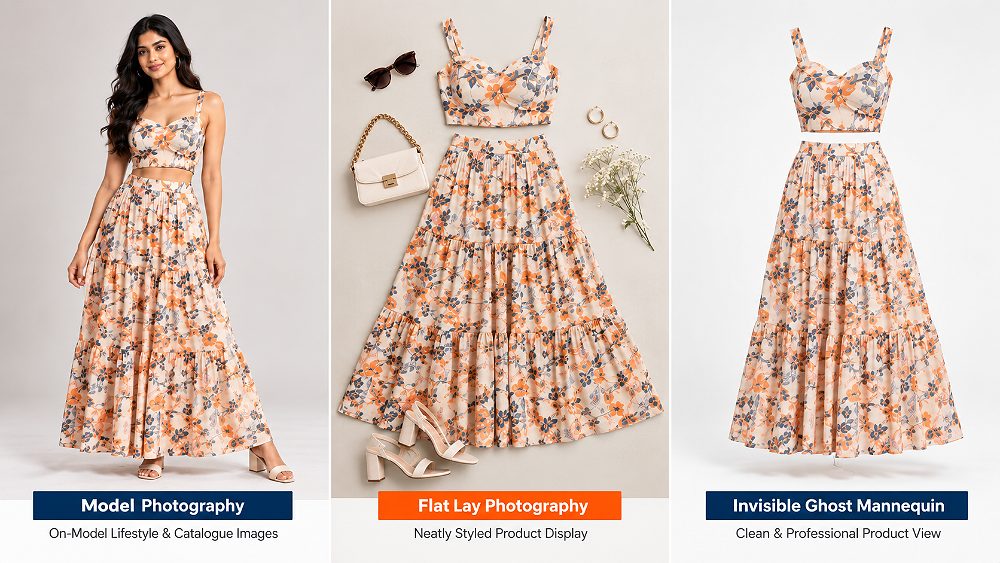
Sellers often ask which technique to choose — Myntra model shoot, flat lay photography, or ghost mannequin photography. The honest answer is: fashion catalogues on Myntra usually need a combination, with model imagery as the hero and the other two as intelligent support.
Model Photography
Best for fashion apparel, fit-sensitive products, premium positioning and any garment where silhouette or styling drives the buy. This is the fashion PDP hero image on almost every winning Myntra listing.
Flat Lay Photography
Best for supporting product imagery, simple garments and detail communication. A well-styled flat lay makes construction and fabric obvious. Our full breakdown of technique lives in the flat lay photographer for clothing brands guide.
Ghost Mannequin Photography
Best for clean, product-only presentation where the garment’s shape matters but a visible model isn’t needed — think inner layers, structured tops or brand-neutral catalogue rows. For sellers weighing options, our ghost mannequin vs model vs flat lay comparison is the deeper dive.
| Photography Type | Best For | Shows Fit | Visual Appeal | Production Complexity | Typical Use | Best Choice for Fashion Brands |
|---|---|---|---|---|---|---|
| Model Photography | Fashion apparel, premium brands | Excellent | High | High | Hero PDP image | Primary choice |
| Flat Lay | Simple garments, detail views | Limited | Medium | Low | Supporting images | Secondary support |
| Ghost Mannequin | Structured garments, clean listings | Good (shape only) | Medium | Medium | Product-only rows | Support / neutral SKUs |
How Much Does a Myntra Fashion Photoshoot Cost in India?
Pricing for a Myntra fashion photoshoot in India varies widely because no two catalogues are the same. A 20-SKU capsule and a 400-SKU seasonal drop cannot cost the same, and comparing a Delhi studio to a Mumbai one on a single number is misleading. The honest way to think about it is: cost scales with SKU count, images per SKU, model category, styling complexity, retouching depth and turnaround.
At Uniqs Studio, we build custom quotes rather than fixed rate cards because that keeps pricing fair for both small D2C brands and high-volume Myntra sellers. For contextual pricing across nearby projects, brands often compare with our fashion photography cost in Delhi and model photoshoot price in Delhi NCR references.
What Determines Myntra Model Shoot Pricing?
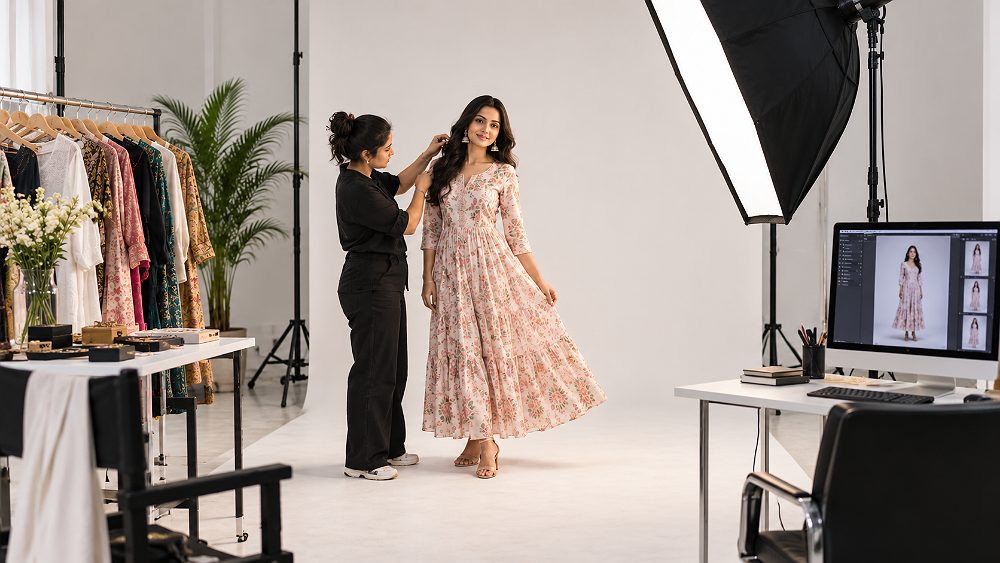
The main cost drivers of a Myntra model shoot are: the model fee, the photographer and studio production, makeup and grooming, styling, number of garments, images required per product, post-production depth, and any urgent-delivery requirement. Each of these can move a quote by 20–40%.
- Model fee and category
- Photographer and studio lighting setup
- Makeup and grooming
- Fashion stylist
- Number of garments and colour variants
- Images per SKU
- Post-production and retouching complexity
- Turnaround / rush delivery
Per-SKU vs Day-Based Fashion Photography Pricing
Small brands with 10–30 SKUs usually win with a day-based package — a fixed team, fixed studio slot, fixed deliverables. Larger sellers doing 100+ SKUs benefit more from per-SKU pricing, which scales predictably and rewards volume. Our garment photography cost India 2026–27 breakdown covers the maths in more depth.
| Plan | Best For | SKU Volume | Model | Styling | Images / SKU | Retouching | Turnaround | Pricing | CTA |
|---|---|---|---|---|---|---|---|---|---|
| Basic | Small D2C launches | 10–30 SKUs | Standard | Light | 4–5 | Standard | 7–10 days | Custom quote on request | Get Quote |
| Standard | Growing Myntra sellers | 30–100 SKUs | Curated | Full | 5–6 | Advanced | 7–12 days | Custom quote on request | Get Quote |
| Premium | Established fashion brands | 100–250 SKUs | Premium | Full + accessories | 6–8 | Premium | 10–15 days | Custom quote on request | Get Quote |
| Enterprise / High-Volume | Large catalogues, manufacturers | 250+ SKUs | Multiple models | Full production | 6–10 | Premium + variants | Milestone-based | Custom quote on request | Get Quote |
Pricing above is illustrative and structural — for a verified quote based on your actual SKU count, model tier and turnaround, call Satyam at +91-8076745824 or email [email protected].
How Better Myntra Fashion Photography Can Improve Product Presentation and Conversion
Better Myntra fashion photography doesn’t guarantee a fixed uplift in clothing conversion rate — anyone promising that number is selling you a story. What it reliably does is: strengthen first impressions, reduce customer uncertainty, and make your listing feel like a real brand next to identical competing products.
Cleaner product listing images, consistent styling and accurate colours help customers make faster, more confident decisions. That typically shows up as better click-through from category pages, lower bounce on the product detail page, and fewer size/colour-related returns. It’s not magic — it’s craft applied consistently at scale, similar to what we’ve explored in how fashion photography increases clothing sales.
Show Fit and Silhouette Clearly
When the customer can clearly see fit and silhouette, they stop guessing. This is the single biggest advantage of a properly executed Myntra model shoot over product-only imagery — and the reason fashion PDPs led by model imagery routinely outperform flat-only listings on Myntra.
Show Fabric, Texture and Product Details
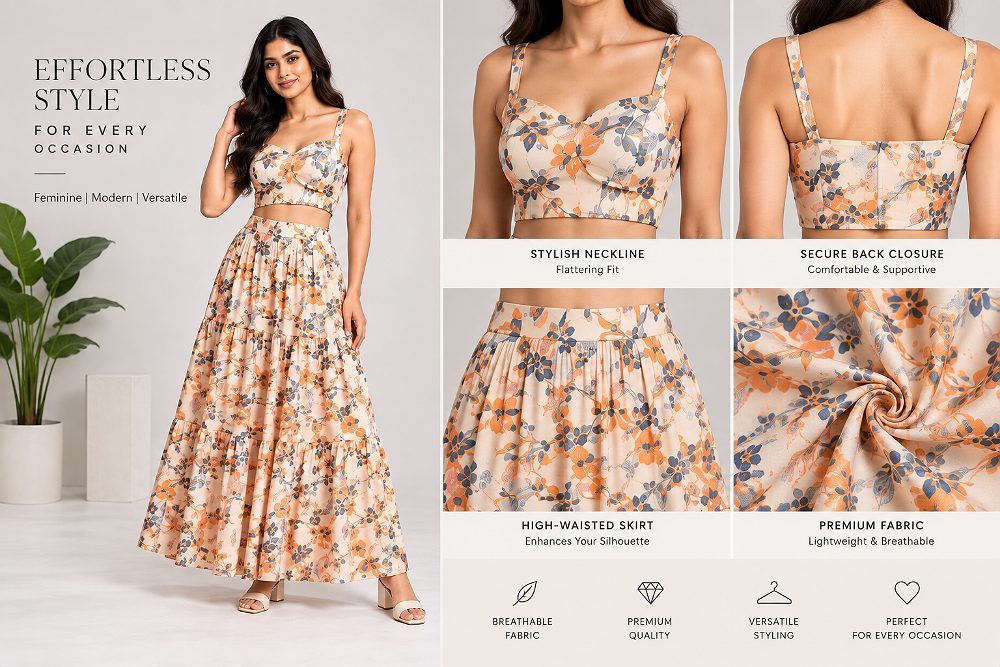
Fabric texture and finish shots close the trust gap that photography of the whole outfit alone cannot. A tight macro on the weave, an honest crop on embroidery, and a clean close-up of the neckline give the customer permission to add to cart.
Keep Catalogue Images Consistent Across Every SKU
Consistency is the invisible driver. When every SKU in a collection shares the same framing, background and pose vocabulary, the entire category page starts to feel like a serious brand. It’s a big part of why sellers moving from studio-only to true garment photography for online marketplaces see better long-term performance across Myntra, Ajio and Nykaa.
Common Myntra Photoshoot Mistakes Clothing Brands Should Avoid
Most Myntra photoshoot mistakes are process failures, not creative ones. Here are the eleven we see most often at Uniqs Studio when brands come to us after a bad experience elsewhere — each one is fixable with proper planning.
- Shooting without a locked shot list
- Casting the wrong model size for the brand’s size grade
- Leaving garments wrinkled or poorly steamed
- Inconsistent framing between SKUs
- Incorrect white balance or drifting colour
- Missing important garment details
- Excessive skin or product retouching
- Changing actual garment colour during editing
- Inconsistent styling across colour variants
- Skipping the final QC pass
- Using outdated marketplace requirements
The scarier reality is that even one of these can delay a Myntra catalogue by days and cost more than the shoot itself. Our recommendation to sellers is simple: invest in process discipline — the same discipline that separates a hobby studio from a real production shop.
Advanced Tips & Pro Insights from the Uniqs Studio Team
Some hard-earned lessons from 9+ years of running high-volume fashion catalogues — the kind that don’t show up in generic ecommerce guides:
- Colour-manage from camera to export: use a colour checker on the first frame of every SKU. It saves hours of re-editing later.
- Lock the camera height and model marks once and don’t move them across the shoot day — your entire category page will thank you.
- Batch-shoot by colour family, not by style — it prevents subtle white-balance drift on the finals.
- Tether every frame to a large monitor so styling, focus and fabric issues get caught live, not in post.
- Never edit and QC on the same day — fresh eyes catch the errors tired eyes miss.
- Shoot video the same day as stills using the same model and set — a technique we build into our reels-first workflow so brands get both catalogue and social assets in one production.
Sellers weighing whether to build in-house or partner externally will find the trade-offs mapped out in our AI vs professional studio and studio vs outdoor shoot comparisons.
Tools & Equipment We Recommend for Myntra Fashion Photography
At Uniqs Studio, our Myntra shoots typically use a professional full-frame mirrorless body (Sony A7R V and Canon R5) paired with a 50mm prime for standard model coverage and a 100mm macro for fabric and detail shots. This combination gives us the sharpness and colour fidelity needed for accurate garment reproduction.
Lighting is where most amateur setups fail. We run a four-head main setup — four Godox SK 400II strobes with strip softboxes for even body lighting, backed by two Elinchrom FRX 400 units with an octabox for softer fill, plus a beauty dish for fashion-forward hero frames. Every shoot is tethered to a colour-calibrated monitor for live review — the same rigorous baseline we apply across all our garment photography for ecommerce productions.
How to Choose a Fashion Photography Studio for Myntra Sellers
Not every studio is built for marketplace catalogue work. A great campaign photographer can still be a poor fit for a 200-SKU Myntra shoot, because the skills — repeatability, SKU tracking, tethered QC, colour discipline — are different. When shortlisting a fashion photography studio for Myntra sellers, focus on production capability, not just portfolio aesthetics.
What to Ask Before Booking a Myntra Model Shoot
Ask blunt, operational questions before signing anything. The answers reveal whether the studio actually understands marketplace work.
- Do you handle marketplace catalogue shoots at volume?
- Can you maintain consistent framing across 100+ SKUs?
- Are model, makeup and stylist available in-house?
- How do you handle colour accuracy against the physical sample?
- What level of retouching is included in your quote?
- What’s your typical turnaround for a Myntra catalogue?
- Can the studio scale up if we grow to 500+ SKUs?
- How are revisions, reshoots and final QC handled?
Why High-Volume Production Capability Matters
High-volume capability is what separates a boutique studio from a real ecommerce partner. Repeatable setups, SKU tracking, consistent file naming, faster turnaround and easy reshoots all compound as your Myntra catalogue grows. Brands that ignore this often outgrow their photographer within one season and lose consistency mid-collection.
Fashion Photography for Myntra in Delhi NCR
Delhi NCR — including Gurgaon, Noida, Faridabad and Ghaziabad — has become one of India’s most active hubs for Fashion Photography for Myntra, driven by the concentration of D2C fashion labels, garment manufacturers and export houses in the region. Local access to models, stylists and makeup artists keeps costs efficient without compromising quality.
Uniqs Studio serves Myntra sellers across Delhi NCR from our Delhi photography studio, with dedicated production tracks for high-volume catalogue projects. Brands in nearby cities can also explore our regional pages — for instance, our Gurgaon model photographers and Noida garment photography service pages. To discuss your Myntra catalogue, connect with Satyam directly on +91-8076745824 or WhatsApp +91-8076745824.
Future Trends in Myntra Fashion Photography (2026–27)
Three trends are actively reshaping Myntra fashion catalogues going into 2026–27. First, video-first product pages — short vertical reels alongside stills — are becoming standard, not optional. Sellers are increasingly booking hybrid shoots that produce both catalogue images and short-form video in the same session, close to the pattern we describe in our ecommerce videoshoot guide.
Second, lookbook photography-style lifestyle imagery is showing up on Myntra brand stores as customers demand more context. Third, size-inclusivity in casting is no longer a nice-to-have — brands showing garments on more than one body type are seeing better trust signals. Our full take on where the medium is going lives in fashion photography trends 2026 and the practical hybrid setups covered in ecommerce videography product video types.
Myntra Fashion Photography Checklist Before Your Products Go Live
Run this checklist before uploading a single SKU to your Myntra seller panel. It’s the same final gate our internal QC team applies to every catalogue that leaves Uniqs Studio.
- All required SKUs photographed and accounted for
- Product codes correctly matched to files
- Required image angles captured for each SKU
- Garment fit looks correct on the model
- Fabric is wrinkle-free and honestly represented
- Colour matches the physical sample
- Important design details are visible
- Model poses remain consistent across SKUs
- Background is clean and neutral
- Images are sharp and correctly exposed
- Crops are consistent across the collection
- Retouching stays realistic — no fantasy skin or fabric
- Export settings match Myntra requirements
- Files are named per the agreed convention
- Latest Myntra category-specific image guidelines rechecked
- Independent QC pass completed
Frequently Asked Questions About Fashion Photography for Myntra
1. What is Fashion Photography for Myntra?
Fashion Photography for Myntra is marketplace-focused apparel photography designed to present clothing clearly and consistently on the Myntra product detail page. It combines model poses, garment styling, controlled studio lighting and specific product angles to produce ecommerce-ready images that meet Myntra’s catalogue standards while helping customers make confident buying decisions.
2. What images should clothing brands include in a Myntra photoshoot?
Most Myntra fashion listings benefit from front, back, three-quarter or side, full-outfit styling, fabric or detail close-up and at least one key design-feature image. That said, category-specific requirements on the Myntra Partner Portal evolve — always cross-check the latest applicable guidelines before finalising your image set.
3. Does a clothing brand need a model for Myntra product photography?
Model photography is especially useful when fit, silhouette, drape or styling drives the buying decision — which is true for most fashion categories on Myntra. Product-only approaches like flat lay and ghost mannequin work well as supporting images, but the hero PDP image usually performs best when a real model shows how the garment actually falls on a body.
4. How much does a Myntra model shoot cost in India?
Pricing varies based on SKU count, model tier, shoot duration, styling depth, number of images per product, retouching complexity and turnaround. Rather than a fixed rate, most professional studios — including Uniqs Studio — offer volume-based quotations. For a verified quote based on your Myntra catalogue, call Satyam on +91-8076745824.
5. How should brands prepare clothes before a Myntra photoshoot?
Organise your SKU list with product codes, confirm sizes for the model, steam every garment thoroughly, prepare styling references, approve the final shot list, and re-verify the current Myntra category requirements. Solid pre-production is what allows a professional studio to shoot 40–60 SKUs a day cleanly, without last-minute chaos on set.
Ready to Plan Your Fashion Photography for Myntra?
Great Fashion Photography for Myntra is not about a single beautiful frame — it’s about a repeatable production system that delivers consistent, marketplace-ready images across every SKU, every collection, every season. Planning, model casting, styling, disciplined lighting and honest retouching all compound into a catalogue that customers trust and Myntra approves without friction.
At Uniqs Studio, we’ve built our production around exactly that discipline — scalable enough for large fashion brands, flexible enough for growing D2C labels. Whether you’re launching your first Myntra collection or scaling a 500-SKU seasonal drop, talk to Satyam about your SKU volume, model requirements, styling and delivery timeline before you plan the shoot.
Plan Your Myntra Fashion Photoshoot with Uniqs Studio
📞 Call Satyam: +91-8076745824
💬 WhatsApp: +91-8076745824
✉️ Email: [email protected]