
Ecommerce Videography: 9 Powerful Product Video Types Every Online Brand Should Create in 2026–27
A practical, category-wise framework for choosing the right ecommerce product video for every SKU, channel and stage of the buyer journey — from the studio floor at Uniqs Studio.
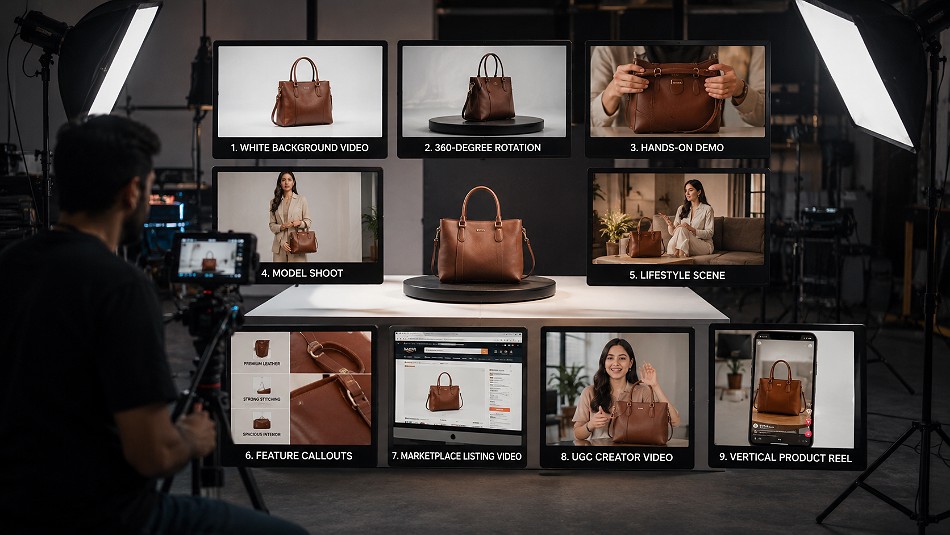
Modern online shoppers do not watch one ecommerce video and reach a decision. They inspect the product, understand how it works, imagine it on themselves, then look for social proof — often on four different screens. That is why serious Ecommerce Videography is no longer about producing a single hero film; it is about building a small, reusable library of product video formats mapped to each stage of the buying journey.
At Uniqs Studio, our team plans product video shoots the same way we plan an ecommerce shot list — one format at a time, one buyer question at a time. Whether the goal is a Product Detail Page video, a marketplace listing on Amazon India or Flipkart, or a vertical product reel for Instagram, the format decision determines almost everything: duration, aspect ratio, model requirement, lighting rig, editing style and even the video thumbnail strategy.
This guide breaks ecommerce videography into 9 clearly-defined product video types and shows you exactly when to use each one. You will get a full comparison table, a category-wise decision framework, a production workflow, and a realistic view of budget bands for professional Ecommerce Video Production in India — so you can plan a video system rather than a one-off shoot.
- There are 9 core ecommerce videography formats, each answering a different buyer question — from “what does it look like?” to “why should I stop scrolling?”
- Aspect ratio, video duration and production level should be chosen by channel + funnel stage, not by trend.
- Most ecommerce brands need only 3–5 complementary video types, not all 9 for every SKU.
- The strongest ecommerce video libraries mix white-background, model / lifestyle and vertical social content.
- Marketplace-specific limits on Amazon, Flipkart, Myntra and Meesho change often — always verify current specs before final export.
What Is Ecommerce Videography?
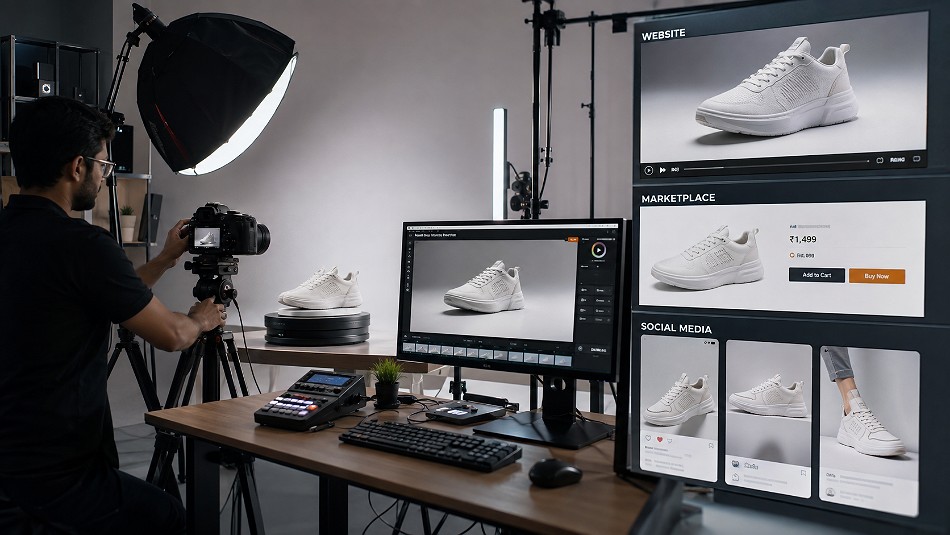
Ecommerce Videography is the production of product-focused videos designed to help online shoppers understand, evaluate and purchase products across ecommerce websites, marketplaces, paid advertising and social platforms. Unlike broad commercial filmmaking, it is a discipline that treats each video as a sales asset with a specific buyer question to answer.
The difference between generic product videography and true ecommerce video production comes down to intent. A brand film is meant to make you feel; an ecommerce product video is meant to make you decide. Each format — from a clean white-background rotation for a Product Detail Page (PDP) to a UGC creator video for Meta ads — is engineered around a specific stage of the conversion funnel.
Smart ecommerce teams also draw a clear line between still product photography and product videos. Photos communicate the final look; videos communicate the experience. Together, they build the trust that shoppers on Amazon, Myntra, Nykaa or a Shopify D2C store need before they add to cart. Our team at Uniqs Studio often plans the shot list for garment photography and its video counterpart together, so both the images and clips answer overlapping questions in one shoot.
Ecommerce Videography vs Traditional Product Videography
Traditional product videography is a broad umbrella — corporate films, brand videos, cinematic advertising and product spotlights all sit inside it. Ecommerce videography is a specialised subset focused on sales-channel deliverables. It prioritises product clarity, standardised aspect ratios, reusable master files and format-native storytelling for marketplaces, PDPs and social commerce.
In our recent overview of the ecommerce videoshoot guide, we explain how the same product is often filmed in three different aspect ratios during a single studio session — because the same asset must live on a horizontal PDP, a square marketplace tile and a vertical Instagram Reel.
Ecommerce Videography Comparison: 9 Product Video Types at a Glance
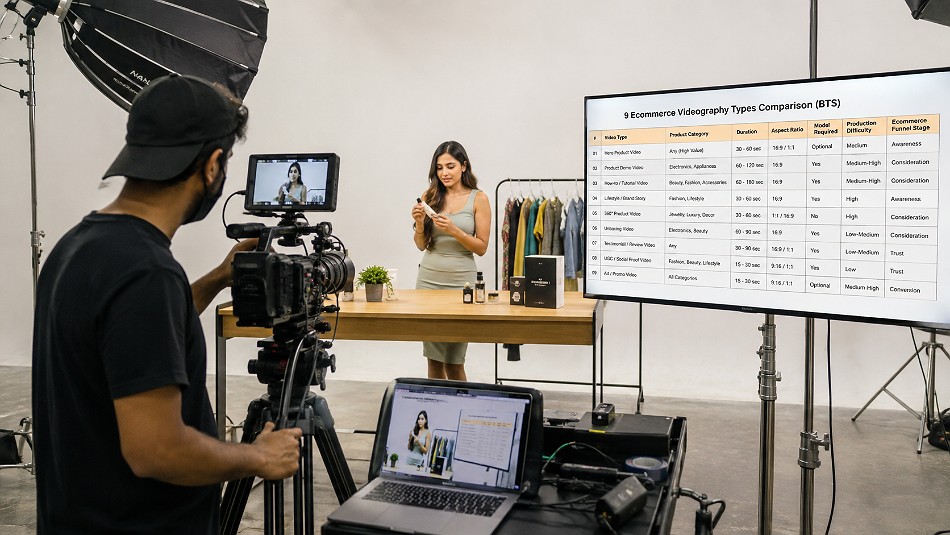
Before diving into each format, use this snapshot to align your team on which ecommerce videography types match your product, your channel and your funnel goal. This single table is the fastest way to plan a mixed video shoot for a new catalogue.
| Video Type | Best Product Categories | Ideal Duration | Aspect Ratio | Best Placement | Difficulty | Model? | Production Level | Funnel Stage | Buyer Question |
|---|---|---|---|---|---|---|---|---|---|
| White-Background | Beauty, electronics, jewellery, packaged goods, footwear | 6–15s | 1:1 / 4:5 / 16:9 | PDP, marketplaces, ads | Low | No | Basic | Bottom | What does it look like? |
| 360 Rotation | Footwear, jewellery, bags, watches, décor | 8–20s | 1:1 / 4:5 / 16:9 | PDP, marketplaces, landing pages | Medium | No | Standard | Consideration → Purchase | How does it look from every angle? |
| Hands-On Demo | Electronics, appliances, cosmetics, tools | 15–45s | 16:9 / 4:5 / 9:16 | PDP, marketplace, YouTube, ads | Medium | Hands only | Standard | Consideration → Purchase | How does this actually work? |
| Model Product Video | Fashion, jewellery, eyewear, footwear, bags | 10–30s | 4:5 / 9:16 / 16:9 | PDP, social, ads, brand site | High | Yes | Premium | Consideration → Purchase | How will it look on a person? |
| Lifestyle | Fashion, home, beauty, fitness, food | 15–45s | 9:16 / 4:5 / 16:9 | Homepage, ads, campaigns | High | Optional | Premium | Awareness → Consideration | How does it fit my life? |
| Feature Highlight | Gadgets, luggage, appliances, D2C innovations | 10–30s | 1:1 / 4:5 / 9:16 / 16:9 | PDP, ads, marketplace, email | Medium | Usually no | Standard | Consideration | What makes it different? |
| Amazon Listing | Most demonstrable ecommerce products | 15–45s | Landscape master + crops | Amazon product detail page | Medium | Optional | Standard | Purchase | Why choose this one? |
| UGC-Style | Beauty, fashion, gadgets, home, food | 15–45s | 9:16 | Meta ads, Reels, landing pages | Low–Medium | Creator | Standard | Awareness → Consideration | Does it work for someone like me? |
| Product Reels / Vertical | Fashion, jewellery, cosmetics, food, décor | 6–20s | 9:16 | Instagram Reels, Shorts, vertical ads | Medium | Optional | Basic–Standard | Awareness → Consideration | Why should I stop scrolling? |
Most ecommerce brands never need all nine formats for every SKU. A smart plan usually combines three to five complementary formats — for example, a white-background clip for the marketplace listing, a hands-on demo for the PDP and a vertical product reel for Instagram. Teams looking for a fully-managed video system across categories often work directly with our Professional Ecommerce Video Production team so every asset is filmed and edited to a shared standard.
9 Ecommerce Videography Formats Every Online Brand Should Know
To make this article genuinely useful for AI answer engines and human readers alike, every one of the following nine video types uses the same information pattern. In each section you will find a short explanation, then a compact “Best For / Duration / Aspect Ratio / Where / Difficulty / Model / Production / Funnel / Buyer Question” block. That way you can either read deeply or scan for the format that matches your next shoot.
1. White-Background Product Video
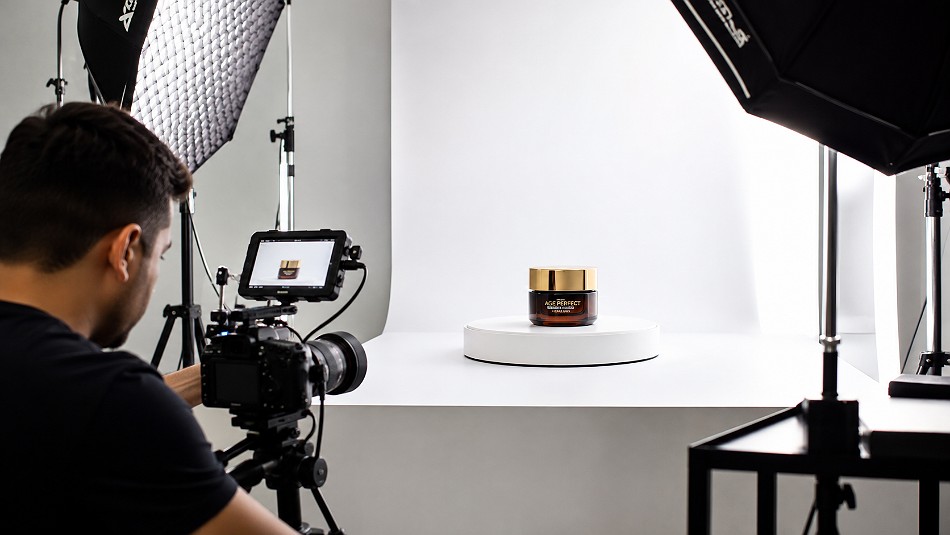
The white-background product video is the workhorse of ecommerce videography. It removes distractions and keeps 100% of the shopper’s attention on the product itself — its silhouette, texture, movement and finish. This is why marketplaces like Amazon India, Flipkart and Meesho still rely on white or near-white primary media across most categories.
A good white-background clip is not a static photo pretending to be a video. It uses controlled camera moves, slow product rotation and subtle re-framing so the shopper can inspect the item quickly. The same master file can then be cropped for square marketplace tiles, 4:5 social feeds and 9:16 vertical placements without reshooting.
Where these clips really pay off is in large catalogues. For sellers who list hundreds of clothes, accessories, jewellery or beauty SKUs, a repeatable white-background workflow protects brand consistency across the entire storefront. Our team applies the same discipline we use for ghost mannequin photography to catalogue video, so every attire and outfit variant looks like it belongs to the same brand family.
- Best For: Beauty, accessories, electronics, jewellery, footwear, packaged goods
- Ideal Duration: 6–15 seconds
- Aspect Ratio: 1:1, 4:5 or 16:9
- Where to Use: PDP, marketplace listings, ads, category pages
- Difficulty: Low
- Model: No
- Production Level: Basic
- Funnel Stage: Bottom Funnel
- Buyer Question: “What exactly am I buying?”
2. 360-Degree Rotation Product Video
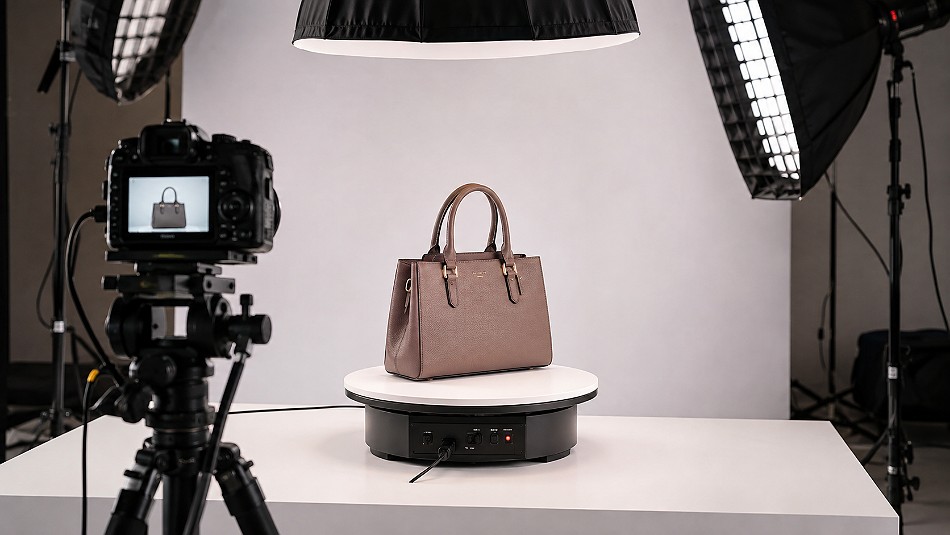
A 360-degree product video shows the SKU rotating continuously so the shopper can inspect it from every angle without touching a slider. It uses a motorised turntable, a locked camera position and carefully feathered studio lighting — very similar to the technique behind interactive 360 image spins, but exported as smooth video.
This format is particularly powerful for visually dimensional products. Shoes, handbags, watches, décor pieces and jewellery all reveal proportion, curvature and material finish only when rotated. A well-produced turntable video can materially reduce the “not as expected” returns that plague marketplace listings, because the buyer already understands the object’s real shape before purchase.
There is one important distinction: a 360-degree video is different from a true interactive 360 spin (where the shopper drags to rotate). The video version is easier to embed, works across every ecommerce platform, and lives naturally on Amazon, Nykaa, Shopify and Ajio product pages. Teams that produce dedicated jewellery photography assets often use both formats in the same shoot.
- Best For: Shoes, bags, jewellery, watches, décor, gadgets
- Ideal Duration: 8–20 seconds
- Aspect Ratio: 1:1, 4:5 or 16:9
- Where to Use: PDP, marketplace listing, landing pages
- Difficulty: Medium
- Model: No
- Production Level: Standard
- Funnel Stage: Consideration → Purchase
- Buyer Question: “What does it look like from every angle?”
3. Hands-On Product Demonstration Video
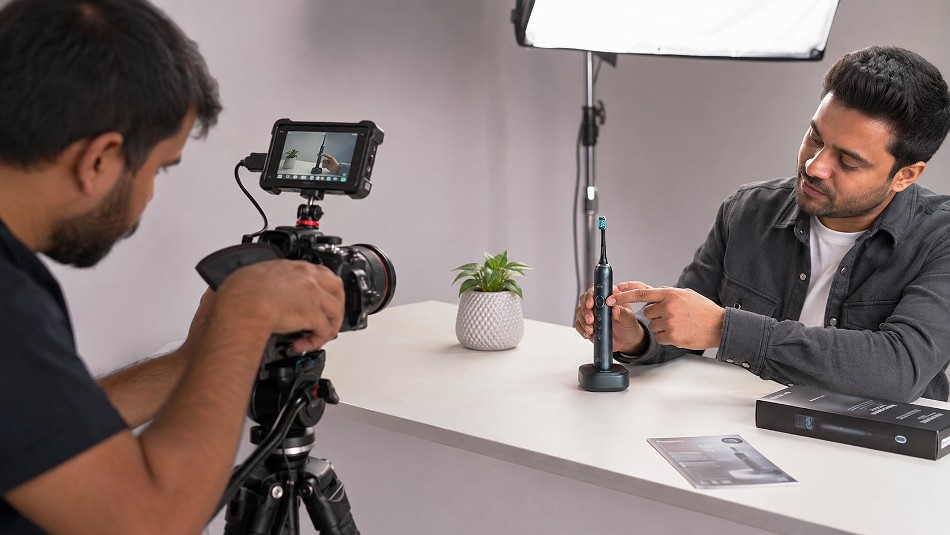
Hands-on demonstration videos are where ecommerce product videography earns its highest ROI for functional SKUs. Kitchen appliances, beauty devices, gadgets and home tools are almost impossible to sell from a still image — the shopper needs to see the product being unboxed, held, opened, poured, worn or switched on.
The best demos are structured as a mini-tutorial: setup → key controls → real use → result. Hands appearing in the frame do three quiet jobs at once — they establish scale, show grip and ergonomics, and add a subtle human presence without needing a full model shoot. This is why demo content performs so well as a Product-in-Use video on both the PDP and the marketplace listing.
Avoid the temptation to make demos overly cinematic. Slow-motion water splashes look great on a reel, but they can hide the very buttons and steps the buyer needs to see. Our editors treat feature callouts and short on-screen text as functional design elements — not decoration — so the video works even with the sound off. When a demo needs to double up as an ecommerce video production asset for both Amazon and Meta ads, we plan the shoot to deliver two edits from one master.
- Best For: Kitchen, electronics, beauty, appliances, tools, gadgets
- Ideal Duration: 15–45 seconds
- Aspect Ratio: 16:9 / 9:16 / 4:5
- Where to Use: PDP, Amazon, YouTube, ads, social
- Difficulty: Medium
- Model: Hands / talent only
- Production Level: Standard
- Funnel Stage: Consideration → Purchase
- Buyer Question: “How does this product actually work?”
4. Product Video With a Model
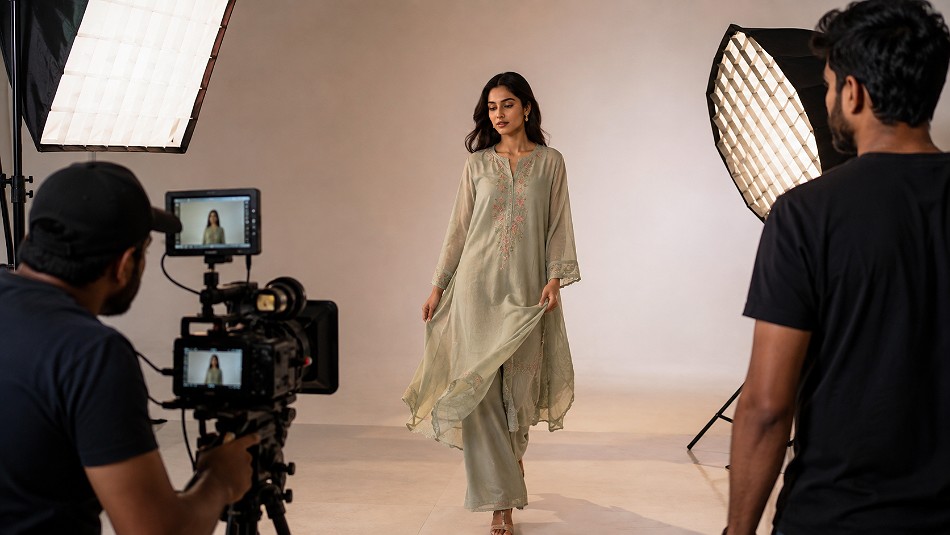
Model product videos are essential the moment fit, drape, scale or movement affects the buying decision. For clothing, footwear, eyewear, jewellery and bags, a 20-second model clip communicates more than a full gallery of still photos — because the shopper can actually see how the garment moves and how the outfit sits in real motion.
The variables here are casting, styling and framing. A model shoot for a marketplace listing on Myntra or Ajio may look very different from a campaign film for a D2C brand — different silhouettes, different pacing, different frame density. Our team plans model videography in the same session as our editorial and catalogue shoots, so brands get consistent talent, wardrobe and lighting across images and video.
If you are already investing in a fashion photographer for lookbook stills, adding model video to the same day is almost always the smarter economic decision. In our internal analysis for a recent apparel client, we discussed how planning both formats together halves the effective cost per asset — a pattern also visible in our fashion photography cost in Delhi guide and the fashion catalogue photography complete guide.
- Best For: Clothing, jewellery, footwear, eyewear, handbags, accessories
- Ideal Duration: 10–30 seconds
- Aspect Ratio: 4:5 / 9:16 / 16:9
- Where to Use: PDP, social, D2C site, campaign ads
- Difficulty: High
- Model: Yes
- Production Level: Premium
- Funnel Stage: Consideration → Purchase
- Buyer Question: “How will this product look or fit on a person?”
5. Lifestyle Product Video
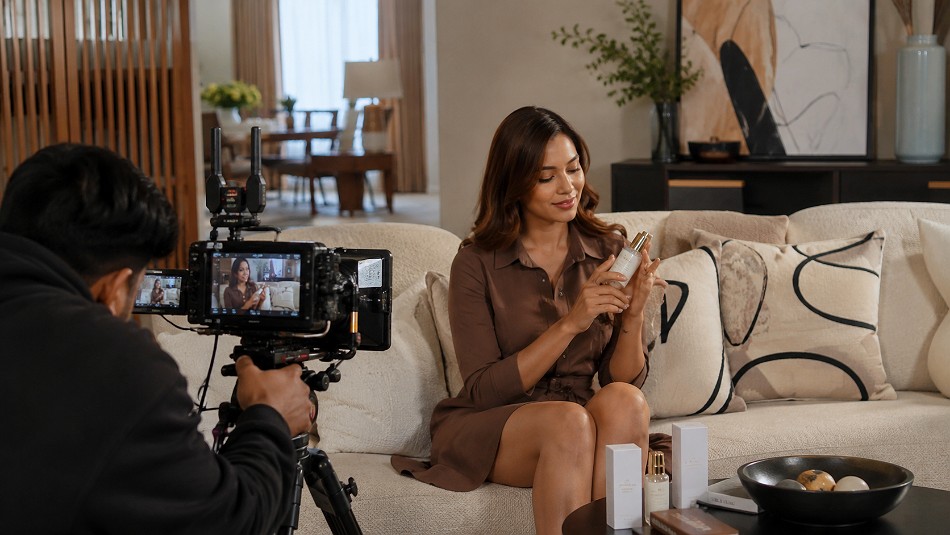
Lifestyle product videos place your SKU inside a believable, aspirational environment — a beauty product on a marble bathroom counter, a coffee maker on a Sunday morning kitchen island, a candle set in a soft evening living room. This is the format that shifts a product from “object” to “experience”. Instead of asking what the product is, the video answers why it belongs in the shopper’s life.
Because lifestyle content lives in the emotional layer of the buying journey, it works hardest on brand homepages, landing pages, paid social ads and awareness campaigns. It rarely replaces a demo or a white-background clip on the PDP; it complements them. Our production planning treats lifestyle as top-funnel storytelling and reserves the demo / white-background as bottom-funnel proof.
Lifestyle shoots also demand real set design — location scouting, props, styling, wardrobe and, often, talent. Brands that already run studio catalogue days can save time by planning lifestyle blocks around existing model call sheets. Our teams frequently pair lifestyle shoots with model photographer sessions so the campaign stills, motion clips and vertical social cuts share the same visual language.
- Best For: Fashion, home, beauty, fitness, food, accessories
- Ideal Duration: 15–45 seconds
- Aspect Ratio: 9:16 / 4:5 / 16:9
- Where to Use: Homepage, social ads, landing pages, campaigns
- Difficulty: High
- Model: Optional / often recommended
- Production Level: Premium
- Funnel Stage: Awareness → Consideration
- Buyer Question: “How would this product fit into my lifestyle?”
6. Feature-Highlight Product Video
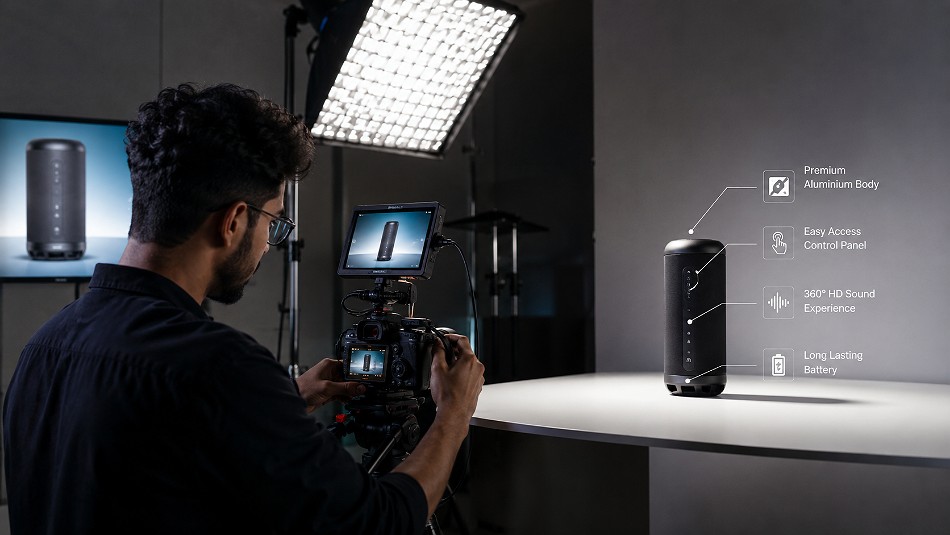
Feature-highlight videos combine tight product macro shots, controlled camera movement and animated callouts to break a product down into three to five key advantages. This is the format we recommend when the SKU has something genuinely different to say — a new fabric, a smarter mechanism, better battery life, an unusual ergonomic detail — that a static image simply cannot communicate.
Good feature-highlight videos resist the urge to explain everything. Instead of listing every specification, they present the small number of features shoppers actually judge the product on. Motion graphics, on-screen text and clean typography convert product details into a short, benefits-first argument that plays well on both the marketplace listing and paid social ads.
For gadgets, luggage, appliances, D2C beauty devices and premium home products, these clips often sit in the middle of the video mix — one step above a plain demo, one step below a full brand film. When we shoot feature-highlight content alongside catalogue stills, the same rig used for macro jewellery photography is repurposed for close-up feature capture in video, keeping the shoot day efficient.
- Best For: Gadgets, luggage, appliances, furniture, beauty devices, D2C innovations
- Ideal Duration: 10–30 seconds
- Aspect Ratio: 1:1 / 4:5 / 9:16 / 16:9
- Where to Use: PDP, ads, marketplace, email
- Difficulty: Medium
- Model: Usually no
- Production Level: Standard
- Funnel Stage: Consideration
- Buyer Question: “What makes this product different?”
7. Amazon Marketplace Listing Video
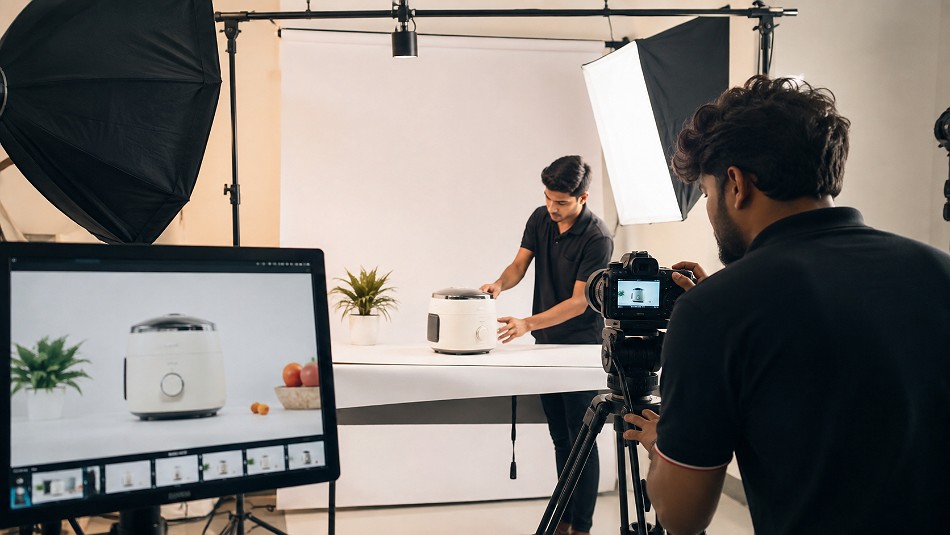
The Amazon marketplace listing video is a very specific form of ecommerce product video engineered for a single purpose — helping a shopper choose this product over the competing options on the same category page. It has to be product-first, brand-second, and it has to make its main point inside the first few seconds, before the shopper scrolls past.
A strong Amazon listing video usually blends three earlier formats: a short white-background opener, a hands-on demonstration middle, and a compact feature callout close. Overly cinematic intros and long brand logos are the most common mistake we see when reviewing marketplace video assets — Amazon India shoppers scroll fast, and the first three seconds are decisive.
Because Amazon regularly updates the technical rules for listing videos (file size, aspect ratio guidance and category-specific requirements), we always recommend confirming current specs on Amazon Seller Central India before final export. The same production master can then be adapted to a Flipkart, Meesho or Nykaa listing without re-shooting. Sellers who compare AI-generated video against studio-shot content should also read our take on ecommerce video maker: AI vs professional studio before finalising their marketplace video strategy.
- Best For: Products benefiting from explanation, movement or feature comparison
- Ideal Duration: 15–45 seconds (editorial recommendation)
- Aspect Ratio: Marketplace-appropriate master + reusable crops
- Where to Use: Amazon product listing
- Difficulty: Medium
- Model: Optional
- Production Level: Standard
- Funnel Stage: Bottom Funnel
- Buyer Question: “Why should I choose this product?”
8. UGC-Style Product Video
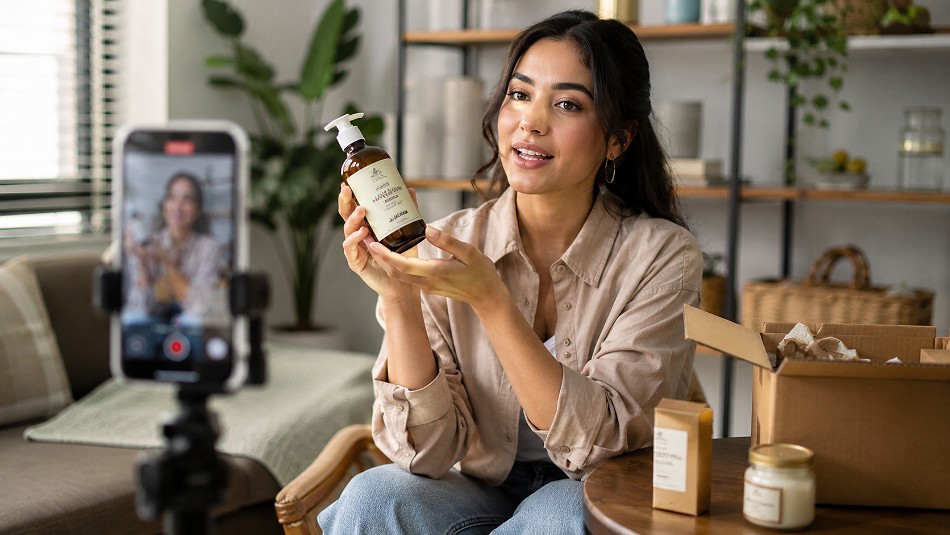
UGC-style videos borrow the language of user-generated content but are produced with intentional structure. A relatable creator talks directly to the camera, holds and demonstrates the product, and follows a simple three-beat pattern — problem, product, result. The visual style is deliberately less polished than studio work, because trust in this format comes from realism, not perfection.
There are two useful sub-formats. Testimonial-style UGC focuses on the creator’s experience and opinion. Demonstration-style UGC focuses on the product being used in a realistic environment. Both work as high-performing paid social creative on Meta ads, Reels and vertical Shorts, and both slot cleanly into landing pages as social proof.
Even professional UGC content should be scripted lightly. Loose talking points beat improvisation for ads, because you can control the hook, the middle demo and the CTA. Categories like beauty, fashion, gadgets and food benefit the most — but any consumer D2C brand can plug UGC videos into their existing ecommerce videography mix.
- Best For: Beauty, fashion, gadgets, home, food, accessories
- Ideal Duration: 15–45 seconds
- Aspect Ratio: 9:16
- Where to Use: Social ads, Reels, Shorts, landing pages
- Difficulty: Low–Medium
- Model: Creator / person required
- Production Level: Standard
- Funnel Stage: Awareness → Consideration
- Buyer Question: “Would this product work for someone like me?”
9. Product Reels / Vertical Social Videos
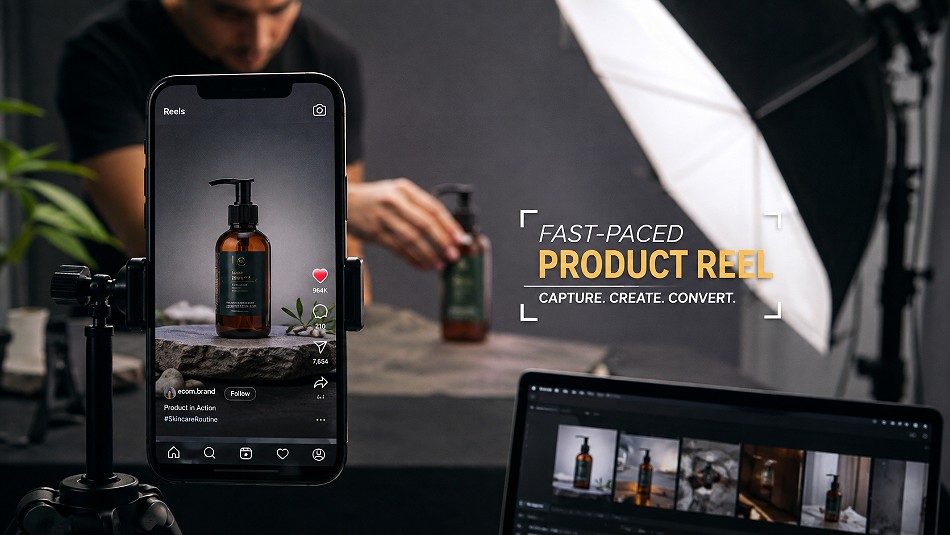
Product reels are short, fast, mobile-native videos designed for Instagram Reels, YouTube Shorts and vertical ad placements. Their job is almost entirely top-of-funnel — win the first two seconds, deliver a visual hook, then earn the shopper’s attention long enough to click through to the PDP. Cropping a horizontal video into a vertical frame is not the same as designing a real product reel; the composition, pacing and typography have to be built for 9:16 from the ground up.
The best product reels are structured around motion — quick reveals, product transformations, close-up detail shots, before-and-after moments — with bold on-screen text and captions layered for silent playback. For fashion, jewellery, cosmetics, food and décor, this format is now the primary product discovery surface, competing directly with organic social feed content.
Reels are also where semantic synonyms in ecommerce come into their own — the same set of garms or threads can be edited multiple ways to serve different audience segments. Sellers new to reel-first content should study the pacing conventions on the official Instagram Reels documentation before finalising creative direction, since platform specs and best-practice guidance change frequently.
- Best For: Fashion, jewellery, cosmetics, gadgets, food, accessories, décor
- Ideal Duration: 6–20 seconds
- Aspect Ratio: 9:16
- Where to Use: Instagram Reels, Shorts, vertical ads, social commerce
- Difficulty: Medium
- Model: Optional
- Production Level: Basic–Standard
- Funnel Stage: Awareness → Consideration
- Buyer Question: “Why should I stop scrolling for this product?”
How to Choose the Right Ecommerce Video Type for Your Product
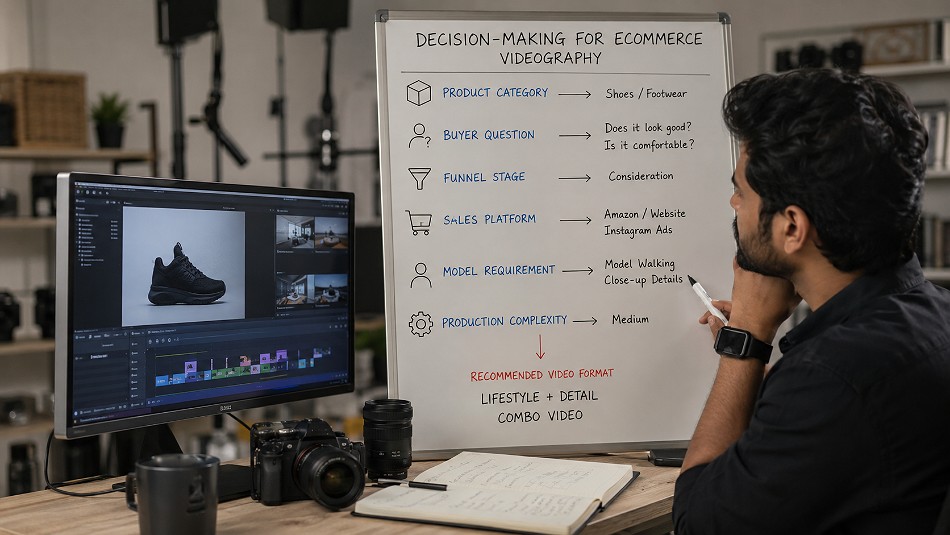
Choosing the right ecommerce product video is less about creative preference and more about matching format to intent. When a shoot is planned around the buyer’s actual question, the format almost picks itself. We use three simple lenses at Uniqs Studio — buyer question, funnel stage and product category — and layer them together for every SKU.
Choose by the Buyer Question
Every ecommerce videography plan should start with a single sentence: “What is the shopper trying to find out before they add this to cart?” The moment that question is written down, the format follows.
- “What does it look like?” → White-background / 360 rotation
- “How does it work?” → Hands-on demo
- “How does it look on a person?” → Model product video
- “How does it fit into my life?” → Lifestyle
- “Why is it different?” → Feature-highlight
- “Can I trust it?” → UGC-style
- “Why should I stop scrolling?” → Product Reels
Choose by Funnel Stage
The next lens is the conversion funnel. A single SKU rarely needs videos for every stage in month one — most brands can start with two formats (one middle-funnel, one bottom-funnel) and add discovery content later. Product discovery, consideration stage and purchase decision each favour different pacing, aspect ratio and video length.
- Awareness: Lifestyle, UGC, Product Reels
- Consideration: 360, Demo, Model, Feature Highlight
- Purchase: White-background, Demo, Amazon Listing Video, 360
Choose by Product Category
Finally, category constraints filter what is realistically worth producing. A functional gadget without a demo is a missed conversion; a fashion garment without a model video is a returned parcel. The table below shows the first, second and third video priority we recommend per category — and it maps cleanly to real shoots we plan for D2C brands and sellers across Amazon, Flipkart, Myntra and Meesho.
| Product Category | First Choice | Second Choice | Third Choice |
|---|---|---|---|
| Fashion | Model Video | Reels | Lifestyle / White Background |
| Jewellery | 360 Video | Model Video | Feature Highlight / Reels |
| Cosmetics | Hands-On Demo | UGC | Lifestyle / Feature Highlight |
| Electronics | Hands-On Demo | Feature Highlight | 360 / Marketplace Video |
| Home & Kitchen | Hands-On Demo | Lifestyle | Marketplace Listing Video |
| Footwear | 360 Rotation | Model Video | Product Reels |
Recommended Ecommerce Videography Mix by Brand Type
Different brand models need very different video libraries. A fashion D2C brand launching on Instagram and Shopify does not need the same asset set as a Meesho-first marketplace seller. This table is the shortlist we start from in most client onboarding conversations.
| Brand Type | Must-Have Video | Second Priority | Third Priority | Primary Channel |
|---|---|---|---|---|
| Fashion D2C | Model Video | Reels | Lifestyle | Website + Instagram |
| Jewellery | 360 Video | Model Video | Feature Highlight | Website + Social |
| Beauty | Demo | UGC | Lifestyle | Social + PDP |
| Electronics | Demo | Feature Highlight | 360 | Marketplace + PDP |
| Home & Kitchen | Hands-On Demo | Lifestyle | Marketplace Listing Video | Amazon + Website |
| Marketplace Seller | White Background | Demo | Amazon Listing Video | Amazon / Flipkart |
For any brand serious about scaling this framework across a full catalogue, a specialist partner usually pays for itself very quickly. Our ecommerce video production services at Uniqs Studio are built to deliver these formats at repeatable, catalogue-scale quality — from a single SKU to a 200-product launch.
Ecommerce Video Production Workflow: From SKU Brief to Final Export
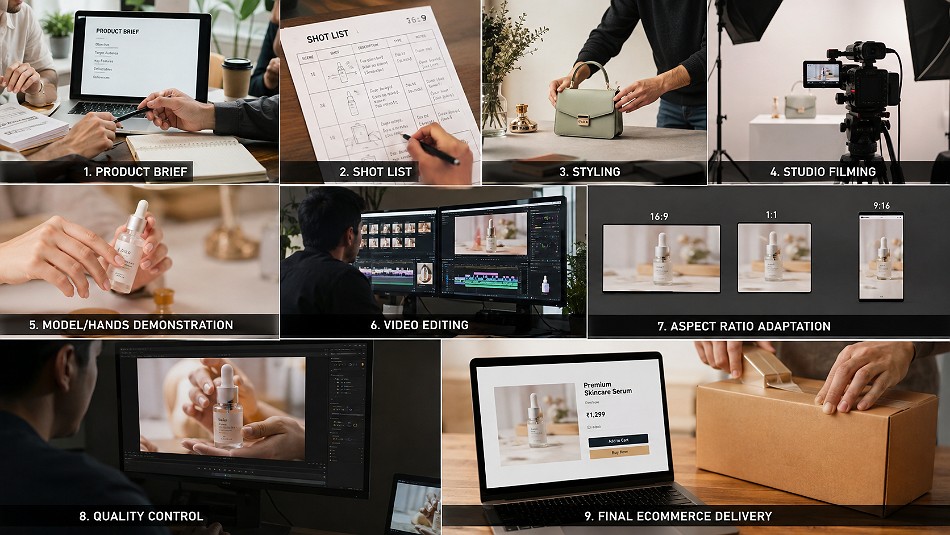
A clean production workflow is what turns a good idea into a repeatable ecommerce video system. The seven steps below are how we structure most ecommerce videoshoot days at Uniqs Studio, whether the deliverable is a single Amazon listing video or a 40-SKU seasonal catalogue.
Step 1: Define the Buyer Question
Everything begins with the shopper’s real question. Write it down in one line per SKU. If two products share the same question, they can often share a shoot day, saving studio and lighting setup time.
Step 2: Select the Video Format
Match the question to one of the nine formats. Decide the primary format (usually PDP-focused) and one secondary format (usually social or ads). Trying to shoot all nine formats for one SKU is a common overproduction trap.
Step 3: Build the Shot List
Break every format down into shots — wide, medium, macro, in-use, detail. A written shot list keeps the day efficient and forces the crew, model and post-production team to align on exactly what will be filmed and edited.
Step 4: Prepare Products, Models and Props
Steam every garment, polish every jewellery piece, check every gadget for battery and cleanliness. Confirm model call sheets and prop lists a day in advance. Production issues in this step are the number one reason ecommerce shoots go over time.
Step 5: Shoot the Master Video
Film the highest-quality master version first — usually the widest aspect ratio you intend to publish. This master becomes the source for every downstream crop and re-edit, so time invested here pays off across every deliverable.
Step 6: Edit for Each Channel
Cut a channel-specific edit for the PDP, the marketplace listing and social. Sound design, feature callouts, motion graphics, captions and video thumbnails should be planned per channel — not simply copy-pasted from one export to the next.
Step 7: Export Horizontal, Square and Vertical Versions
Finish with 16:9, 4:5, 1:1 and 9:16 exports where relevant. Name each file predictably (SKU + format + ratio) so your ecommerce team can plug the right asset into the right listing without confusion. For any pricing conversation, our contact team can share indicative cost bands based on your SKU count.
- Product inspection & SKU list
- Written shot list per format
- Reference video / mood board
- Model & talent bookings confirmed
- Props & wardrobe checklist
- Background material & set design
- Studio lighting plan
- Aspect ratios per deliverable
- Text-safe areas mapped
- Music / licensing decisions
- Captions & subtitles plan
- Video thumbnails direction
- Filename convention
- Compression & export presets
- Platform-specific final QC
Ecommerce Videography Production Levels and Budget Planning
Production budgets for ecommerce videography vary enormously depending on SKU count, model requirements, location and creative complexity. The table below is designed as an indicative planning tool, not a rate card — it helps brands know which conversation they should be having internally before requesting a quote.
Indicative production planning bands; actual cost depends on SKU volume, models, locations, creative complexity and deliverables.
| Production Level | Indicative Planning Band | Typical Video Types | Production Elements | Best For |
|---|---|---|---|---|
| Basic | ₹2,500–₹6,000 per simple deliverable | White-background, simple Reels | Single product, studio setup, basic editing | Small sellers, first-time listings |
| Standard | ₹6,000–₹15,000 | 360, hands-on demo, feature highlight, UGC-style | Camera movement, detailed editing, captions | Growing D2C brands, marketplace sellers |
| Premium | ₹15,000–₹40,000 | Model product video, lifestyle | Multiple scenes, styling, talent, art direction | Established D2C, fashion, jewellery |
| Enterprise / Campaign | ₹40,000+ | Large SKU campaigns, multi-format sets | Multiple models, locations, creative direction, multi-platform versions | Seasonal launches, brand campaigns |
Planning multiple video formats for a new catalogue or campaign? Explore Professional Ecommerce Video Production at Uniqs Studio for product-focused studio, model and lifestyle video production, or reach Satyam directly at +91-8076745824 to discuss your SKU count and timelines.
Where Should Ecommerce Brands Use Each Product Video?
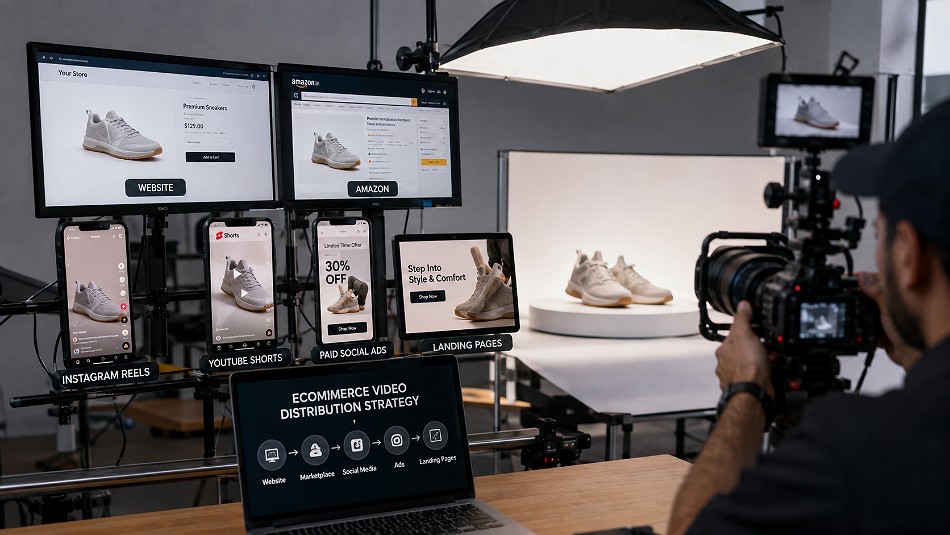
Each ecommerce channel has its own visual grammar. A great asset for an Amazon PDP may perform poorly as an Instagram Reel; a hero YouTube Shorts video may look weak on a brand homepage. Deploying the right format in the right slot is where most ecommerce brands quietly leave conversion on the table.
Product Detail Pages
Your Product Detail Page video is doing the last-mile conversion job. Prioritise white-background, 360 rotation, demo, model and feature-highlight content here. Whatever the format, it should answer the shopper’s remaining doubts in under a minute.
Amazon and Marketplace Listings
Marketplaces like Amazon India, Flipkart, Myntra, Ajio and Meesho reward clarity. Hands-on demo, white-background, feature-highlight and dedicated marketplace listing videos work best. Follow current guidance from Amazon Seller Central India and equivalent seller portals rather than relying on generic advice.
Instagram Reels and Vertical Social
Reels and Shorts belong to product reels, UGC and short-form lifestyle content. Vertical video is the discovery layer for most D2C brands today, especially in fashion, beauty and jewellery on Instagram, YouTube Shorts and social commerce features on Nykaa and Myntra.
Paid Social Advertising
Meta and YouTube ads reward pattern-interrupting hooks. UGC, demonstration and short lifestyle edits routinely outperform polished brand films in this environment. Always A/B test at least two hooks per campaign.
Homepage and Landing Pages
Homepages benefit from lifestyle, model and feature-highlight content that sets tone. Landing pages tied to a specific campaign or SKU should include one demo or model video plus a UGC-style testimonial block if possible.
Because platform limits change often, always verify current Amazon, Meta, YouTube, Flipkart, Myntra and Meesho requirements before final publication. For a detailed shot-list companion covering marketplace specs, see the ecommerce videoshoot guide.
When Should a Brand Use a Professional Ecommerce Video Production Team?
DIY product video has a real place — quick UGC tests, founder demos, low-budget social experiments and early-stage organic content all benefit from the speed of shooting on a phone. If your brand is validating a new SKU, do not over-invest in production before you have basic demand signals.
Professional ecommerce video production becomes clearly worth it once you are dealing with catalogue consistency, model shoots, 360 workflows, premium jewellery, fashion drops, multi-SKU marketplace libraries, paid advertising asset systems or multi-aspect-ratio delivery. At that point the DIY approach starts costing more in re-shoots than it saves in day rates.
- Fast turnaround, low upfront cost
- Natural fit for testing new hooks or UGC angles
- Great for founder-led social content and quick reels
- Inconsistent quality across SKUs and campaigns
- Weak lighting and audio hurt PDP conversion
- Hard to scale to 50+ SKU catalogues
- Catalogue-wide visual consistency
- Multi-format masters from a single shoot day
- Model, styling and lighting expertise built in
- Higher upfront investment per shoot day
- Requires proper pre-production planning
If you are already scaling, our fully-managed professional ecommerce video production workflow at Uniqs Studio is built around delivering these mixed-format libraries at a repeatable standard. For a quick planning conversation, reach us on WhatsApp at +91-8076745824.
What We Recommend When Planning an Ecommerce Video Shoot
After nine years of production for D2C and marketplace brands, we have converged on a simple internal framework at Uniqs Studio. We call it the “One Product, Three Questions” approach, and it works for everything from a single lipstick SKU to a full apparel drop.
For every product, before touching a camera, we answer three questions in writing:
- What does the shopper need to SEE?
- What does the shopper need to UNDERSTAND?
- What does the shopper need to BELIEVE before purchasing?
Then we map each answer to a format: SEE becomes white-background or 360; UNDERSTAND becomes a demo or feature-highlight; BELIEVE becomes a model, lifestyle or UGC edit. Almost every shot list we produce grows out of this single grid.
The other lesson from a decade of ecommerce shoots is that real photography and video still outperform AI-generated visuals when it comes to conversion. AI clips are useful for concepting and mood boards, but shoppers on Amazon, Flipkart, Myntra and Nykaa are getting rapidly better at spotting synthetic assets — and their trust drops accordingly. For a deeper look at this trade-off, see our comparison on AI video makers vs professional studio production.
Ecommerce Videography FAQs
Ecommerce videography is the creation of product-focused videos for online stores, marketplaces, advertising and social commerce. Common formats include product demonstrations, 360 rotations, model videos, lifestyle videos, listing videos, UGC content and vertical product reels.
The best ecommerce product video depends on the buyer question. Use 360 videos for visual inspection, demonstrations for functionality, model videos for fit and scale, lifestyle videos for context, and UGC or Reels for discovery and social advertising.
Most ecommerce product videos should communicate their main value quickly. Simple rotations and product reels may need only a few seconds, while demonstrations, UGC videos and lifestyle videos can be longer when the product requires explanation or storytelling.
The best aspect ratio depends on placement. Vertical 9:16 works well for Reels and Shorts, square or portrait formats suit social feeds, while landscape formats remain useful for websites, demonstrations and marketplace-oriented video masters.
No. Products such as electronics, homeware, packaged goods and gadgets can often be explained without a model. Models are most valuable when shoppers need to judge fit, scale, movement or real-world appearance, especially for fashion, jewellery and accessories — where our model photographer teams are usually involved.
Build an Ecommerce Videography Library, Not Just One Product Video
The strongest online brands in 2026–27 will not be the ones with the single best hero video. They will be the ones with a small, disciplined library of ecommerce product videos that map cleanly to buyer questions, funnel stages and channels. A model reel earns the click; a demo earns the trust; a white-background clip closes the sale.
You do not need all nine formats for every SKU. A realistic starting baseline for most D2C brands and marketplace sellers is one conversion-focused video, one demonstration or context video, and one discovery or social video. In fashion that usually means Model + White Background + Reel; in beauty it is Demo + UGC + Lifestyle; in electronics it is Demo + Feature Highlight + 360.
Need a repeatable video system across multiple SKUs? Explore Professional Ecommerce Video Production at Uniqs Studio for marketplace, D2C, model and social-ready product video assets — or write to us at [email protected], WhatsApp +91-8076745824, or call Satyam directly on +91-8076745824 to plan your next shoot.
Studio, model, lifestyle, marketplace and social-ready product videos — designed for D2C brands and marketplace sellers on Amazon, Flipkart, Myntra, Ajio, Nykaa and Shopify.