
Ecommerce Video Maker in 2026-27: AI vs Professional Studio — 9 Critical Differences D2C Brands Must Know
A category-wise, decision-focused comparison for fashion, jewellery, beauty and lifestyle D2C brands by Uniqs Studio, Delhi NCR.
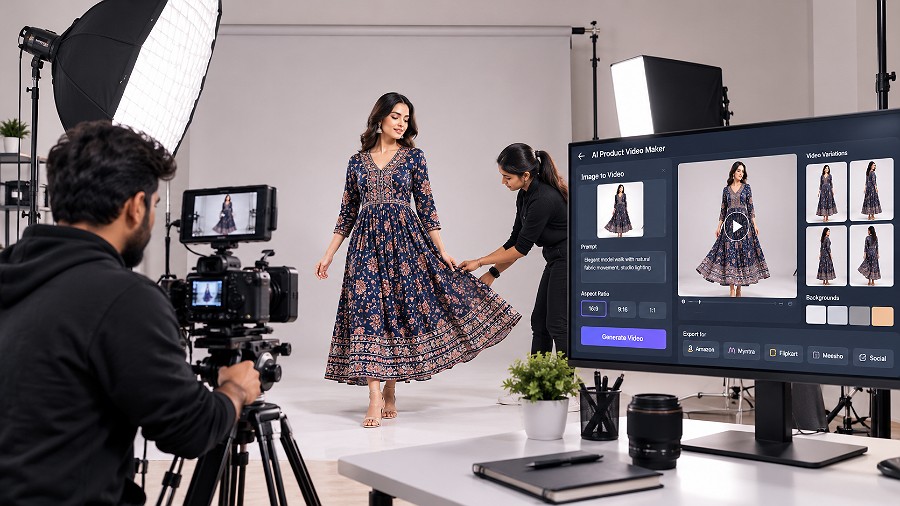
The phrase Ecommerce Video Maker now describes two very different worlds. On one side sit AI ecommerce video maker platforms that can generate an attractive product clip in minutes from a single photograph. On the other sit professional ecommerce video production studios, where real garments, real models, real cameras and real light create footage that shows exactly what the customer will actually receive. Both are valid tools — but they solve very different commercial problems for D2C brands selling on Amazon India, Myntra, Flipkart, Ajio, Meesho, Nykaa and Shopify.
At Uniqs Studio, Satyam and the team have spent 9+ years producing catalogue photography and ecommerce video production for D2C fashion, jewellery, beauty and lifestyle brands. This guide is written from that shop-floor experience: not a software list, but a straight commercial answer to the question every founder is asking in 2026-27 — should we use an AI ecommerce video maker or hire a professional studio?
Ecommerce Video Maker: AI or Professional Studio? The Quick Verdict
For most D2C brands in 2026-27, the honest answer is neither pure AI nor pure studio — it is the right tool for the right layer of your catalogue. An AI Ecommerce Video Maker earns its place on rapid concept tests, background variations, short social creatives and low-risk marketing assets where the physical product is not being misrepresented. Professional ecommerce video production earns its place wherever fit, fabric texture, material accuracy, colour accuracy, jewellery scale, real product movement or human interaction changes the buying decision.
Speed, variations and low-risk creative. Great for concepts, moodboards and social experiments where product truth is not at stake.
Product truth, purchase confidence and marketplace-safe catalogue video. The default for apparel, jewellery, footwear and premium D2C SKUs.
Real master footage from a studio + AI-assisted variations and post-production. The strongest 2026-27 workflow for scaling D2C catalogues.
What Is an Ecommerce Video Maker in 2026-27?
An Ecommerce Video Maker is any tool or team that produces short-form video content specifically for product detail pages (PDPs), marketplace listings, brand websites and paid social. In 2026-27 the term covers two very different production models: AI-driven software platforms that generate synthetic clips from product images and prompts, and professional ecommerce videography teams that shoot real garments, real jewellery and real models in a controlled video production studio environment.
The difference is not just workflow — it is evidentiary weight. AI produces a plausible-looking clip; a professional shoot produces a truthful clip. For D2C brands selling apparel, attire and outfits on Amazon India, Myntra and Ajio, that distinction has direct consequences on returns, review scores and ecommerce conversion rate. Understanding what each type of ecommerce video maker actually does is the first step in choosing correctly.
What Is an AI Ecommerce Video Maker?
An AI ecommerce video maker takes a product image or short prompt and generates motion — a rotating packshot, a synthetic model wearing the outfit, an animated lifestyle scene or a background variation. Under the hood these tools combine image-to-video diffusion, AI-generated models, template-based motion graphics, automated voiceovers and one-click background generation. The output can look surprisingly polished for social creative, storyboards and pre-visualisation of a campaign concept.
What these platforms cannot reliably deliver is product authenticity. Stitching lines drift, embroidery placement warps, chain lengths shorten, gemstone facets flatten and logos reshape between frames. For a customer trying to decide whether to spend money on your product, that gap between synthetic representation and real garment can quietly damage brand consistency and purchase confidence.
What Is a Professional Ecommerce Video Maker?
A professional Ecommerce Video Maker is a studio team — photographer, videographer, stylist, model coordinator, lighting technician and editor — that physically produces your ecommerce catalogue video. The workflow starts with product intake, moves through garment preparation, styling and studio lighting setup, then into camera work covering hero shots, product rotation, close-ups, model interaction and lifestyle video segments before finishing with editing, colour correction and platform-specific exports for Amazon, Myntra, Flipkart, Nykaa and Shopify.
This is what services like Uniqs Studio’s ecommerce video production and garment photography deliver — real product footage that survives macro inspection because it is the product, not a generated interpretation of it.
How AI Ecommerce Video Makers Work for D2C Brands
A typical AI ecommerce video maker workflow for a D2C brand looks like this: upload a clean product photograph, pick a template or environment, choose an AI-generated model if the SKU is apparel, generate motion, add text overlays and voiceover, produce multiple background variations, then export in Reels, Shorts and marketplace aspect ratios. On paper it looks like a one-hour catalogue solution — and for the right kind of asset, it genuinely is.
The catch is that every step compresses a real production decision — lighting, styling, model direction, camera movement, product handling — into a prompt. For simple packshot animation on a solid background, that compression is fine. For anything where the customer needs to trust the product being shown, the compression starts to hurt.
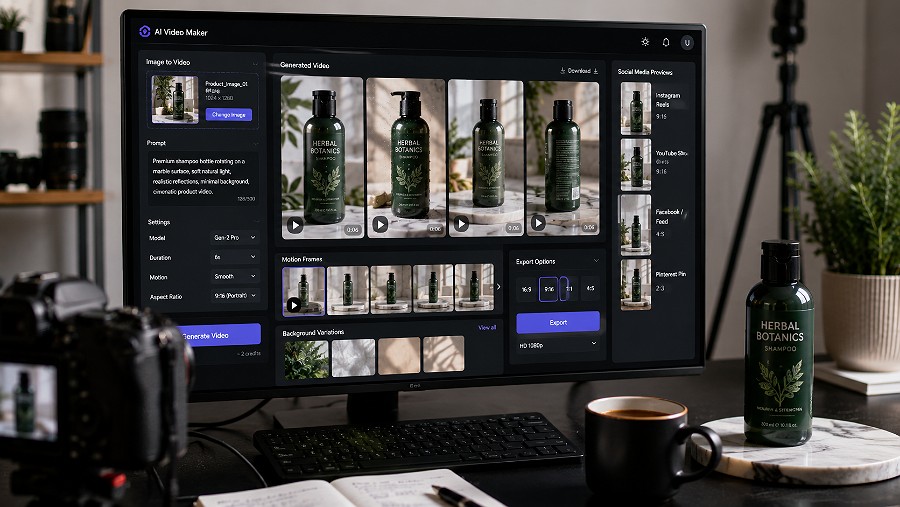
Where AI Product Video Makers Perform Well
AI shines in creative production workflow layers where speed and variation matter more than pixel-level product truth. It is excellent for rapid concept development, moodboard building, storyboards for a paid campaign, quick social variations of an existing asset, simple packshot animation, background swaps for seasonal creatives, ad testing at scale, campaign ideation and reformatting one master asset into fifteen different aspect ratios.
For a growing D2C brand testing which hook, which background, which colour story or which voiceover performs best on Meta and YouTube, an AI product video maker is a legitimate creative accelerator. Uniqs Studio recommends it for exactly these layers of the funnel.
Where AI Ecommerce Video Makers Struggle
The problems start when the AI is asked to represent the physical product itself. Common failure modes we see in real client review calls include product hallucination (buttons appearing where none exist), altered colours between frames, silently changed garment structure, fabric texture that reads as plastic, incorrect jewellery proportions, chain length compression, inconsistent brand logos, missing or fabricated stitching detail, unrealistic reflections on metals and stones, and jarring frame-to-frame inconsistency during motion.
These are not edge cases — they are the default failure pattern of current AI-generated product video for apparel, attire, jewellery, footwear and any SKU with fine detail. And every one of these failures translates directly into product returns, negative reviews and eroded ecommerce conversion rate on the very platforms the video was made for.
AI Ecommerce Video Maker · Pros
- Very fast concept-to-clip turnaround
- Excellent for creative variations and A/B testing
- Low per-variation cost after subscription
- Great for social experimentation and moodboards
- Removes background-generation bottleneck
AI Ecommerce Video Maker · Cons
- Product hallucination on complex garments
- Weak colour accuracy and material accuracy
- Poor at real fabric movement and product rotation
- Unreliable jewellery scale and reflective surfaces
- Marketplace-risk asset for accuracy-sensitive SKUs
Professional Ecommerce Video Production: How a Real Studio Works
Professional ecommerce videography follows a disciplined production pipeline built around the physical product. A typical Uniqs Studio ecommerce videoshoot moves through: creative brief, product intake and quality check, garment preparation or jewellery styling, lighting setup on the video production studio floor, camera setup with the correct lens for the SKU, hero shots, model and product interaction, macro close-ups, product movement passes, editing, colour correction against real reference and finally platform-specific exports for Amazon, Flipkart, Myntra, Ajio, Nykaa and Shopify.
This is a slower process by design. The point of a professional Ecommerce Video Maker is not to be fast — it is to produce footage that survives when a customer zooms in on the product detail page. That is why the same brands that use AI for social variations still book studios for their core PDP video and catalogue production.
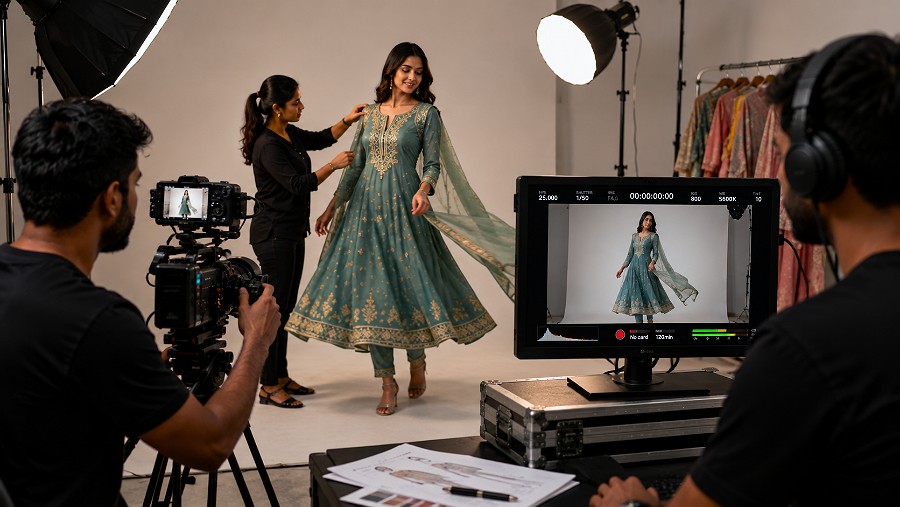
Why Physical Product Footage Matters
Real footage carries information that no synthetic clip can currently fake at scale — exact garment construction, genuine fabric drape, actual dimensions, honest reflections, authentic movement, real styling proportions and true human interaction with the product. When a shopper on Myntra sees an outfit worn by a real model, their brain reads dozens of unconscious cues about fit, weight and finish that AI-generated model footage does not yet reproduce reliably.
Uniqs Studio has produced real footage for D2C fashion, jewellery and lifestyle brands where these cues directly moved add-to-cart rates. Our model photography and fashion photography teams see this pattern daily, and it is echoed in our comprehensive fashion catalogue photography guide.
Colour, Texture, Fit and Movement Accuracy
Colour accuracy is not a nice-to-have on ecommerce — it is the single most cited reason for apparel returns in India. A professional studio manages colour through calibrated monitors, colour-checker references and controlled studio lighting, so the ivory in your listing is the same ivory in the parcel. AI ecommerce video makers, in contrast, treat colour as a stylistic variable that shifts with prompt and seed.
The same logic applies to fabric movement, garment fit, product texture and jewellery scale. Customers buying apparel, jewellery, footwear, accessories, beauty and home products often need information that only genuine product footage can reliably demonstrate. That is the commercial reason professional ecommerce videoshoot remains the default for accuracy-sensitive SKUs.
Ecommerce Video Maker Comparison: AI vs Professional Studio — 9 Critical Differences
Every conversation we have with D2C founders eventually lands on the same nine factors. Here is the honest side-by-side, based on real Uniqs Studio production experience with brands shipping on Amazon India, Myntra, Flipkart, Meesho, Ajio and Shopify.
| Factor | AI Ecommerce Video Maker | Professional Studio | Winner |
|---|---|---|---|
| Production speed | Very fast | Requires planning & shoot | AI |
| Initial cost | Lower | Higher | AI |
| Product accuracy | Variable | High | Professional |
| Colour accuracy | Variable | Controllable | Professional |
| Texture accuracy | Limited on complex SKUs | Real physical detail | Professional |
| Clothing fit | Simulated | Actual on real model | Professional |
| Jewellery scale | Can vary | Actual & consistent | Professional |
| Human interaction | Generated | Authentic | Professional |
| Creative variations | Very scalable | Moderate | AI |
| Real-world movement | Simulated | Genuine | Professional |
| Marketplace product truth | Higher risk if altered | Stronger | Professional |
| Brand campaign ideation | Excellent | Excellent | Tie / Hybrid |
| Product demonstrations | Limited for complex use | Strong | Professional |
| Social experimentation | Excellent | Good | AI |
| Core PDP / hero asset | Product-dependent | Stronger for accuracy-sensitive SKUs | Professional |
1. Video Quality and Realism
AI ecommerce video makers can deliver visually polished output — but polish is not the same as realism. On close inspection, AI-generated product video often reveals soft edges, dreamlike lighting and slightly wrong reflective surfaces. Professional ecommerce video production, by contrast, is grounded in real optics and studio lighting, so the clip reads as physical reality — which is what customers instinctively trust on a product detail page.
2. Product and Colour Accuracy
Colour accuracy is the highest-stakes battleground for any Ecommerce Video Maker. A professional studio calibrates the entire pipeline — light source, camera profile, monitor, edit suite — to a known reference, so a maroon kurta on screen matches the maroon kurta in the parcel. AI product video makers cannot yet guarantee this because colour is a downstream property of a generative model, not a controlled measurement. For any brand where returns hurt margins, professional production is the safer investment.
3. Texture and Material Representation
Fabric weave, embroidery raised detail, leather grain, gemstone facets, satin gloss and reflective surfaces on metals all carry huge signal about product quality. A real camera at close distance under real light captures those signals directly. An AI ecommerce video maker approximates them from training data and often produces plastic-looking textures on high-value products — exactly where texture matters most.
4. Fit, Scale and Product Proportions
For apparel and jewellery, proportion is the product. Real model photography and real jewellery macro footage give customers immediate, correct information about garment fit and jewellery scale. AI-generated model output, especially for Indian body types and traditional silhouettes, still routinely distorts proportions — dupattas float, ring shanks thicken, chain lengths compress. Uniqs Studio’s ghost mannequin photography and jewellery photography workflows exist specifically to solve this scale problem cleanly.
5. Product Movement and Human Interaction
Dress drape, saree pleats swinging, a jacket structure holding shape, a bag opening, jewellery moving as the model turns, shoe flex on step — these are the moments that convert browsers into buyers. Real product footage captures them with physics intact. AI product animation approximates them, and viewers detect the wrongness even when they cannot articulate it. This is the single biggest reason model video and lifestyle video should be produced in a real studio.
6. Production Speed
Here AI genuinely wins. An AI ecommerce video maker can produce a first-cut clip in minutes; a professional shoot takes days from brief to delivery. For time-sensitive social creative, that speed advantage is real. For catalogue production, however, the speed of the shoot matters less than the accuracy of the output.
7. Cost
The AI-is-cheaper narrative usually collapses once total production cost is measured honestly. AI cost includes subscriptions, credit packs, repeated generations to reach an acceptable clip, prompt engineering time, manual correction, retouching to fix hallucinated details, editing and human QC. Professional ecommerce video production cost includes studio, crew, models, styling, camera, lighting, editing and marketplace deliverables — but those inputs produce a reliably usable asset in one pass.
8. Scalability
AI scales creative variations beautifully — one master concept becomes fifty ad variants. Professional production scales differently, through efficient shot lists, batching multiple SKUs per shoot day and template-based editing. The right answer for most D2C brands is to use both scaling models on different layers of the funnel.
9. Customer Trust and Product Truth
This is the deciding factor. Every ecommerce transaction is an act of trust — the customer is paying for something they cannot touch. Real professional footage strengthens that trust; AI-altered footage quietly erodes it, one return and one one-star review at a time. On a long enough timeline, product authenticity is the single most valuable asset a D2C brand owns, and the choice of Ecommerce Video Maker directly shapes it.
AI-Generated Model vs Real Model for Ecommerce Videos
AI-generated models have improved dramatically, but for apparel, jewellery and beauty D2C brands they still fall short on the details customers care about — clothing fit on Indian body types, natural body-product interaction, correct jewellery placement, product scale, hair movement against fabric, honest skin reflections, correctly rendered hands and fingers, and brand-consistent model continuity across a season. These are exactly the cues that build purchase confidence.
Real model photography and real model video, produced in a controlled video production studio, deliver every one of those cues without prompt engineering. That is why brands committed to accurate representation still book real models for their core catalogue, even while they experiment with AI models for background campaigns. Uniqs Studio’s model photographer and male model photographer teams routinely see this split usage across our client roster.
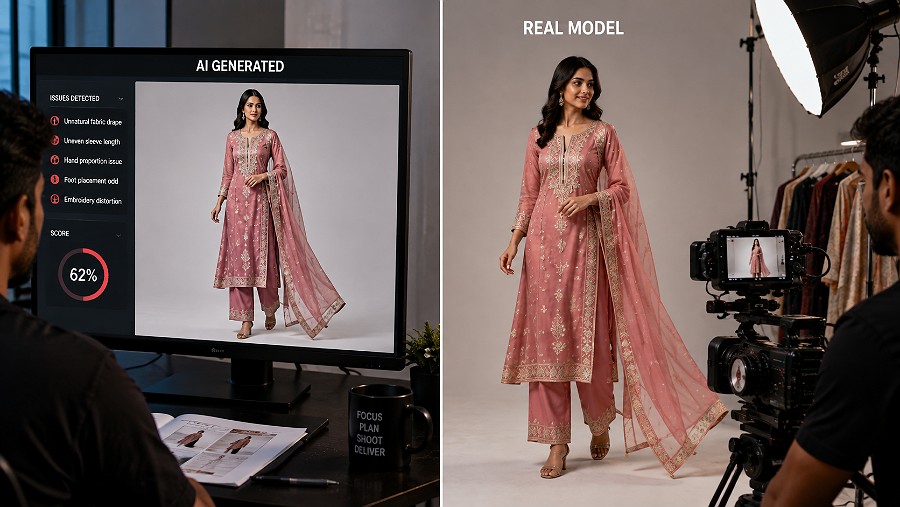
For a deeper look at how professional model production actually runs — from casting to campaign — our model photography for fashion brands guide and our editorial vs commercial vs catalogue shoots explainer are worth reading before you commit to an AI-only approach.
AI Product Animation vs Real Product Footage
AI product animation is genuinely good for abstract movement, motion graphics, impossible camera moves, brand concept visuals and fast variations of an existing hero clip. If you need a product to float, split apart, morph or fly through an unreal landscape, AI is the right tool — and a very fun one.
Real product footage wins whenever the product needs to be believed rather than dramatised. Real opening and closing of a clasp, actual product operation, true reflections across a metallic finish, physical movement of fabric, correct material response to light and accurate dimensions on a hand — these are trust signals that only a real Ecommerce Video Maker session produces. For product demonstration and product close-up work in particular, real footage is not optional. It is the format that carries the commercial weight.
In practice, the strongest campaigns we produce combine both: a hero PDP video shot professionally, then AI-driven motion graphics layered on top for a Reels edit or a marketplace listing overlay. That is a much smarter use of AI than trying to fake the product itself.
Which Ecommerce Video Maker Is Better for Fashion Brands?
For fashion brands — apparel, outfits, clothing, threads or however you refer to your SKUs — the answer is decisive. Core PDP and hero videos should be produced professionally because they need to demonstrate garment fit, fabric drape, texture, stitching, embroidery, transparency, stretch, actual garment length, real movement and clean front, back and side views. AI ecommerce video makers cannot yet reproduce these attributes reliably on Indian silhouettes.
Uniqs Studio’s fashion photographer and flat lay photographer teams handle these details every day, whether the deliverable is stills or video. If you are building out a clothing brand’s ecommerce production plan, our fashion photography for clothing brands guide and our studio vs outdoor shoot breakdown both cover decisions that carry over directly into video work.
AI still has a real seat at the table for fashion — background variations, campaign concept development, seasonal moodboards and social experiments. But when the video is doing the selling on Myntra, Ajio or your Shopify PDP, the core asset should come from a professional shoot. Brands weighing the numbers can start with our fashion photography cost in Delhi breakdown for a realistic budgeting frame.
Which Ecommerce Video Maker Is Better for Jewellery Brands?
Jewellery is the category where AI ecommerce video makers struggle most visibly. Gemstone appearance, metal finish, exact stone size, jewellery scale on the wearer, chain length, honest reflections, tiny clasp details and correct product proportions all live in a level of physical detail that generative video cannot yet respect frame-to-frame. A macro close-up of a real diamond looks different from an AI approximation, and buyers know.
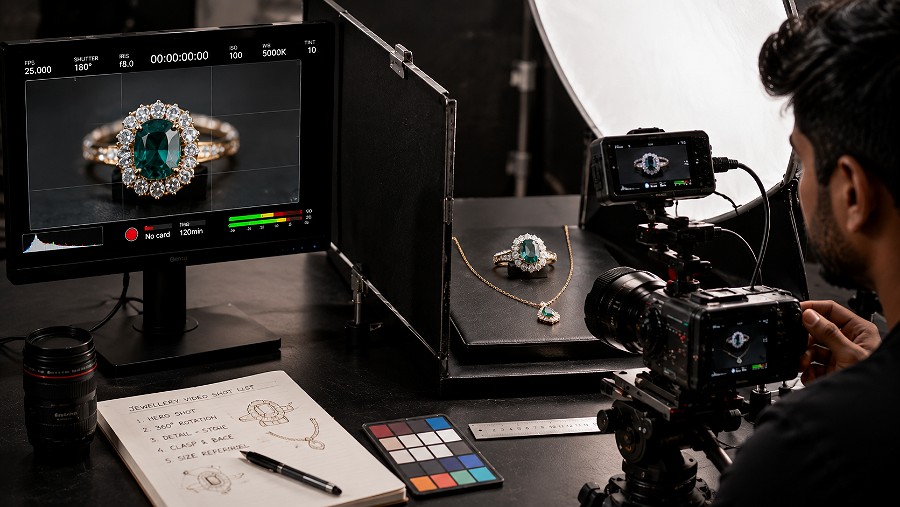
Professional macro videography, controlled reflection management and real on-model footage are the reason serious jewellery brands still book studios. Uniqs Studio’s jewellery photography service handles exactly this — and the same principles carry directly into jewellery video work. For readers who want to go deeper, our guides on macro photography for jewellery and 360 jewellery spin videos explain why physical setup wins for this category.
Amazon, Myntra, Flipkart, Meesho, Nykaa & Shopify — Which Video Approach Makes Sense?
Every marketplace has slightly different appetites and slightly different rules, and the right Ecommerce Video Maker choice shifts with each one. Below is our practical read from producing catalogue video for D2C brands across these platforms — but always verify current media specifications against each platform’s official seller documentation before you publish.
Amazon India
Amazon India buyers respond strongly to authentic product demonstration and listing-focused footage. Real product operation, honest packaging shots and clean close-ups outperform stylised AI clips. Amazon’s own seller documentation on video listings is worth checking directly — see the official Amazon India Seller Central guidance for current specs.
Myntra & Ajio
These fashion-first marketplaces reward garment fit, silhouette accuracy, real movement and consistent styling. Model video with real fabric drape wins here. AI-generated models are not yet the right primary asset for Myntra or Ajio PDPs.
Flipkart
Flipkart’s audience prioritises clear demonstrations and faithful product representation. For any SKU where the buyer needs to see the product working — appliances, gadgets, kitchenware, home goods — real footage carries the trust.
Meesho
Meesho’s high-volume, price-sensitive audience makes scalable production workflows attractive — but the accuracy requirement does not disappear. Batching real shoots for multiple SKUs is usually a better economics than mass-generating AI clips that misrepresent the garment.
Nykaa & Beauty
Nykaa buyers zoom in on packaging, product texture, swatches and finish. Real macro footage under controlled studio lighting outperforms AI-generated beauty video every time.
Shopify & Standalone D2C
Shopify brands have the most creative freedom and can genuinely use a hybrid mix — real PDP video, UGC-style clips, lifestyle footage, real model footage and AI campaign variants layered together for paid social and email. This is where the hybrid workflow really pays off.
AI Ecommerce Video Maker vs Professional Video Production Cost
The most misleading number in this whole conversation is the AI subscription fee. It looks like the total cost of ownership, and it isn’t. Real AI cost also includes credit top-ups, repeated generations to reach a usable clip, prompt engineering time, manual retouching to fix hallucinated details, editing labour and human QC. Real professional cost includes studio, crew, models, styling, camera, lighting, editing and platform deliverables — but the output is usable on first pass.
For readers thinking through video budgets alongside stills, our garment photography cost breakdown for 2026-27 gives a realistic anchor for D2C production planning.
| Cost Factor | AI Ecommerce Video Maker | Professional Studio |
|---|---|---|
| Setup cost | Low | Medium–High |
| Cost per creative variation | Low | Higher |
| Physical shoot required | No | Yes |
| Model cost | Usually avoided | When required |
| Manual correction & retouching | Can increase significantly | Controlled in workflow |
| Product accuracy QC | Essential and ongoing | Built around physical product |
| Large-scale creative variations | Strong | Moderate |
| Core catalogue / PDP production | Product-dependent | Strong |
When Does an AI Ecommerce Video Maker Make Sense?
An AI ecommerce video maker earns its place in the stack for a specific set of use cases. Reach for it when you need:
- Concept development for a new campaign
- Fast moodboards for a stakeholder review
- Storyboards before booking a professional shoot
- Background variations of an approved master asset
- Simple packshot animation on solid backgrounds
- Short social variations for A/B testing
- Rapid ad testing across Meta and YouTube
- Pre-production visualisation for the studio team
- Reformatting an existing real-footage asset to new aspect ratios
- Any SKU where the physical product is not being materially altered on-screen
Used this way, AI is a genuinely powerful accelerator in the creative production workflow — not a threat to professional production, but a complement to it.
When Should D2C Brands Choose Professional Ecommerce Video Production?
Professional production should be the default whenever the buying decision depends on physical truth. In practice this covers most fashion, jewellery, footwear, beauty and premium lifestyle SKUs. Choose a real studio when fit influences purchase, exact colour influences purchase, material influences purchase, texture influences purchase, scale influences purchase, product operation influences purchase, physical movement influences purchase, real human interaction improves product understanding, marketplace accuracy matters, or when product returns could result from a misleading visual.
Brands that need accurate product representation across their catalogue can explore Uniqs Studio’s ecommerce video production service for professional model, product and catalogue video production tuned for Amazon, Flipkart, Myntra, Ajio, Nykaa and Shopify. Talk to Satyam directly at +91-8076745824 or email [email protected] to plan a shoot.
The Best 2026-27 Workflow: Professional Master Footage + AI-Assisted Variations
The strongest 2026-27 workflow is not AI versus professional — it is professional first, AI second. The pattern that consistently delivers for our clients follows a clear sequence:
- Shoot accurate hero and product footage professionally in a real studio.
- Capture supporting product details, macro close-ups and honest movement passes.
- Build a trusted real-footage master asset library organised by SKU.
- Use AI ecommerce video makers for concept development on new campaigns.
- Use AI for background experimentation where product representation stays intact.
- Generate creative variations of approved master assets for social A/B testing.
- Adapt formats across Reels, Shorts, marketplace video slots and email GIFs.
- Add motion graphics, captions and language variants using AI editing tools.
- Keep real footage locked in for core ecommerce and PDP communication.
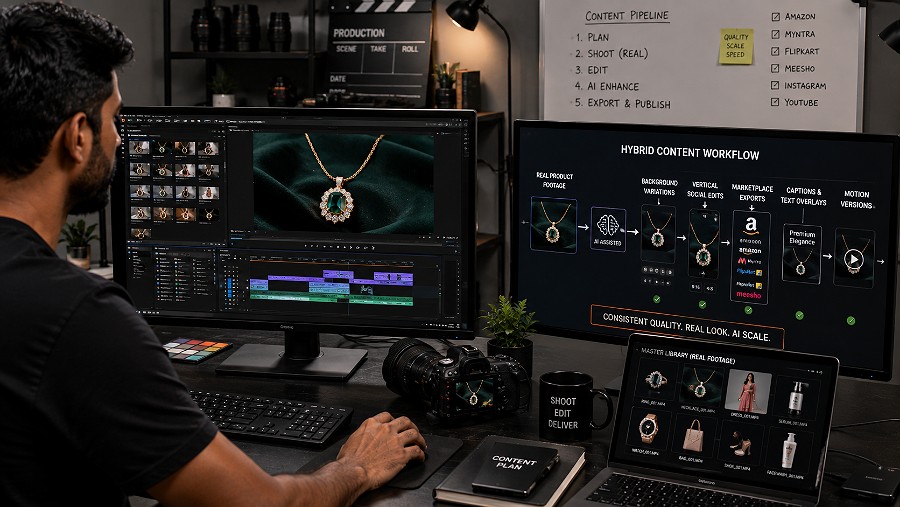
Positioned this way, professional production creates the product truth, and AI scales the creative possibilities around it. That is the workflow Uniqs Studio recommends to every D2C brand asking the AI-versus-studio question in 2026-27.
Key Takeaways
- An Ecommerce Video Maker is either an AI platform or a professional studio — treat them as different tools, not competitors.
- AI wins on speed, cost per variation and creative scale; professional production wins on product accuracy, fit, texture, colour and trust.
- For fashion, apparel, jewellery and beauty PDPs, real footage from a video production studio should be the primary asset.
- AI is a genuine accelerator for concepts, backgrounds and social variations — use it there, not on core catalogue.
- The strongest 2026-27 workflow for D2C brands is hybrid: professional master footage plus AI-assisted variations.
The F-T-C-M-S Test: Which Ecommerce Video Maker Should Your Brand Choose?
Uniqs Studio uses a simple internal framework to decide which Ecommerce Video Maker approach fits any given SKU. We call it the F-T-C-M-S Test. Run each of your top SKUs through it before you commit to an AI-only production plan.
Planning product videos for a D2C catalogue right now? Get a production recommendation based on your product category, SKU volume and selling platforms — WhatsApp Satyam at +91-8076745824 for a same-day production plan.
Decision-Making Table: What Fits Your Brand?
| Brand Requirement | AI | Professional Studio | Recommended |
|---|---|---|---|
| Fast social concepts | Excellent | Good | AI |
| Background variations | Excellent | Good | AI |
| Real garment fit | Weak / Variable | Excellent | Professional |
| Exact jewellery scale | Weak / Variable | Excellent | Professional |
| Product colour accuracy | Variable | Strong | Professional |
| Texture demonstration | Variable | Excellent | Professional |
| Physical operation / demo | Limited | Excellent | Professional |
| Lifestyle concept testing | Excellent | Excellent | Hybrid |
| Core PDP video | Product-dependent | Excellent | Professional |
| High-volume creative testing | Excellent | Moderate | AI |
| Premium D2C campaign | Good | Excellent | Professional / Hybrid |
What We See in Real Ecommerce Video Production at Uniqs Studio
After 9+ years running real ecommerce video production for D2C fashion, jewellery, beauty and lifestyle brands out of our Delhi NCR studio, a few patterns show up in almost every project. The brands that choose professional master footage tend to have lower return rates on apparel and jewellery. The brands that rely purely on AI-generated product video tend to spend more on post-purchase support and revised creatives once real customer feedback lands.
On the shoot floor, our team uses professional full-frame mirrorless cameras (Canon R10 and Sony A7R5), a 100mm macro lens for jewellery and beauty close-ups, a 50mm and 85mm combination for model work, four Godox SK 400II heads and two Elinchrom FRX 400s driving strip softboxes, octabox and beauty dish setups, plus continuous LED for video passes. That equipment stack exists for one reason — to make sure the product on screen matches the product in the parcel.
The most common request we get from clients moving off AI-only workflows is simple: make it look like the real product. That is exactly what a professional Ecommerce Video Maker is built to do.
Practical Example: A Fashion Brand Choosing AI vs Professional Production
A recent D2C apparel client came to Uniqs Studio with 40 new SKUs needing catalogue video. They had tested an AI ecommerce video maker for a season and hit two consistent problems — fabric drape looked wrong on kurtas and returns spiked on pieces where AI had subtly altered length. We booked a two-day shoot, produced real model master footage across all SKUs, then handed off the approved master assets to their in-house team to generate AI variations for Reels and Meta ads. Returns normalised; ad creative velocity went up. That hybrid pattern is the norm now, not the exception.
Common Ecommerce Video Maker Mistakes to Avoid
- Using AI to generate the primary PDP video for apparel or jewellery SKUs.
- Assuming the AI subscription fee equals total production cost.
- Ignoring frame-to-frame product consistency in AI-generated clips.
- Skipping colour accuracy QC because the clip looks stylish.
- Using AI-generated models for size and fit demonstrations.
- Treating AI and professional production as either/or instead of layers of one workflow.
- Publishing marketplace video without checking current platform media specs.
Ecommerce Video Maker Implementation Checklist
- Run every top SKU through the F-T-C-M-S Test before booking any Ecommerce Video Maker.
- Lock professional shoot dates for core PDP and catalogue video assets.
- Build a real-footage master library organised by SKU and season.
- Define which AI use cases are approved (backgrounds, variations, motion graphics).
- Set a colour accuracy QC step before any video goes live on Amazon or Myntra.
- Verify current marketplace video specs against official seller documentation.
- Keep model video and jewellery macro video in the professional bucket permanently.
- Track ecommerce conversion rate and return rate by video source for 60 days.
Future Trends: Where the Ecommerce Video Maker Space Is Heading
AI ecommerce video maker capability is improving fast, and by 2027 we expect frame-to-frame consistency on simple SKUs to close meaningfully. Even so, physical accuracy on textured fabrics, reflective jewellery and Indian silhouettes will lag real production for a while yet. Meanwhile professional studios are absorbing AI into their own post-production stacks — smart cutdowns, automated colour matching to master frames, and one-click aspect ratio adaptations. The winning D2C brands in 2026-27 will not pick a side; they will run a hybrid stack that keeps real footage at the core.
Ecommerce Video Maker FAQs
Is an AI ecommerce video maker good enough for D2C brands?
Is AI or professional product video production better for fashion brands?
Can AI create accurate jewellery product videos?
How much does ecommerce video production cost in India?
Should brands use AI product videos or real product footage?
Can AI reproduce exact product colours?
Are AI-generated models suitable for Indian fashion ecommerce?
Final Verdict: Which Ecommerce Video Maker Should D2C Brands Choose in 2026-27?
AI ecommerce video makers are valuable creative-production tools, but they should not automatically replace professional production. Recommend AI primarily for ideation, experimentation, background variations, simple animations, social creative and asset adaptation. Recommend professional production for fashion, jewellery, footwear, accessories, beauty, premium physical goods, products with important colours or materials, products demonstrating movement, model-dependent products and products where physical scale affects buying.
For D2C brands, the strongest 2026-27 workflow is not AI versus professional production — it is professional product truth first, with AI used intelligently to scale creative output around trusted master assets.
Need Ecommerce Videos That Show the Real Product Accurately?
Talk to Uniqs Studio about professional ecommerce video production for D2C brands, fashion, jewellery and marketplace catalogues on Amazon, Flipkart, Myntra, Ajio, Nykaa and Shopify.
Serving D2C brands across Delhi, Gurgaon, Noida, Faridabad, Ghaziabad, Mumbai, Bangalore, Jaipur, Hyderabad, Chennai and Kolkata. External references: Amazon India Seller Central · Google Search Central — Video SEO.