
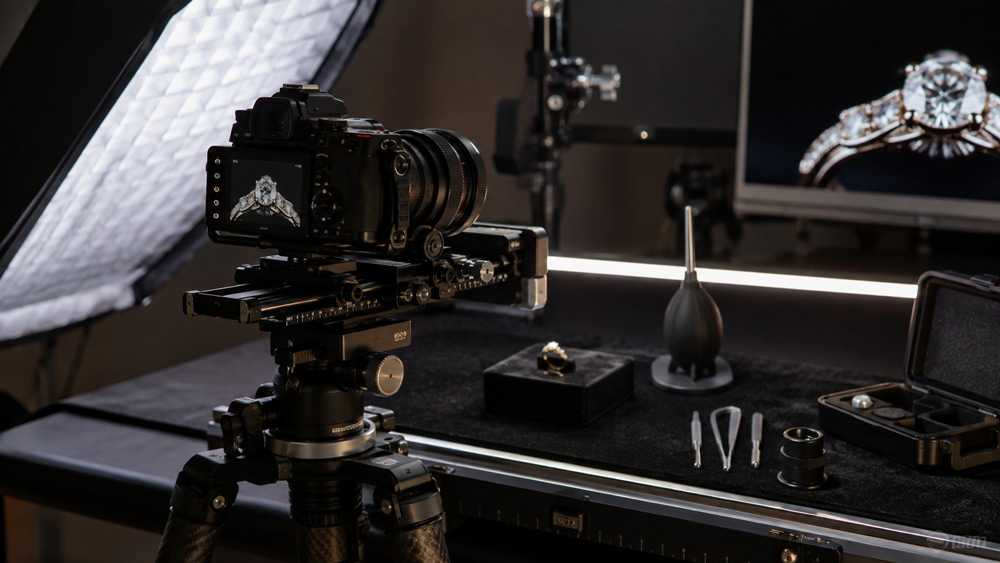
In luxury jewellery, the story is told in millimetres — the fire in a diamond facet, the whisper of an engraving on a gold band, the depth inside a royal sapphire. Macro photography for jewellery is what makes those millimetres visible on a phone screen, and it is the single biggest reason a buyer scrolls, trusts, and clicks “add to cart”. This definitive Delhi NCR guide breaks down exactly how professional macro shoots work at Uniqs Studio — the gear, the lighting, the focus stacking, the retouching, the pricing — so jewellery brands, ecommerce sellers and bespoke designers can make an informed decision before hiring a specialist.
Key Takeaways
- Macro photography for jewellery shoots at 1:1 magnification or higher, capturing detail invisible to the naked eye — fire, clarity, engravings, hallmarks.
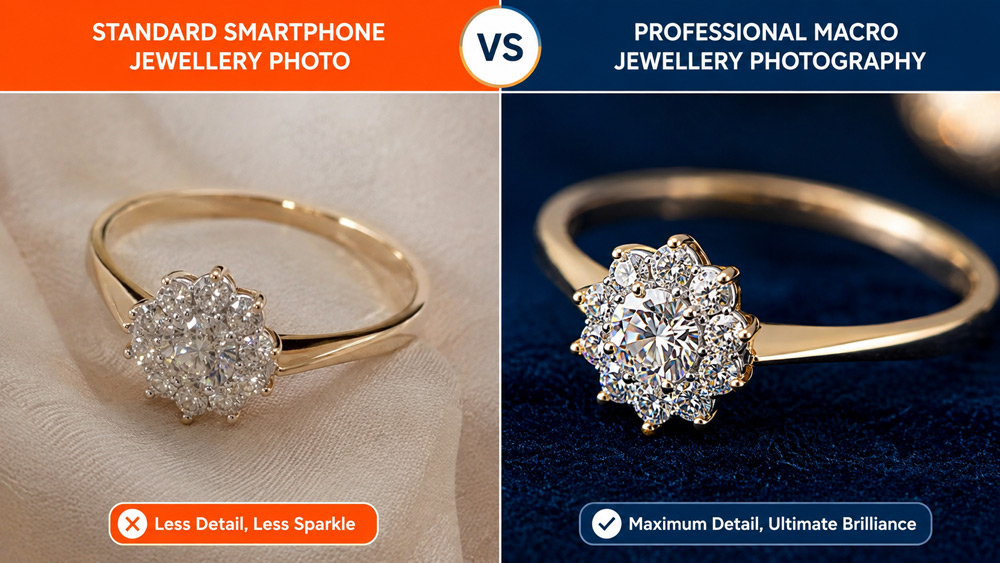
- Detailed macro images can lift jewellery ecommerce conversion by up to 40% versus flat, standard product shots.
- The specialist stack is: dedicated macro lens (90–105mm), focus rail, focus stacking, diffused lighting, and gemstone-accurate colour grading.
- Uniqs Studio’s Delhi NCR macro packages start from ₹499 per piece, with turnaround of 3–5 working days.
- Real, professional macro photos always outperform AI-generated jewellery imagery — Google, Amazon and buyers can tell the difference.
What Is Macro Photography for Jewellery?
Macro photography for jewellery is a specialised close-up discipline that captures fine details of rings, gemstones and engravings at 1:1 life-size magnification or greater. Unlike regular product photography which shows the piece in context, close-up jewellery photography reveals the microscopic story — the geometry of a diamond crown, the inclusions in a sapphire, the hand-cut chase marks on a bespoke band. At Uniqs Studio, we treat every piece as a subject with two portraits: one that shows what it is, and one that shows what it feels like to hold.
The technical distinction is simple. Regular ecommerce jewellery photography operates at focal ratios and distances designed to make an object recognisable. Macro operates at focal distances so short that a lens becomes a microscope, resolving detail at 30 lines per millimetre and beyond. The result is jewellery detail photography that Amazon zoom viewers, Myntra premium buyers and luxury catalogue readers can inspect exactly the way they would inspect a physical piece.
Why Macro Photography for Jewellery Matters for Modern Brands
Every jewellery buyer in India is now a screen buyer first. Whether the final purchase happens on Amazon, Flipkart or in a Delhi showroom, the customer’s decision starts with images on a small device. Macro photography for jewellery is the fastest, most direct way to earn buyer confidence — because it shows what a photo of the piece from a distance cannot. Sparkle proves cut quality. Sharpness proves finishing. Colour accuracy proves gem quality. In a market flooded with generic listings, luxury jewellery photography that operates at macro depth is a competitive moat.
Modern D2C brands who commission proper macro work see it in three metrics: conversion rate, average order value and return rate. Buyers who can see clarity and craftsmanship before purchase are far less likely to return. For premium sellers, macro is the difference between being one of a thousand listings and being the listing that closes the sale. Uniqs Studio has helped Delhi NCR brands document everything from bridal sets to certified diamonds, and the pattern is consistent — macro-quality catalogues convert better and return less.
Higher Conversions on Amazon, Flipkart, Myntra & Meesho
Every major Indian marketplace rewards detail-rich imagery. Amazon’s zoom feature only activates at 1000px+ on the longest side, and buyers use it — Amazon Seller Central’s image guidelines explicitly recommend high-resolution, detail-showing photography for jewellery categories. Flipkart Studio requirements, Myntra’s fashion imagery specs and Meesho’s premium categories all favour macro-level clarity. Sellers who commission professional jewellery photography at macro depth routinely report 2–3x lift in click-through and stronger review scores.
Building Trust with High-Ticket Buyers
The higher the price, the closer the buyer wants to look. A ₹1,000 fashion earring is bought on emotion; a ₹1,50,000 diamond band is bought on evidence. Diamond macro photography gives that evidence — table facets, girdle geometry, inclusions the certificate mentions. For high-ticket buyers, choosing the right jewellery photographer becomes a brand decision, not a service purchase.
Essential Gear for Macro Photography for Jewellery
Great macro work does not begin with camera bodies — it begins with the discipline of gear that removes every variable except the piece itself. Macro photography for jewellery is unforgiving: any wobble becomes blur, any weak light becomes lifeless metal, any wrong angle becomes an ugly reflection. Uniqs Studio’s macro kit is built around one principle: eliminate uncertainty, then create beauty. Below is the full stack we deploy on every serious shoot.
Best Macro Lenses for Jewellery Photography
A dedicated macro lens with true 1:1 magnification is non-negotiable. Our primary optics are the Canon RF 100mm f/2.8L Macro IS and the Sony 90mm f/2.8 G Master Macro, both of which resolve at the ultra-fine level required for gemstone facets and engraved surfaces. A 90–105mm focal length gives working distance without distortion, keeping the lens far enough that lighting rigs and hands don’t cast interference. For extreme close-ups — pave settings and hallmark stamps — we add extension tubes to push magnification beyond 1:1.
Camera Bodies & Sensors That Deliver Sharpness
Sensor resolution matters at macro because retouching, cropping and marketplace exports all draw from the base file. Uniqs Studio shoots macro on the Sony A7R V (61 MP) for luxury and certified diamond work, and the Canon R10 for high-volume ecommerce catalogues. Full-frame sensors give cleaner shadow detail and better colour rendering on gold, platinum and rose gold — essential for fine jewellery photography.
Tripods, Focus Rails & Stabilisation Tools
Stability is oxygen for macro. We use heavy carbon-fibre tripods with geared centre columns, paired with a precision focus rail that moves the camera in 0.5mm micro-increments. This is what makes focus stacking possible. Cable releases or tethered triggers eliminate shutter shake, and every shoot begins with mirror lock-up or electronic first-curtain shutter engaged. The result: pin-sharp files that hold up to 300% marketplace zoom.
Lighting Kits: Softboxes, Ring Lights & Diffusers
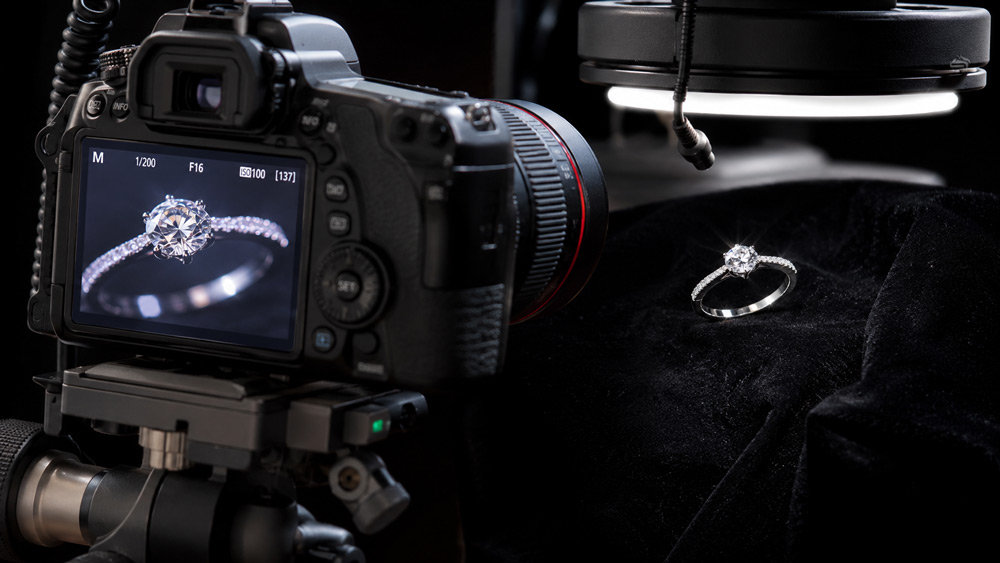
Lighting is where amateurs lose and professionals win. Uniqs Studio’s macro rig runs Godox SK 400II strobes through strip softboxes and octaboxes, with polymer diffusion panels bringing light temperature to a controlled 5500K daylight balance. Ring lights are used sparingly — mainly for engraved bands where symmetric illumination reveals depth. Every jewellery piece receives its own bespoke light plan: diamond macro photography uses one style, silver jewellery macro photography another, engraved bands a third.
Lighting Techniques for Rings, Gemstones & Engravings
Lighting is the single variable that separates a photograph from a portrait. In macro photography for jewellery, the same ring can look like a plastic prop or a museum piece depending purely on how it is lit. Uniqs Studio’s approach is layered: a soft key light shapes the piece, a fill light rescues shadows without flattening, and precision rim lights reveal metal edges. For gemstones, we add a controlled specular source — often a small diffused flash bounced at a precise angle to trigger fire without blowing highlights. This is why our ecommerce jewellery photography guide puts lighting first, before any lens or camera decision.
Capturing Fire & Brilliance in Diamonds
Diamonds reward specific lighting geometry. According to GIA’s research on diamond light performance, brilliance depends on how a diamond returns white light, fire on how it disperses spectral colours, and scintillation on how bright and dark facets alternate as the stone moves. To photograph all three, our team uses a directional key with a narrow diffusion, plus a black card to introduce controlled darkness against which fire can be seen. The technique matters as much for a ₹15,000 solitaire as for a certified 2-carat stone.
Managing Reflections on Gold & Silver Surfaces
Polished metal is essentially a mirror. Every softbox, every stand, every hand in the room can end up reflected in a band. Uniqs Studio uses light tents and black flag panels to sculpt exactly what the metal sees. For macro photography for gold jewellery, we warm the light slightly to preserve gold’s honey tones. For silver, we cool it slightly to keep the metal crisp rather than yellow-tinged. Small changes, huge visual difference.
Revealing Engravings, Hallmarks & Filigree Details
Engravings need side light, not top light. A steep grazing angle throws micro-shadows into every cut, making the depth of engraved lines readable. For BIS hallmarks — critical for buyer trust in India — we shoot at slightly higher magnification with directional lighting so serial numbers and karat marks are legible in the final image. Filigree work needs a mixed approach: fill for the underlying pattern, rim for the raised metalwork.
Camera Settings for Macro Photography for Jewellery
Settings for macro photography for jewellery are not a preset — they are a decision tree driven by piece, material and desired look. That said, there is a reliable base recipe. Uniqs Studio’s default macro exposure is manual, ISO 100, aperture between f/8 and f/11, and shutter speed synchronised to strobe (usually 1/125s). White balance is fixed by shooting a colour chart at the start of every session. For colour-critical work — bridal sets, coloured gemstones, gold-tone accuracy — we tether to a calibrated monitor and adjust in real time.
Aperture, Shutter Speed & ISO Sweet Spots
Aperture is the trade-off. Wider apertures (f/2.8–f/5.6) look creamy but leave most of the piece out of focus. Smaller apertures (f/16–f/22) deepen focus but introduce diffraction that softens fine detail. The sweet spot for most rings and pendants is f/8 to f/11. Where deeper focus is essential — long earrings, extended bracelets — we use focus stacking instead of stopping down further. ISO stays at 100 for cleanest colour; shutter speed is locked to sync with our strobe lighting.
White Balance for Colour-Accurate Gemstones
Colour accuracy is professionally critical for coloured stones. A sapphire shot at wrong white balance can look purple; a ruby can look brown. Uniqs Studio uses X-Rite ColorChecker Passport at the start of every gemstone shoot to build a custom camera profile. We shoot in RAW and calibrate white balance to daylight (5500K) unless a specific creative treatment demands otherwise. This is the invisible discipline that keeps gemstone macro photography honest.
Focus Stacking: The Secret to Ultra-Sharp Jewellery Detail
Focus stacking is what elevates competent macro photography into collector-grade imagery. At close range, depth of field collapses to a few millimetres — meaning the front of a ring is sharp but the back is blurred, or the top of a gemstone is crisp while the pavilion is soft. Focus stacking solves this by capturing many frames at incremental focus points and merging them into one image where every millimetre is razor sharp. It is why the diamonds in a Uniqs Studio ring photograph look sharper than the ring in your hand.
Step-by-Step Focus Stacking Workflow
The workflow is precise, but not mysterious. Below is the exact sequence Uniqs Studio’s macro team follows on every high-detail assignment — the same process taught in our pricing and workflow guide and refined over 9+ years of jewellery work in Delhi NCR.
- Stabilise the setup. Camera on tripod with focus rail. Every screw locked. Zero touch to the piece once framed.
- Set exposure and focus start point. Aperture f/8–f/11, ISO 100, WB calibrated. Focus manually on the nearest point of the piece (front facet, prong tip).
- Capture sequential frames. Advance the focus rail in 0.5mm–1mm increments and shoot 15–40 frames depending on piece depth.
- Import into stacking software. Helicon Focus for professional work, Adobe Photoshop’s auto-blend for lighter jobs.
- Blend and clean. The software analyses each frame, chooses the sharpest pixels from each, and merges into one composite.
- Retouch and export. Remove dust, colour-correct, sharpen, export in marketplace-ready dimensions with proper sRGB conversion.
See the Difference Macro Makes on Your Own Collection
Ready to look at your jewellery the way premium buyers do? Get a free 15-minute macro strategy call with Satyam.
Backgrounds, Props & Styling for Macro Jewellery Shots
Backgrounds are silent brand cues. A crumpled fabric drape signals emotion; a matte black acrylic signals luxury; a bright white signals ecommerce. At Uniqs Studio, background choice is decided before lighting, because it changes the entire lighting plan. Our standard macro palette includes deep matte black acrylic, ivory microfibre, brushed brass sheet, marble tile, and reflective glass. Props are minimal by design — a rough gemstone off-camera, a whisper of silk — chosen so the eye never leaves the piece being sold. Sellers looking at their complete ecommerce catalogue strategy should treat backgrounds as a system, not an afterthought.
Minimal vs Editorial Styling
Marketplace requirements push toward minimal: white or near-white background, piece centred, no distraction. Amazon jewellery categories effectively demand it. Editorial styling is the opposite — moody backgrounds, moisture droplets, sculpted shadows — reserved for hero campaign shots, catalogue covers and Instagram. A serious jewellery brand needs both, because the ecommerce catalogue and the brand story are two different jobs.
Post-Production & Retouching for Macro Jewellery Photography
Macro photography reveals every fingerprint, every dust particle, every micro-scratch. Half the work of professional macro photography for jewellery happens after the shutter closes. Uniqs Studio’s in-house retouching team spends 30–60 minutes on every hero image — cleaning, correcting, polishing without falsifying. The rule is honesty: we remove dust because that isn’t on the piece, we correct colour because monitors lie, but we never remove a real inclusion or reshape a real facet. Buyers who receive the piece must find it matching the photograph exactly.
Dust, Scratch & Reflection Cleanup
The first pass is technical. Dust visible only at macro is cloned out using healing tools. Reflections of surroundings on polished metal are neutralised. Micro-scratches accumulated in retail handling are softened, not erased — the piece still looks used and real, just presentable. Adobe Photoshop is the workhorse, supported by Adobe Lightroom’s advanced colour tools for global corrections.
Colour Grading for Gold, Rose Gold & Platinum
Metal grading is where amateur retouching gives itself away. Yellow gold should look like honey, not urine. Rose gold should have subtle pink undertones, not orange. Platinum should read cool without slipping into blue. Uniqs Studio uses layered curve adjustments and hue/saturation masks per metal type, calibrated against physical reference samples kept in the studio. This is the invisible craft behind luxury jewellery photography.
Macro Photography for Different Jewellery Categories
Not every jewellery category is photographed the same way. Rings and pendants live and die on facet detail. Necklaces need composition strategy. Kundan and temple pieces need warmth. Loose gemstones need clinical clarity. Below is Uniqs Studio’s category-by-category approach, refined across hundreds of shoots for Delhi NCR clients.
Engagement & Wedding Rings
Engagement rings are storytelling pieces. The buyer wants proof of quality and a hint of emotion. Uniqs Studio’s engagement ring workflow uses a focused overhead key light for centre-stone fire, a soft side fill for band warmth, and often a black background for maximum contrast. Focus stacking is mandatory. For bridal jewellery clients, we frequently pair macro shots with wider bridal styling imagery so the full campaign story is coherent.
Loose Gemstones & Certified Diamonds
Certified diamonds require documentary precision. We photograph face-up, girdle profile and pavilion — matching the angles on the certificate. For coloured gemstones, we shoot in daylight-balanced light and preserve the exact hue described by the lab. This is precious stone photography as evidence, and it is what gives high-ticket buyers confidence to purchase online.
Earrings, Pendants & Necklaces
Suspended pieces need vertical framing and shadow control. Uniqs Studio uses invisible mono-filament suspension to float earrings and pendants, giving them clean profile without flat backgrounds. Necklaces get a special treatment — either sculpted on custom neck forms or laid flat with careful chain choreography.
Antique, Kundan & Temple Jewellery
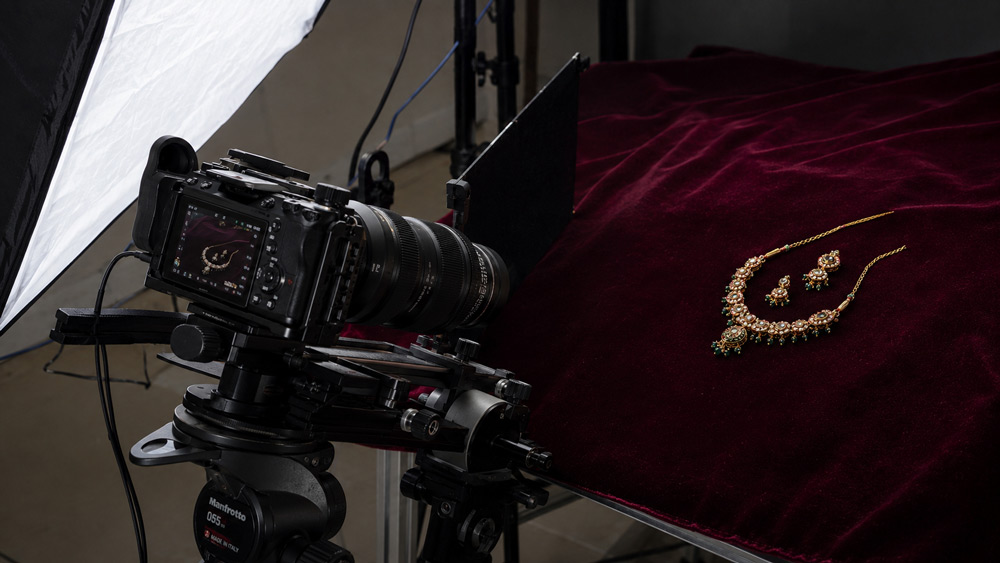
Traditional Indian pieces have their own visual language. Kundan needs warm light to reveal meenakari enamel colour. Temple jewellery needs directional lighting to catch relief detail. Antique pieces need honest colour — no overcorrection into brightness that erases patina. Uniqs Studio has documented bridal Kundan sets, meenakari earrings and antique heirlooms for private collectors and jewellery designers alike.
Common Mistakes in Macro Jewellery Photography (And How to Avoid Them)
Nine years of shooting jewellery in Delhi NCR has shown Uniqs Studio the exact places most sellers and even freelance photographers stumble. Every mistake below is fixable — most in a single studio session. Understanding them is the first step to demanding better from your imagery.
❌ Amateur Macro Pitfalls
- Shooting at f/2.8 — beautiful bokeh, unusable for ecommerce
- On-camera flash creating harsh hotspots on metal
- No colour calibration — gold looks green, silver looks yellow
- Skipping focus stacking — half the piece blurred
- Cluttered background reflections in polished bands
- Over-retouching that erases real inclusions
- Using AI-generated jewellery images instead of real shots
✅ Professional Macro Discipline
- f/8–f/11 base with focus stacking for depth
- Diffused studio strobes with polarising discipline
- Colour chart calibration before every shoot
- 15–40 frame stacks for true corner-to-corner sharpness
- Sculpted light tent controlling every reflection
- Retouching that cleans without falsifying
- Real photography of the actual piece — always
A word on AI-generated jewellery images: we strongly recommend brands avoid using AI-generated imagery as ecommerce hero shots. AI can invent facets that don’t exist, misrepresent gemstone clarity, and violate marketplace policy — creating return liability and buyer distrust. Real, professional macro photography for jewellery is the only imagery that legally and ethically represents your product. Uniqs Studio delivers only real photographs of the actual piece.
Macro Photography for Jewellery Pricing in Delhi NCR
Transparent pricing is one of the reasons Uniqs Studio is trusted across Delhi NCR. Rates for macro photography for jewellery depend on piece complexity, number of shots per piece, focus stacking depth, retouching level and turnaround. For a working benchmark, our standard packages run from ₹499 to ₹1,499 per piece, with enterprise catalogues priced on volume. Compare these to the full breakdown in our detailed pricing guide for context on what shapes final quotes.
- Up to 10 pieces
- Basic focus stacking
- Standard retouching
- 1 background
- Amazon-ready exports
- 5 working days
- Up to 25 pieces
- Full focus stacking
- Detailed retouching
- 3 backgrounds
- Amazon + Flipkart exports
- 4 working days
- Up to 60 pieces
- Advanced focus stacking
- Premium retouching
- 5 backgrounds
- All marketplace exports
- 3 working days
- 100+ pieces
- Advanced focus stacking
- Premium retouching
- Unlimited backgrounds
- All marketplaces + custom
- Custom turnaround
What Influences Macro Jewellery Photography Cost
Piece complexity is the biggest cost driver. A simple stud earring might need 8 frames in a focus stack; a pavé cocktail ring might need 40. Retouching intensity is second — a clean piece needs 20 minutes, a heavily used showroom piece with scratches and dust might need 60. Add coloured gemstones, unusual metals, or client-specific creative direction, and price rises accordingly. Uniqs Studio always shares a scoped quote after seeing sample pieces — no surprises later.
| Feature | Basic | Standard | Premium | Enterprise |
|---|---|---|---|---|
| Pieces per package | Up to 10 | Up to 25 | Up to 60 | 100+ |
| Focus stacking | Basic | Standard | Advanced | Advanced |
| Retouching level | Standard | Detailed | Premium | Premium |
| Backgrounds included | 1 | 3 | 5 | Unlimited |
| Marketplace exports | Amazon | Amazon + Flipkart | All marketplaces | All + custom |
| Turnaround | 5 days | 4 days | 3 days | Custom |
| Starting price | ₹499/piece | ₹899/piece | ₹1,499/piece | Custom |
Why Uniqs Studio Is Delhi NCR’s Trusted Macro Jewellery Photography Specialist
Choosing a macro jewellery photographer is not the same as choosing a general product photographer. Macro is a specialisation — one that demands the right gear, the right lighting philosophy, the right retouching discipline, and years of category-specific work. Uniqs Studio is founded and led by Satyam, a photographer with 9+ years of Amazon imaging and D2C jewellery experience. Our Delhi NCR studio serves 500+ brands across marketplaces including Amazon and Flipkart, with dedicated macro specialists, in-house retouching and calibrated colour workflows.
Our Signature Macro Workflow
Every Uniqs Studio macro assignment follows the same disciplined workflow: piece intake and inspection, background and lighting plan, calibration chart shoot, primary macro capture with focus stacking, tethered review with client (where possible), in-house retouching with quality gates, and marketplace-ready delivery in every required export size. The result is consistent quality — brands who ship a second batch to us find their new imagery visually indistinguishable from the first.
Portfolio Highlights & Client Success Stories
Uniqs Studio’s macro jewellery portfolio includes bridal Kundan sets for Delhi NCR designers, certified diamond documentation for Amazon Renewed sellers, gold jewellery catalogues for regional D2C brands, and hero campaign shots for luxury ateliers. One Delhi bridal jewellery brand reported a 3x lift in Amazon conversion after switching from smartphone shots to Uniqs Studio macro. A D2C ring startup cleared Myntra premium image approval on their first submission after previous rejections. Explore more via our jewellery photography services page or read how to evaluate a jewellery photographer.
- Dedicated macro specialist team (not general product shooters)
- Full-frame mirrorless bodies, professional macro optics, focus rails
- Calibrated colour workflow with X-Rite ColorChecker Passport
- In-house Adobe Photoshop retouching — no outsourcing
- Marketplace-ready exports for Amazon, Flipkart, Myntra, Meesho, Ajio
- 500+ Delhi NCR jewellery brands served since 2016
- Transparent pricing with no hidden charges
- Real photography only — never AI-generated imagery
Frequently Asked Questions About Macro Photography for Jewellery
Below are the questions Uniqs Studio hears most often from jewellery brands and ecommerce sellers considering their first professional macro photography for jewellery assignment. If your question isn’t answered here, talk to our team for a specific answer.
Macro photography for jewellery is a specialised close-up photography technique that captures extremely fine details of rings, gemstones, and engravings at 1:1 magnification or greater, revealing sparkle, texture, and craftsmanship invisible to the naked eye. At Uniqs Studio, we use professional macro lenses and focus stacking to deliver ultra-sharp, marketplace-ready jewellery images.
Macro photography for jewellery in Delhi NCR typically ranges from ₹499 to ₹1,499 per piece depending on complexity, focus stacking, retouching level, and turnaround. Uniqs Studio offers Basic, Standard, Premium, and Enterprise packages tailored for ecommerce sellers, luxury brands, and bridal jewellery labels.
A dedicated macro lens with 1:1 magnification — typically 90mm to 105mm focal length — is best for jewellery macro photography. Popular choices include Canon 100mm f/2.8L Macro, Sony 90mm f/2.8 G Master, and Nikon 105mm f/2.8 VR. Uniqs Studio uses professional macro lenses paired with focus rails for maximum sharpness.
Macro photography for jewellery is essential for ecommerce because it builds buyer trust by clearly showing gemstone clarity, metalwork detail, and engravings — which directly increases conversion rates on Amazon, Flipkart, Myntra, and Meesho. Detailed macro images can boost jewellery product sales by up to 40% versus standard shots.
A typical macro jewellery photoshoot at Uniqs Studio takes 3 to 5 working days from shoot to final delivery, depending on the number of pieces and package selected. Enterprise-scale catalogue shoots can be customised with expedited turnaround for large jewellery brands in Delhi NCR.
Book Your Macro Jewellery Photoshoot with Uniqs Studio Today
If your jewellery brand is ready to be seen the way premium buyers actually want to see it, Uniqs Studio is Delhi NCR’s specialist choice. Nine years of category-specific expertise, a fully equipped macro rig, in-house retouching, calibrated colour, and marketplace-ready delivery — all under one roof. Whether you sell 10 pieces or ten thousand, we scale to fit. Reach out via email at [email protected] or start a WhatsApp conversation at +91-8076745824. Explore our core jewellery photography service and complementary video services for a full ecommerce media package.
Reveal Every Detail. Sell With Confidence.
Delhi NCR’s trusted macro jewellery photography specialists. Real photography, honest craft, marketplace-ready delivery.