Prepare business and tax records
Match the legal business name, PAN-linked information, GSTIN and registered details before uploading anything. If a field is uncertain, resolve it against the source document instead of guessing.

A practical pillar guide for Indian D2C fashion brands, apparel manufacturers, boutique owners and marketplace teams preparing to sell, launch and scale on Myntra.

Becoming a Myntra seller is not only a registration task. For an Indian fashion brand, the real job is to align business verification, brand rights, catalogue width, product data, article images, sizing, inventory, fulfilment and profitability before the first collection goes live. This 2026-2027 Myntra Seller Guide brings those moving parts into one operating framework instead of treating seller onboarding as a form-filling exercise.
The guide is written for clothing brands, apparel manufacturers, designers, footwear and accessories labels, ecommerce managers, catalogue teams and existing Amazon or Flipkart sellers expanding to Myntra. It also helps D2C teams that sell through Shopify, Ajio, Nykaa, Paytm and other channels understand what needs to change when they enter a fashion-first marketplace. Marketplace rules can change; official Myntra information should always take priority over third-party claims.
Uniqs Studio approaches this topic from a catalogue-production perspective: the studio does not promise account approval and is not Myntra’s registration agent. Its role is to help fashion and ecommerce businesses prepare consistent product imagery and marketplace-ready visual assets. For the registration-only workflow, read the step-by-step Myntra Seller Registration guide; this page stays broader so it can act as the main Myntra seller pillar.
A serious Myntra seller needs four foundations: valid business and brand documentation, a catalogue that meets the marketplace’s product-data and image expectations, an operating system for inventory/orders/returns, and unit economics that remain healthy after fees, discounts, logistics and returns. Registration opens the door; catalogue readiness and operations determine whether the channel can scale.
Myntra Seller Registration begins on the official partner onboarding environment, but brands should do a readiness audit before they start entering data. The most common pain points are simple: the business name differs across GST and bank records, the signatory information is inconsistent, brand ownership is unclear, article images are not ready, or the team assumes that submitting an application equals marketplace approval.
Before opening the official Myntra Partner Portal, collect the business email and contact details that the team will continue monitoring after submission. Keep one internal owner responsible for the application. Duplicate submissions, different spellings and scattered ownership create avoidable confusion when Myntra asks for clarification.
Match the legal business name, PAN-linked information, GSTIN and registered details before uploading anything. If a field is uncertain, resolve it against the source document instead of guessing.
Use the correct bank account details, cancelled cheque and authorised signatory information. The goal is consistency across the application and supporting documents.
Own-brand sellers should have the applicable trademark evidence. Resellers or authorised sellers should have clear brand authorisation or NOC documentation where the current Myntra requirement applies.
Do not wait for account approval to start sizing, SKU mapping, article images and catalogue photography. A seller account without upload-ready product assets still cannot produce a strong launch.
For the full Myntra seller account registration step by step process, use the dedicated Myntra seller onboarding process in India guide. It focuses specifically on registration, documents, brand approval and troubleshooting without duplicating the wider commercial and catalogue strategy on this page.
Myntra’s current Partner Portal guidance lists a concise document set for onboarding: PAN Card, GSTN Certificate, cancelled cheque, authorised signatory signature copy, and an original trademark certificate or an applicable authorisation letter/NOC on the brand owner’s letterhead. Sellers should recheck the official portal immediately before applying because marketplace requirements can change.
| Document | Why it matters | What to check | Common issue |
|---|---|---|---|
| PAN Card | Business/tax identity | Name and entity consistency | Different spelling or entity details |
| GSTN Certificate | GST registration evidence | GSTIN, legal name, address | Application data does not match certificate |
| Cancelled Cheque | Bank account verification | Account/business name and bank details | Unclear scan or mismatched account holder |
| Authorised Signatory Signature | Application authority | Current authorised signatory information | Wrong or outdated signatory |
| Trademark Certificate | Own-brand rights evidence | Brand name and proprietor details | Brand name does not align with submitted identity |
| Authorisation Letter / NOC | Authority to sell another brand | Brand-owner letterhead and clear authorisation | Informal or incomplete permission |
GST terminology and registration records should be understood from official government sources. The CBIC GST portal is a reliable reference for GSTIN and registration context. Trademark ownership terminology can be checked through IP India. These sources explain the underlying legal records; Myntra still decides what it needs for its own onboarding process.
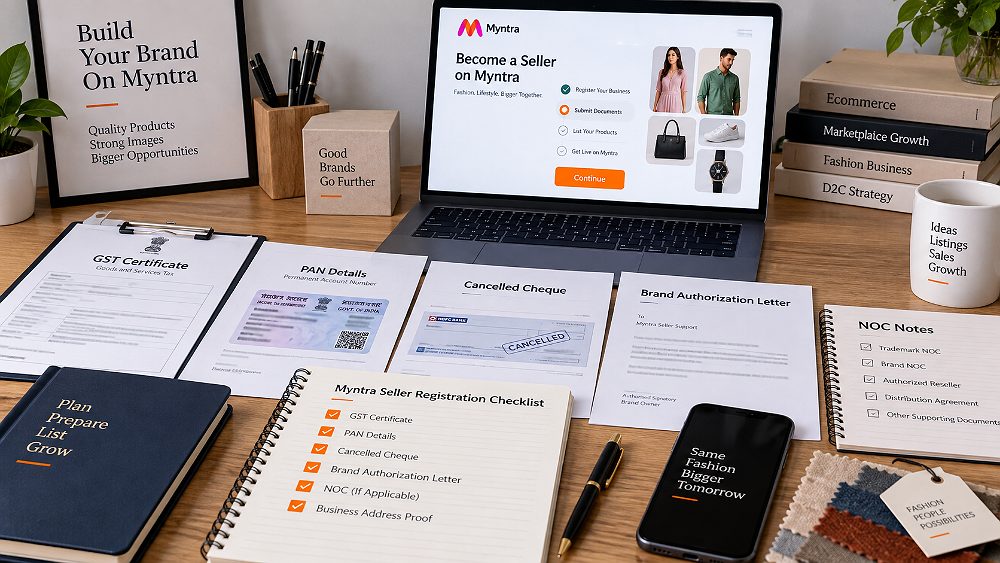
Brand approval is where many new sellers discover that onboarding is not an automatic account-creation flow. Myntra’s current seller information says a qualifying brand should have a sizeable catalogue width, quality product and a unique value proposition. Those are selection signals, not guarantees. A brand can prepare well and still need to satisfy Myntra’s current selection criteria.
How long does Myntra seller approval take? According to Myntra’s Partner Portal information available on 21 September 2026, brands meeting its defined selection criteria can be onboarded within approximately 15 business days, while major sale events can extend onboarding up to 45 days. Treat those numbers as a published reference, not a promised SLA for every applicant.
If the applicant owns the brand, the trademark certificate should identify the brand rights cleanly. If the applicant is authorised to sell another brand, the current Myntra onboarding guidance refers to an authorisation letter/NOC on the brand owner’s letterhead. Avoid assuming that a pending trademark application, distributor invoice or informal WhatsApp permission automatically satisfies Myntra’s current brand-verification process.
The dedicated Myntra product photography and image guideline guide is useful at this stage because brand approval and catalogue readiness frequently overlap in practice: the team may have the paperwork ready while product images, sizing and merchandising data are still unfinished.
One of the easiest ways to make a bad marketplace decision is to copy a single Myntra commission percentage from an old blog and treat it as universal. Commercial terms can vary by category, price band, agreement and operational model. A serious seller should calculate contribution margin from the current terms supplied to the business and then layer in the real cost of returns, logistics, discounts, advertising, packaging, catalogue production and working capital.
For a deeper breakdown, use the Myntra seller fees, charges and commission guide. The purpose is not to predict your contract but to help your finance and ecommerce teams identify every cost line that must be reconciled.
A catalogue can grow rapidly while contribution falls because returns, heavy discounting or paid visibility absorb the gross margin. Track profit by SKU and by collection. Products with different fabric, fit, price point and return behaviour should not be managed as one blended number. For fashion brands, high-quality product presentation can reduce avoidable expectation gaps, but it cannot fix a weak product, wrong sizing or unsustainable commercial terms.
Myntra’s current onboarding material says sellers should prepare brand tag details, accurate product sizing information and article images that meet Myntra specifications and guidelines. That makes catalogue readiness a first-class onboarding requirement, not a last-minute photography job. The seller team should own a single source of truth for SKU code, style name, colour, size set, fabric, care information, MRP, inventory and image filenames.
At Uniqs Studio, large-SKU fashion production is handled like an operations workflow: samples are checked, steamed, tagged, shot in a repeatable setup, mapped to SKU folders and quality-controlled before retouching and export. The approach is useful whether the collection will live on Myntra, Amazon, Flipkart or a Shopify store because the master assets remain organised even when each channel needs a different crop or content sequence.
Fashion brands can use the Fashion Photography for Myntra guide for the wider production workflow and the Myntra model shoot checklist for pose, angle and on-set quality control. Clothing brands working across marketplaces should also compare the Myntra, Amazon and Flipkart fashion photography workflow.
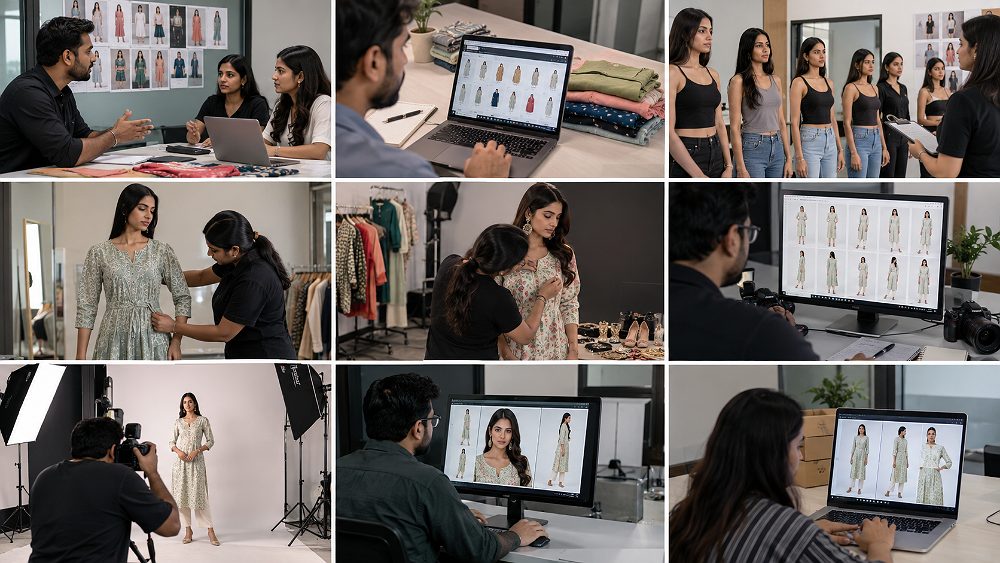
Professional production is most valuable when volume creates complexity. A 10-SKU test drop may be manageable with a basic setup, but 100-500 styles need repeatable lighting, framing, garment preparation, model continuity, file naming and post-production. Uniqs Studio supports fashion brands with garment photography, model photography and fashion photography workflows designed for ecommerce scale.
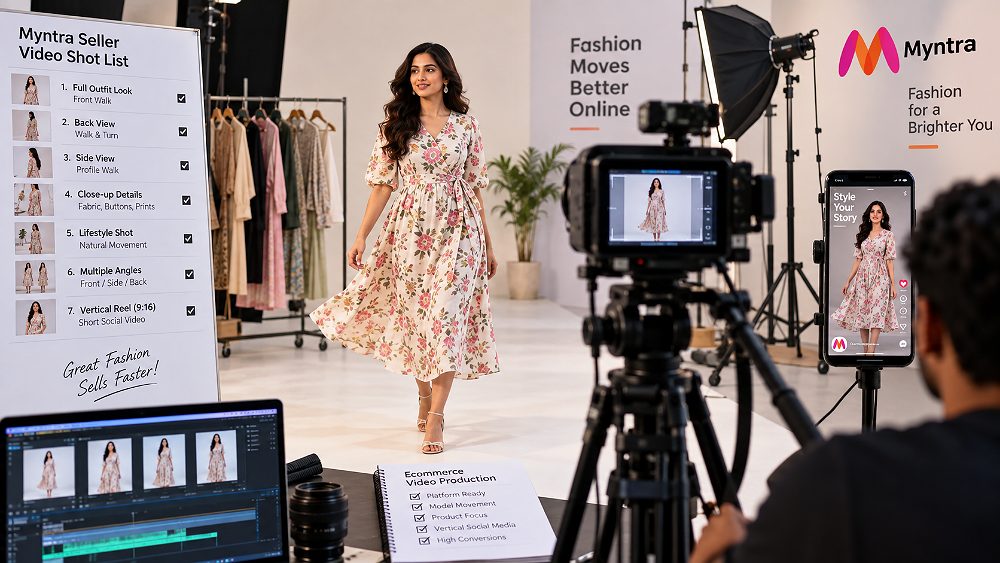
Video should be planned alongside still photography whenever the same samples, model, styling and set are already in production. A short movement clip can explain drape and fit more effectively than another still image; a detail reel can show embroidery, fabric texture or construction; and a social cut can extend the value of the shoot beyond the marketplace PDP.
The Myntra garment video and product reels guide explains the format choices. For multi-platform output, use the ecommerce videoshoot shot-list guide and the one-shoot multiple-assets workflow.
AI video tools can help with ideation, backgrounds or derivative creative, but product-truth assets deserve more caution. Apparel fit, texture, colour, stitching and movement are commercial facts. The comparison between AI garment video and real fashion shoots shows where synthetic visuals can create mismatch risk. The wider AI vs professional ecommerce video guide is useful for teams deciding what to automate and what to capture for real.
After approval and cataloguing, the seller problem changes from onboarding to execution. Inventory accuracy matters because a fashion SKU is not one unit; it is a style-colour-size matrix. A single oversold size can create cancellations, while stock sitting unavailable on one channel can reduce sell-through. Multi-channel sellers need a process that reconciles Myntra inventory with Amazon, Flipkart, Ajio, Nykaa and their Shopify D2C store.
Myntra currently states that it offers its own free-of-cost OMS for inventory and order processing dedicated to Myntra. Myntra also describes fulfilment options in which the seller stores and packs products while Myntra delivers, or Myntra stores, packs and delivers. The right operating model depends on the arrangement offered to the seller, warehouse capability and the team’s multi-channel stack.
| Operating area | Seller control point | What to monitor |
|---|---|---|
| Inventory | SKU-size stock accuracy | Available-to-sell stock and channel sync |
| Orders | Processing and dispatch workflow | Cut-offs, cancellations and ageing |
| Fulfilment | Storage/packing responsibility | Packaging, handover and SLA discipline |
| Returns | Reverse movement and condition checks | Reason codes, evidence and reconciliation |
| Settlement | Finance reconciliation | Order-level deductions and payout matching |
Myntra’s current Partner Portal information describes a 15-day payment settlement cycle from the date of delivery to the customer. Finance teams should still reconcile actual settlement reports, because order returns, adjustments and deductions can make a payout file more complex than a simple calendar calculation.
Returns are not only a customer-service issue; they are a catalogue, sizing, packaging and finance issue. Fashion sellers should monitor why products return: size expectation, colour difference, quality issue, wrong item, damaged parcel or customer preference. The return-rate pattern tells the team whether the fix belongs in product design, size-chart content, photography, listing copy or fulfilment.
When a returned product appears damaged, wrong or otherwise dispute-worthy, evidence becomes important. Keep organised order records, dispatch documentation, packaging references and any applicable supporting images. The Myntra SPF claim, returns and seller protection guide explains a more structured response framework.
Myntra growth is usually a system, not one hack. Sellers need enough assortment to create discovery, strong hero images to earn attention, detail images that reduce uncertainty, accurate sizing, disciplined inventory, competitive pricing and a process for learning from returns and sell-through. Traffic can amplify a strong catalogue, but it also amplifies weak conversion and poor stock management.
Keep product titles, attributes, colour, category, size and merchandising information accurate and complete. Missing attributes reduce the ways a customer can find the right product.
Use consistent model scale, fabric-detail images, accurate colour and useful alternate views so shoppers understand what they will receive.
Prioritise winning styles and sizes. A high-performing listing with unreliable inventory cannot compound sales.
Analyse return reason patterns by SKU. Fix recurring size, fit, colour or quality issues instead of treating all returns as random marketplace noise.
The dedicated Myntra seller growth guide covers this in more depth. If the growth bottleneck is visual merchandising, Satyam and the Uniqs Studio team can help plan a catalogue-production workflow; call +91-8076745824 or WhatsApp +91-8076745824.
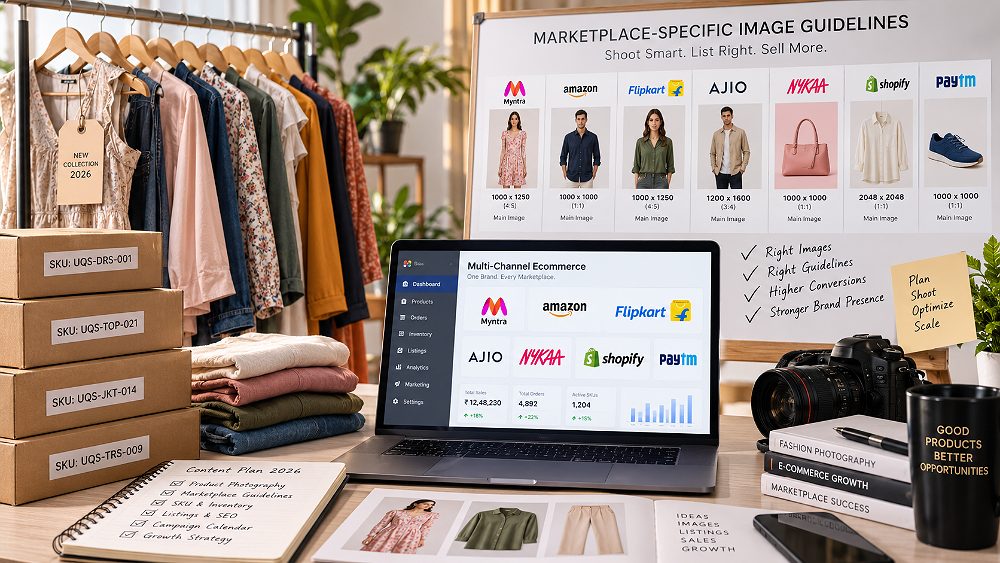
A brand that sells on Myntra rarely stays single-channel forever. Amazon and Flipkart can add broad marketplace reach, Ajio and Nykaa Fashion add fashion/lifestyle discovery, Shopify keeps the brand’s own D2C relationship, and other channels such as Paytm or social commerce may play a role depending on category and strategy. The operational risk is creating a separate content universe for every platform.
The more scalable approach is a master asset system: shoot high-resolution product truth once, then create channel-specific exports, crops, image sequences and video cuts. For example, a front catalogue image can serve as a base asset, while marketplace-specific requirements determine final dimensions and ordering. A model-detail crop can support Myntra and Ajio, while a square product-focused export can serve Amazon or Flipkart where relevant.
Brands expanding to Amazon can use the Amazon clothing photography guide, the 7-image Amazon fashion framework and the Amazon model photography guide. For video, the Amazon garment video guide helps keep production modular across channels.
GSTIN, PAN, bank and signatory details should read like one consistent business identity. Fix mismatches before submission instead of hoping verification will ignore them.
Application submission and brand selection are separate stages. Myntra’s selection criteria and current marketplace needs still apply.
Catalogue photography, size charts and SKU mapping can be prepared in parallel. Waiting creates a second launch delay after the seller account is ready.
Build profitability from your actual commercial terms and settlement reports. Internet averages do not replace your agreement.
Synthetic fashion visuals can distort fit, texture, stitching and colour. Use real professional product/garment photography for listing truth; use AI carefully for secondary creative when it does not misrepresent the SKU.
Analyse return reasons early. Catalogue, sizing, product quality and fulfilment issues can look similar in topline dashboards but need different fixes.
If the visual-production part of this checklist is the bottleneck, Uniqs Studio can help fashion brands structure catalogue stills, model photography and ecommerce video from one production plan. Email [email protected], call +91-8076745824 or use WhatsApp +91-8076745824. Marketplace approval remains entirely Myntra’s decision.
This pillar is designed to route each problem to a deeper specialist guide. Use the registration article for onboarding, the fees article for commercial modelling, the SPF article for returns, the growth article for optimisation, and the photography/video cluster for catalogue production. That keeps the Myntra seller page broad enough to answer the full journey without forcing every subtopic into one oversized section.
Plan brand-led fashion imagery before marketplace expansion.
Build a repeatable catalogue production workflow for apparel SKUs.
Choose the right production environment for catalogue and campaign assets.
Understand the major pricing factors behind fashion production.
Compare synthetic video workflows with real product production.
Use a marketplace-aware video shot list and delivery workflow.
Map product video formats to PDP, ads and social use cases.
Turn one production day into multiple short-form assets.
Plan Myntra-focused fashion catalogue photography end to end.
Use a production checklist for model poses, angles and on-set QC.
Compare cross-marketplace fashion image planning.
Plan video assets that complement a fashion catalogue.
Prepare Amazon fashion listings alongside Myntra expansion.
Understand where real apparel footage protects product accuracy.
Build an image sequence for Amazon fashion PDPs.
Coordinate marketplace-ready model photography for Amazon.
Prepare garment video assets for Amazon fashion brands.
Follow the registration, documents and approval workflow in detail.
Prepare product images and model-shoot assets for catalogue submission.
Understand return disputes and seller-protection preparation.
Move from account setup to sustainable catalogue and sales growth.
Review profitability inputs without relying on generic commission assumptions.
Myntra Seller Registration is the onboarding process used by eligible businesses and brands to apply for a seller relationship, provide business and brand documents, complete verification, prepare catalogue information and move toward account activation. The exact requirements can change, so the official Myntra Partner Portal should be treated as the current source of truth.
Start with the official Myntra Partner Portal, prepare your business, tax, bank and brand-rights documents, enter details exactly as they appear on supporting records, submit the requested information and track communication through the registered email or portal. For the detailed workflow, use Uniqs Studio’s Myntra seller registration guide linked in this article.
Myntra’s current Partner Portal guidance lists PAN Card, GSTN Certificate, cancelled cheque, authorised signatory signature copy, and an original trademark certificate or an applicable authorisation letter/NOC on the brand owner’s letterhead. Requirements can change, so recheck the Partner Portal immediately before submission.
Myntra currently states that brands meeting its defined selection criteria can be onboarded within about 15 business days, while major sale-event periods may extend onboarding up to 45 days. This is not a guaranteed approval timeline; selection, document readiness, catalogue quality and clarification requests can affect the process.
Myntra’s current onboarding guidance refers to an original trademark certificate or an applicable authorisation letter/NOC on the brand owner’s letterhead. Sellers representing another brand should prepare valid brand-rights evidence. Do not assume a pending application or informal permission will be accepted unless the current Partner Portal guidance confirms it.
Myntra’s current document checklist includes a GSTN Certificate. Applicants should keep valid GST information ready and make sure the legal name, PAN-linked data and business details are consistent across the documents submitted for verification.
After approval, the operational work begins: catalogue creation, product data, size charts, article images, inventory, order processing, fulfilment, settlement reconciliation, returns and performance management. Fashion sellers should make catalogue readiness a parallel workstream rather than waiting until the account is approved.
Prepare accurate sizing, brand tags, clean article images, product names, colour and fabric data, SKU mapping and a consistent image workflow. For fashion categories, controlled model photography and repeatable framing make large collections easier to merchandise and maintain across seasonal uploads.
Do not rely on generic commission percentages copied from third-party blogs. Commercial terms can vary by category and agreement. Use your current Myntra commercial terms, settlement reports and operational costs to calculate real contribution margin, then model returns, logistics, discounts, production and advertising separately.
Yes, if the production is planned as a multi-output workflow. A master shot list can capture platform-safe catalogue frames, detail images, alternate crops, model views and video clips in one shoot, then export platform-specific deliverables for Myntra, Amazon, Flipkart, Ajio, Nykaa, Shopify and other channels without making every marketplace look identical.
Uniqs Studio helps clothing brands, D2C labels and marketplace teams plan consistent product, garment, model and video assets for large SKU catalogues. The studio can support the content-production side of your launch; Myntra controls seller selection and account approval.