
Myntra Seller Fees & Charges 2026-2027: What Does It Really Cost to Sell?
A practical guide to Myntra seller commission, logistics, returns, GST, seller payout and real contribution margin—without pretending that every brand has the same commercial rate.
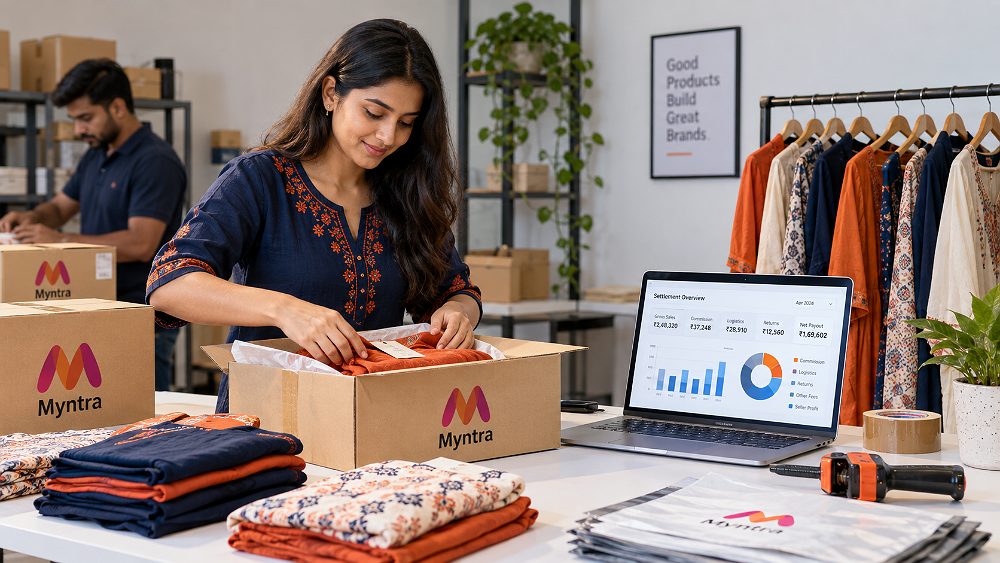
Myntra Seller Fees are best understood as a complete cost stack rather than one commission percentage. A fashion brand should model applicable marketplace commission, forward logistics, reverse logistics, customer returns, promotional participation, marketplace advertising, taxes or deductions, packaging and its own COGS before deciding whether a SKU is commercially healthy.
This matters because two sellers can sell similar products at the same gross selling price yet receive different economics due to category, brand agreement, fulfilment model, seller program, price band, return rate and commercial negotiations. For onboarding context, brands can first review Uniqs Studio’s Myntra seller services and the practical Myntra seller account registration guide.
The central rule for 2026-2027 is simple: do not treat a generic internet commission table as your own rate card. Your current Myntra commercial agreement, seller reports, invoices and settlement statement are the final references for account-specific terms. This guide shows how to think about those numbers so finance, catalogue and ecommerce teams can build a usable marketplace P&L.
How Much Does It Cost to Sell on Myntra in 2026-2027?
The total cost of selling on Myntra is the combined impact of applicable commission, logistics or fulfilment charges, expected return and reverse-logistics cost, GST on applicable marketplace services, promotional or advertising spend, packaging, COGS and other seller operating costs. There is no responsible way to calculate exact Myntra Seller Fees for every brand using one universal percentage. Always verify contracted rates against your latest Myntra agreement and settlement statement.
- Marketplace commission is only one part of total Myntra selling charges.
- Forward logistics, reverse logistics and return rates can materially change fashion ecommerce contribution margin.
- Zero commission does not automatically mean zero total selling cost.
- Seller payout is not the same thing as contribution margin or final net business profit.
- Your current agreement, invoices and settlement reports should override generic rate estimates found online.
Myntra Seller Fees 2026-2027: Complete Cost Breakdown
Myntra product selling charges should be viewed as a layered stack. Some items are percentage-based, some are per-order, some depend on shipping or returns, and others are seller-controlled operating costs. This distinction is especially important for a D2C fashion brand because catalogue pricing, discounts and return behaviour can shift the contribution margin even when the marketplace commission remains unchanged.
A seller moving from an owned Shopify store to marketplaces may compare Amazon and Flipkart economics first, then model Myntra and Ajio separately because fashion-led fulfilment, discovery, promotions and returns can behave differently. Beauty brands may also compare Nykaa economics, while teams with legacy marketplace operations may still have Paytm-related internal benchmarks. The correct approach is not to force one platform’s fee assumptions onto another platform.
| Cost Component | When It Applies | Calculation Basis | Fixed / Variable? | Impact on Profit | What Seller Should Verify |
|---|---|---|---|---|---|
| Commission | As per commercial terms | Seller-specific commissionable value × rate | Usually variable | Direct marketplace deduction | Contracted category/brand terms |
| Forward logistics | Shipment to customer | Fulfilment model, zone, weight/dimensions | Variable | Per-order contribution | Current logistics schedule |
| Reverse logistics / returns | Returned or reversed orders | Return event and applicable policy | Variable | Can materially reduce margin | Return and reverse-logistics treatment |
| Payment-related charges | If applicable under agreement | Seller-specific commercial terms | Variable | Settlement deduction | Invoice and settlement line items |
| GST on marketplace services | On applicable taxable service invoices | Taxable service value × applicable GST | Variable | Cash-flow/accounting impact | Tax invoice and ITC eligibility |
| Promotion / advertising | When seller participates | Campaign, CPC/CPA or agreed contribution | Optional / variable | Reduces contribution after marketing | Campaign-level ROI |
| Discount funding | During offers or events | Seller/platform sharing terms | Variable | Reduces realised revenue | Who funds each discount |
| Packaging | Every fulfilled unit | Seller material and labour | Mostly seller-controlled | Per-order variable cost | Protection vs dimensional weight |
| COGS | Every unit sold | Cost of goods sold | Seller-controlled | Core gross margin driver | True landed product cost |
| RTO / return operations | When order reverses or returns | Movement + handling + inventory loss | Variable | Often underestimated | RTO and customer return tracking |
Is There One Standard Myntra Seller Commission Rate?
No single percentage should be presented as the universal Myntra seller commission for every brand. Myntra commission charges can vary by category, brand agreement, seller model, program eligibility, price band where applicable and commercial negotiation. A figure that is accurate for one seller may be wrong for another seller, even when both operate in apparel.
For exact profitability, use the commission rate shown in your own commercial terms. If your finance sheet still contains a generic “Myntra commission rate for sellers 2026” copied from an old blog, replace it with the seller-specific rate before making inventory or pricing decisions.
Fixed vs Variable Myntra Selling Costs
Myntra selling charges may include percentage-based costs, per-order costs, zone/weight-dependent logistics, return-dependent adjustments and optional promotional costs. Seller-controlled items such as packaging, COGS, warehouse handling and marketplace advertising sit outside the platform fee label but still determine whether the order creates profit.
Myntra Seller Commission: How Commission Is Calculated
Myntra commission calculation begins with two seller-specific inputs: the applicable commission rate and the commissionable order value defined by the commercial agreement. The calculation logic is straightforward, but the base and rate must come from your own seller terms rather than a third-party table.
Myntra Commission Calculation Example
Illustrative example only: assume a fashion SKU has a customer selling price of ₹1,499 and a hypothetical seller-specific commission rate of 12%. If the agreement treats ₹1,499 as the commissionable value, the illustrative commission would be ₹179.88. The 12% rate here is deliberately a sample for calculation practice; it is not represented as Myntra’s universal official commission percentage.
A useful seller sheet should store the rate as an editable input rather than hard-code it. That allows the same Myntra seller charges calculator to reflect category changes, renegotiated terms or a special seller program without rebuilding the formula.
Why Two Myntra Sellers May Have Different Commission Costs
The Myntra seller fee structure can differ because of category, brand maturity, commercial terms, seller program, promotional participation and fulfilment model. This is why a marketplace manager should maintain a seller-specific master sheet and reconcile it against invoices instead of assuming that one published percentage defines all Myntra product selling charges.

Myntra Zero Commission in 2026: What Sellers Need to Know
In 2026, Myntra publicly promoted a zero-commission construct for eligible digital-first made-in-India D2C brands under Myntra Rising Stars. The current Myntra Partner Portal displays the program, making it an important consideration for eligible fashion, beauty and lifestyle brands evaluating marketplace entry.
However, “Myntra zero commission seller” should be treated as a program eligibility question, not a blanket marketplace rule. A brand should verify current Myntra Rising Stars zero commission terms, eligibility, duration and other commercial conditions directly before building a pricing model around the waiver.
Who May Qualify for Myntra’s Zero-Commission Program?
The program has been positioned for new homegrown, digital-first D2C brands, particularly across fashion, beauty and lifestyle categories. Qualification can depend on the current program rules and onboarding assessment. Sellers researching “Myntra zero commission program 2026” or “is Myntra zero commission for sellers” should therefore confirm the live terms rather than assume automatic eligibility.
Does Zero Commission Mean Selling on Myntra Is Free?
No. Zero commission should not be interpreted as zero total cost. Logistics, customer returns, reverse logistics, packaging, promotional participation, marketplace advertising, operational expenses, applicable tax treatment and COGS can still affect Myntra seller profitability.
Always model the complete per-order economics before scaling an eligible D2C fashion brand.
Myntra Shipping & Logistics Charges for Sellers
Myntra shipping charges seller economics can be influenced by fulfilment model, forward movement, shipping zone, actual weight, volumetric dimensions, exchange movement and return shipment. Exact logistics rates must come from the seller’s current arrangement, but the decision principle is universal: a shipping fee that looks manageable in rupees can consume a much larger percentage of contribution on low-ASP products.
Forward Shipping Charges
Forward logistics is the movement that gets an accepted order to the customer. For marketplace P&L, treat the applicable forward logistics cost as a per-order variable expense and compare it with net realised revenue—not MRP. The same discipline should be used when comparing fulfilment economics across Myntra and Ajio, or when benchmarking against Amazon and Flipkart.
Volumetric Weight vs Actual Weight
Fashion sellers should optimise both product weight and packaging dimensions. Oversized boxes can increase ecommerce shipping cost under volumetric logic even when the garment itself is light. Packaging should protect the product while avoiding unnecessary dimensional weight, especially for multi-SKU catalogues where a small per-order difference compounds across thousands of shipments.
How Shipping Charges Affect Low-ASP Products
Consider ₹499, ₹999 and ₹1,999 products facing a similar rupee-level logistics expense. The fee takes the largest percentage bite from the ₹499 item, so low-ASP fashion can require tighter COGS, lower packaging cost and stronger return control. This is why Myntra seller profit margin should be reviewed at SKU level instead of only looking at monthly revenue.
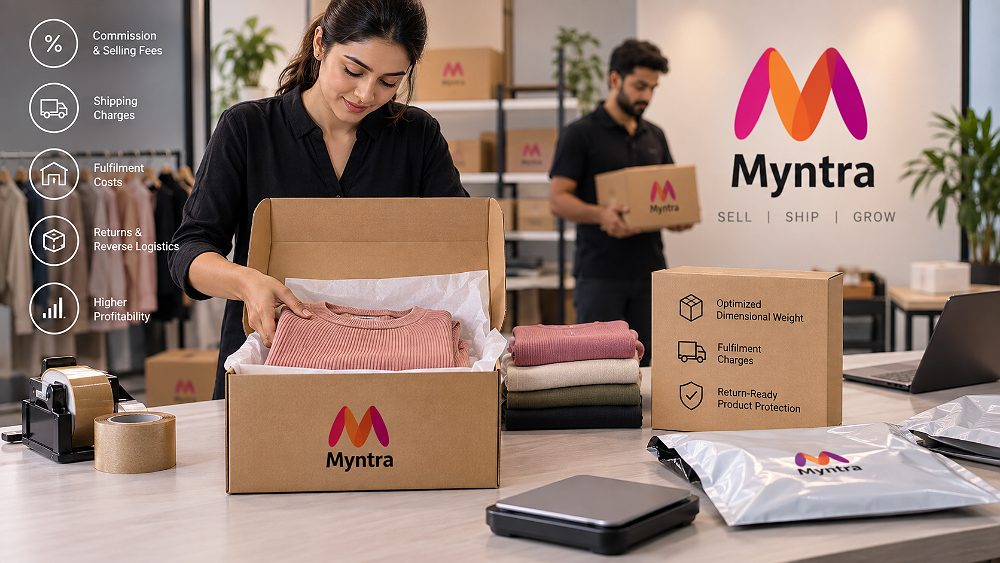
Myntra Return Charges: The Cost Sellers Often Underestimate
Myntra return charges seller planning deserves the same attention as commission because fashion ecommerce naturally carries fit, size, colour, styling and expectation-related return risk. A seller can appear profitable before returns and become weak after reverse logistics, damaged inventory, repackaging and remarketing are included.
This is also where better catalogue execution can support economics. Uniqs Studio’s Myntra product photography image guidelines explain how marketplace-ready images communicate garment details, while the Myntra model shoot checklist helps brands cover useful poses and angles.
Reverse Logistics Cost
Reverse logistics can include customer return pickup, movement back through the network, inspection or processing, repackaging and possible inventory loss. The exact Myntra reverse logistics charges depend on the seller’s arrangement, so finance teams should model an expected cost per return and compare that assumption with actual settlement data.
Return-to-Origin vs Customer Return
RTO and customer returns should be tracked separately. RTO generally describes an order that does not complete final delivery and returns through the fulfilment flow, while a customer return happens after delivery. Both create marketplace deductions or operational costs, but their causes and corrective actions may differ.
For seller protection and claims context, the Myntra SPF claim and returns guide is a useful companion resource.
Effective Return Cost Formula
GST on Myntra Seller Fees & Marketplace Charges
GST on Myntra seller fees should be separated from GST collected or payable on product sales. Marketplace service invoices may carry GST where applicable, while a registered seller may evaluate input tax credit subject to eligibility, documentation and the relevant GST rules. The CBIC ecommerce GST guidance is a better authority for tax concepts than marketplace blogs.
For bookkeeping, reconcile platform invoices, credit notes, order reports and the seller settlement statement. Tax treatment depends on the seller’s facts, registrations and transactions, so Uniqs Studio recommends confirming business-specific GST treatment with a qualified CA or GST professional rather than relying on a generic example.
GST Example on Marketplace Fees
Illustrative example: if an applicable marketplace service line has a base fee of ₹200 and the service is assumed for illustration to attract 18% GST, the gross service invoice would be ₹236. A seller may then evaluate input tax credit treatment if eligible and properly documented. This example demonstrates invoice math only; it is not personalised tax advice.
TDS, TCS and Marketplace Reconciliation
India’s Section 194-O covers TDS on certain payments by an e-commerce operator to an e-commerce participant. The official Income Tax Department text currently specifies 0.1% of the gross amount under the section, subject to its conditions and exceptions. Sellers should verify how TDS, any applicable TCS, GST entries and settlement adjustments appear in their books rather than treating every deduction as a marketplace fee.
For the current statutory wording, refer to Income Tax Department Section 194-O. The accounting objective is clean order reconciliation: gross order value → platform deductions → tax deductions/credits → bank settlement.
Myntra Seller Payout: How Your Net Settlement Is Calculated
Myntra seller payout is the amount that remains after the marketplace applies relevant commercial deductions, logistics adjustments, returns, taxes/deductions and settlement adjustments. The exact line items vary, so sellers should read settlement reports as transaction-level accounting records rather than assume that payout equals sales revenue.
Why Myntra Payout Is Different From Profit
Net payout is not net business profit. After a seller receives marketplace settlement, it still needs to account for COGS, packaging, warehouse cost, staff, ERP or OMS, photography and content production, marketing, marketplace advertising, damaged returns and inventory carrying cost. Contribution margin is the better operating bridge between marketplace payout and final net margin.
This distinction is also useful when comparing owned-channel Shopify revenue with marketplaces such as Myntra, Amazon or Flipkart. Owned stores may avoid marketplace commission but absorb other acquisition, payment processing, shipping and returns costs directly.
Myntra Seller Charges Calculator: Calculate Your Real Profit
A practical Myntra seller charges calculator India sheet should be built around editable seller-specific assumptions. The calculator is not a rate finder; it is a unit-economics model that combines your contracted fees with product costs, returns and marketing inputs.
Inputs Required for a Myntra Profit Calculator
- MRP
- Actual selling price
- Product COGS / cost of goods sold
- Applicable seller-specific commission rate
- Forward logistics cost
- Expected return rate
- Average reverse logistics cost
- Packaging cost
- Promotional contribution or discount funding
- Marketplace advertising cost per order
- Applicable marketplace taxes / fees
- Other variable operating costs
Myntra Seller Profit Formula
Break-Even Selling Price Formula
Work backwards from COGS, desired contribution, marketplace costs, expected returns and marketing spend. The minimum commercially viable selling price is the price at which your realised contribution meets the target after all variable costs. This is more useful than asking only “how much does Myntra charge sellers?” because it converts fees into an actual pricing decision.
Myntra Seller Profit Examples: ₹799 vs ₹1,499 vs ₹2,499 Product
The table below uses a hypothetical 12% commission rate only to demonstrate mechanics. Illustrative rate only. Replace every assumption with your actual commercial agreement, logistics data, return cost and product COGS before using the result for a business decision.
| Metric | ₹799 Product | ₹1,499 Product | ₹2,499 Product |
|---|---|---|---|
| Customer selling price | ₹799 | ₹1,499 | ₹2,499 |
| COGS | ₹280 | ₹520 | ₹850 |
| Illustrative commission @ 12% | ₹95.88 | ₹179.88 | ₹299.88 |
| Forward logistics | ₹70 | ₹85 | ₹100 |
| Expected return cost | ₹36 | ₹54 | ₹72 |
| Packaging | ₹25 | ₹35 | ₹45 |
| Promotional / advertising cost | ₹40 | ₹75 | ₹125 |
| Other applicable charges | ₹20 | ₹30 | ₹40 |
| Illustrative marketplace payout | ₹577.12 | ₹1,150.12 | ₹1,987.12 |
| Illustrative contribution | ₹232.12 | ₹520.12 | ₹967.12 |
| Contribution margin % | 29.1% | 34.7% | 38.7% |
Example 1: Budget Fashion Product
At ₹799, the rupee commission is lower, but logistics, packaging and return cost consume a larger percentage of selling price. Heavy discounting can quickly compress gross margin. Budget products therefore need disciplined COGS and return-rate control to keep Myntra seller profit margin healthy.
Example 2: Mid-Price Fashion Product
At ₹1,499, the example shows more room between selling price and fixed-ish per-order operational costs. That does not guarantee profitability, but it illustrates why a healthy ASP can support marketplace economics when discount funding, customer returns and advertising remain controlled.
Example 3: Premium Product
At ₹2,499, the illustrative commission is higher in absolute rupees, yet logistics can represent a smaller share of revenue. Premium products can still carry greater absolute return exposure and higher inventory carrying cost, so a seller should not judge the SKU only by its gross margin percentage.
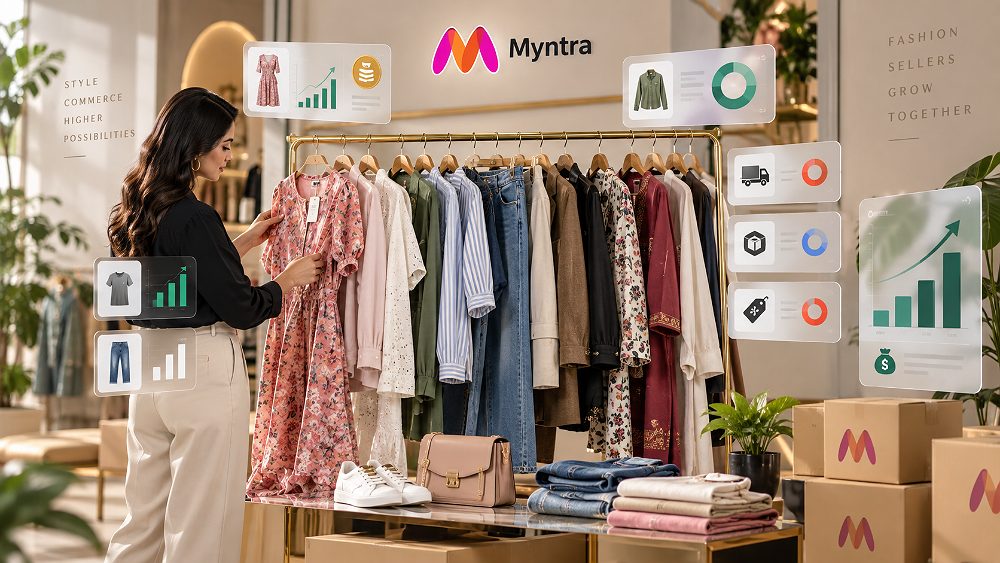
What Really Determines Myntra Seller Profitability?
Myntra seller profitability is a function of product economics and operational quality together. Commission matters, but the strongest drivers are usually realised selling price, product gross margin, return rate, discount dependency, logistics, advertising and catalogue conversion quality.
Average Selling Price
ASP determines how large each rupee cost looks as a percentage of revenue. A ₹70 logistics cost is 14% of a ₹499 order but only 3.5% of a ₹1,999 order. This is why low-ASP sellers often need tighter contribution control.
Gross Product Margin
Gross margin begins with the gap between realised selling price and COGS. If COGS is already too high, marketplace commission, shipping and returns have little room to fit. Use landed product cost rather than an incomplete manufacturing estimate.
Return Rate
Fashion returns often reflect size, fit, colour, fabric expectation and styling mismatch. Strong product information cannot eliminate every return, but accurate images and measurements can reduce avoidable expectation gaps that create unnecessary reverse logistics.
Discount Dependency
MRP margin is not realised margin. Track the customer selling price after discounts and identify who funds each offer. A SKU that looks attractive at MRP may become weak when recurring discount funding is included in the marketplace P&L.
Advertising & Promotional Spend
Marketplace advertising should be measured against contribution after ad spend, not only ROAS. A campaign can show revenue growth while still eroding net margin if product economics, returns or promotional cost are weak.
Catalogue Quality & Conversion Rate
Accurate fashion ecommerce images, product videos, colour representation, size/fit communication and complete catalogues can improve conversion quality while reducing avoidable mismatch. For Myntra-focused execution, Uniqs Studio’s fashion photography for Myntra guide and ecommerce fashion photography marketplace guide explain the production side of listing quality.
Video can also support product understanding when used strategically. Brands can review Myntra garment video formats and the comparison between AI garment video and real fashion shoots before choosing a content workflow.
How to Reduce the Effective Cost of Selling on Myntra
A seller cannot control every marketplace fee, but it can control the economics around those fees. The most useful optimisation plan improves contribution margin without compromising product experience.
Improve Product-Level Contribution Margins
Negotiate sourcing, reduce avoidable packaging cost, control discounts and set a minimum contribution threshold by SKU. Do not scale inventory merely because a product generates revenue.
Reduce Size and Fit-Related Returns
Use accurate measurements, readable size charts, product imagery, model references and clear fit information. Professional catalogue work should help customers understand what they are buying, not only make the product look attractive.
Optimize Product Packaging
Balance dimensional efficiency with product protection. Too much packaging can increase volumetric burden; too little can create damage, presentation issues and avoidable product returns.
Track Profitability by SKU
Track revenue, discount, commission, shipping, return cost, ad cost, COGS and contribution for every SKU. Aggregate GMV can hide loss-making products.
Audit Myntra Settlement Reports Regularly
Reconcile order report, product returns, marketplace invoices, credit notes, tax records and bank settlement on a consistent schedule. A seller settlement audit is both a finance-control process and a profitability diagnostic because unexpected deductions, return behaviour and fee trends become visible at order level.
For growth after the unit economics are stable, see how to increase sales on Myntra. For production budgeting, the fashion photography cost guide helps brands plan one part of the catalogue investment.
Myntra Seller Fee Structure: Costs You Can Control vs Costs You Cannot
A useful optimisation meeting separates seller-controlled levers from marketplace-dependent costs. Teams should spend the most energy on the factors they can change quickly while continuing to verify contracted Myntra selling charges.
| Cost | Seller Control Level | How to Reduce It | Priority |
|---|---|---|---|
| Commission | Low to medium | Verify program eligibility / commercial discussion | High |
| COGS | High | Sourcing, production efficiency, assortment planning | Very high |
| Forward logistics | Low to medium | Packaging dimensions, fulfilment choices | High |
| Return rate | Medium to high | Fit information, catalogue accuracy, product quality | Very high |
| Packaging | High | Right-size materials and damage prevention | Medium |
| Discount | Medium | Promotion discipline and margin floor | High |
| Advertising | High | SKU-level contribution and campaign efficiency | High |
| Catalogue/content quality | High | Accurate images, video, size/fit communication | High |
| Inventory cost | High | Depth planning and sell-through control | High |
Is Selling on Myntra Profitable in 2026-2027?
Selling on Myntra can be commercially viable when a brand has sufficient gross margin, disciplined discounting, healthy ASP, manageable returns and accurate product-level contribution tracking. It is not automatically profitable or unprofitable for every seller; the answer depends on the actual fee structure and the brand’s own economics.
Potentially Stronger Fit
- Healthy gross margins
- Fashion/lifestyle product-market fit
- Competitive, accurate catalogue
- Strong size and fit communication
- Controlled return rates
- Enough margin after discounts
- SKU-level financial tracking
Higher-Risk Economics
- Thin gross margins
- Very low ASP
- High return rates
- Heavy discount dependency
- Poor catalogue conversion
- Profit calculated before returns and ads
- Unreconciled seller deductions
This framework also explains why cross-platform expansion must be modelled separately. Amazon, Flipkart, Myntra, Ajio and Meesho may serve overlapping sellers, but fee structures, catalogue expectations and customer behaviour differ. Nykaa can have different economics for beauty, while Shopify remains a useful owned-channel comparison point.
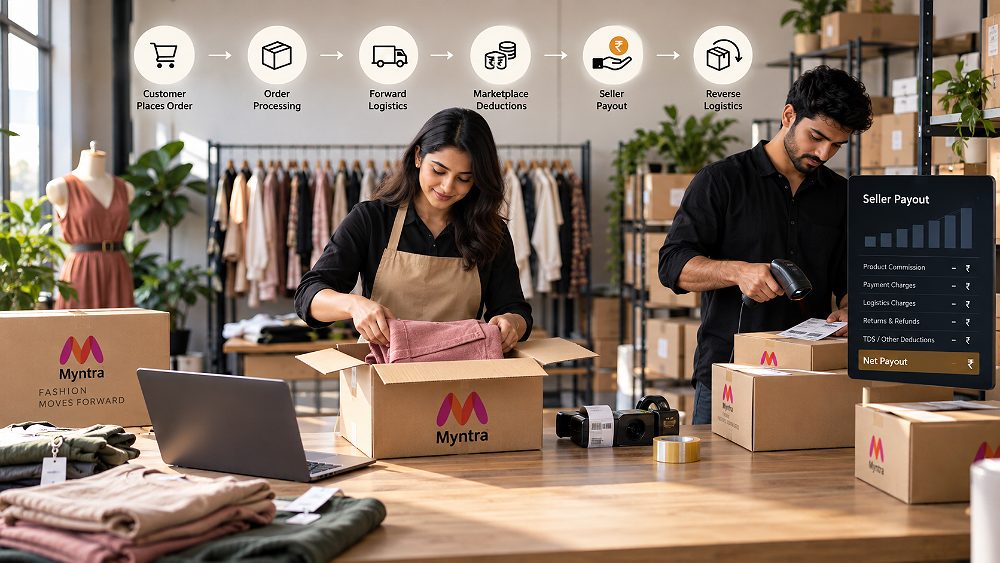
Myntra Seller Cost Checklist Before You List a Product
Use this checklist before approving a new SKU, promotion or price band. It converts the Myntra seller fee structure into practical inputs that merchandising, finance and marketplace teams can review together.
For catalogue preparation, the fashion catalogue photography guide covers structured image planning. Brands that want to turn one production day into more assets can also review the one-shoot multiple-assets workflow.
Terms a Myntra Seller Finance Sheet Should Track
A clean marketplace P&L should use consistent language across commercial, finance and operations teams. Useful entities include Myntra marketplace, Myntra seller, Myntra partner, Myntra Rising Stars, marketplace commission, seller settlement, net payout, gross selling price, order value, marketplace deductions, forward logistics, reverse logistics. Operational tracking should also distinguish RTO, customer returns, product returns, shipping fee, fulfilment charges, payment processing, GST, input tax credit, TDS, TCS, COGS, cost of goods sold, because each can affect order-level reconciliation differently.
For profitability review, keep contribution margin, gross margin, net margin, discount funding, promotional cost, marketplace advertising, fashion ecommerce, D2C fashion brand, seller profitability, settlement statement, order reconciliation, marketplace P&L visible in the same reporting structure. This vocabulary prevents a common error: treating every marketplace deduction as “commission” and every bank settlement as “profit.”
Build the Catalogue and Seller Workflow Around Real Unit Economics
If a brand is preparing to sell or scale on Myntra, Uniqs Studio can support marketplace-ready catalogue planning, fashion photography, model shoots, product video and seller-content workflows. Start with Myntra marketplace support or discuss the requirement directly with Satyam.
Myntra Seller Fees FAQ
Myntra Seller Fees can include applicable commission, logistics, returns, marketplace service charges and taxes, promotional costs, plus seller-controlled operating expenses such as packaging and COGS. Exact commercial rates should be checked in the seller’s current agreement, invoices and settlement statement rather than assumed from one generic percentage.
A single universal Myntra seller commission percentage should not be assumed for every seller. Myntra commission charges may vary by brand, category, agreement, program and commercial model. For an exact Myntra commission calculation, use the contracted rate shown in your own commercial terms.
Myntra promoted a zero-commission construct in 2026 for eligible new homegrown digital-first D2C brands through Myntra Rising Stars. Eligibility and current terms should be confirmed through Myntra’s official partner channel. Zero commission does not automatically remove logistics, returns, advertising, packaging, tax or operating costs.
Applicable Myntra shipping charges seller and reverse-logistics treatment depend on the seller’s commercial and fulfilment arrangement. Model both forward logistics and expected Myntra return charges for sellers when calculating contribution margin, then reconcile actual costs against seller reports.
Calculate Myntra seller profit as net realised revenue minus COGS, marketplace fees, logistics, expected return costs, advertising, packaging and other variable expenses. A Myntra seller profit margin calculator should use seller-specific rates, actual return data and SKU-level costs instead of generic marketplace assumptions.
Calculate the Full Myntra Cost Before Scaling
Commission alone does not determine Myntra profitability. Sellers should calculate the complete per-order economics—including logistics, returns, COGS, applicable marketplace costs, promotional spend and taxes—before pricing or scaling. Then reconcile the assumptions against actual seller settlement data so the model improves over time.
For brands building a stronger marketplace catalogue, Uniqs Studio also recommends reviewing fashion photography for clothing brands and the ecommerce videoshoot marketplace guide. For direct Myntra seller support, call +91-8076745824 or email [email protected].