
Apparel Product Photography: The Complete Shot List for Every Clothing SKU (2026 Playbook)
The production-ready shot list Uniqs Studio uses to photograph every clothing SKU — mapped to Amazon, Myntra, Flipkart and D2C stores.
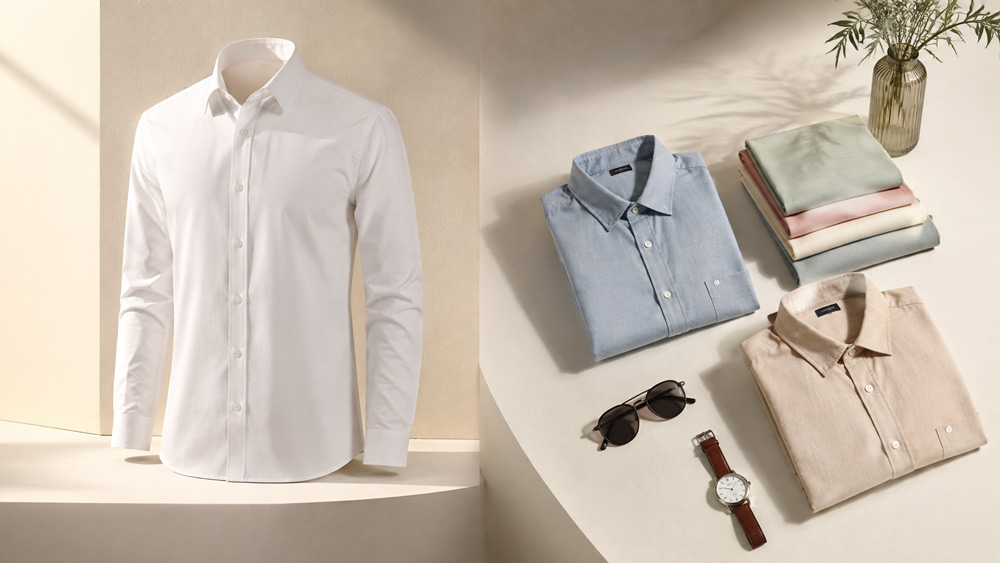
If you are running a clothing label in India today, your product page does the selling — not your description. And the single biggest reason apparel brands lose sales, get returns and burn shoot budgets is one boring, invisible thing: no proper apparel product photography shot list. In this 2026 playbook, Satyam and the team at Uniqs Studio share the exact shot list we use for every clothing SKU we shoot for D2C brands and marketplace sellers across Delhi NCR.
You will get the 8 non-negotiable angles, category-wise shot mapping for menswear, womenswear, kidswear, innerwear and bridal, marketplace-wise requirements for Amazon, Myntra, Flipkart and Ajio, a ghost mannequin vs flat lay vs on-model decision matrix, a full pre and post-production checklist, our per-SKU pricing framework, and answers to the questions clients ask us every single week. Everything here is battle-tested on real catalogues — the kind of garment photography we deliver every day, and the fashion catalogue photography workflow that keeps our clients’ listings converting.
Key Takeaways
- Every clothing SKU needs 6–10 core images: front, back, both sides, ghost mannequin, flat lay, detail, lifestyle.
- A structured apparel product photography shot list cuts reshoots by 40–60% and shoot days by 30–40%.
- Ghost mannequin wins for structured garms; flat lay wins for soft basics; on-model wins for lifestyle and A+ content.
- Amazon, Myntra, Flipkart and Ajio each have subtle angle and background rules — one shot list, four export presets.
- Uniqs Studio delivers apparel product photography from ₹399/SKU (basic) to premium editorial per-SKU packages in Delhi NCR.
On this page
- What Is a Shot List in Apparel Product Photography?
- The 8 Non-Negotiable Shots for Every SKU
- SKU-Type Shot List (Menswear, Womenswear, Kidswear, Innerwear, Bridal)
- Marketplace-Wise Shot List (Amazon, Myntra, Flipkart, Ajio, D2C)
- Ghost Mannequin vs Flat Lay vs On-Model
- Pre-Production Checklist
- Post-Production Checklist
- How Many Images Per SKU?
- 360° Spin & Video Requirements
- Pricing in Delhi NCR
- Common Shot List Mistakes
- Why Choose Uniqs Studio
- FAQs
What Is a Shot List in Apparel Product Photography?
A shot list in apparel product photography is a pre-planned, garment-wise checklist that spells out every camera angle, framing, styling detail and image variation each clothing SKU needs before the first frame is captured. Think of it as the production script — the intent is zero improvisation on set. At Uniqs Studio, our shot list combines the marketplace’s mandatory angles, the brand’s lookbook direction and the SKU’s construction, so the crew, model and stylist walk in aligned. Whether the deliverable is a 50-piece kurta drop or a 300-SKU winter catalogue, the same shot list logic scales across shoot days.
Brands that operate without a proper garment shot list end up paying twice — once for the shoot, once for reshoots. Our internal data across 50,000+ SKUs shows that a documented apparel product photography shot list reduces reshoot rates by 40–60% and shortens shoot days by 30–40%. That is why every serious brand we work with — from marketplace sellers to premium D2C labels — treats the shot list as non-negotiable, right alongside their fashion photography brief.
Why Every Apparel Brand Needs a Shot List Before the Camera Rolls
A shot list forces alignment between the founder, catalogue manager, stylist, photographer and model — before anyone touches a garment. It defines the exact hero angle, the number of detail crops, whether the SKU goes on a ghost mannequin or a fit model, and how the flat lay is styled. This is the difference between production and improvisation, and it is why disciplined garment photography studios outperform freelance-only setups on volume shoots. Our team refined this framework across hundreds of fashion photography for ecommerce projects.
The Real Cost of Shooting Without a Structured Shot List
Without a shot list, four things almost always happen: missed marketplace angles, inconsistent framing across SKUs, forgotten detail crops and expensive reshoots two weeks later when the catalogue team spots the gaps. A single reshoot day in Delhi NCR — model, studio, stylist, retoucher — easily costs ₹35,000–₹60,000. Multiply that across categories and the math gets ugly fast. A one-page shot list, printed and taped to the shoot monitor, saves that money. Our clients often plug this into their broader fashion photography cost planning before signing off on a season’s catalogue.
Apparel Product Photography Shot List: The 8 Non-Negotiable Angles
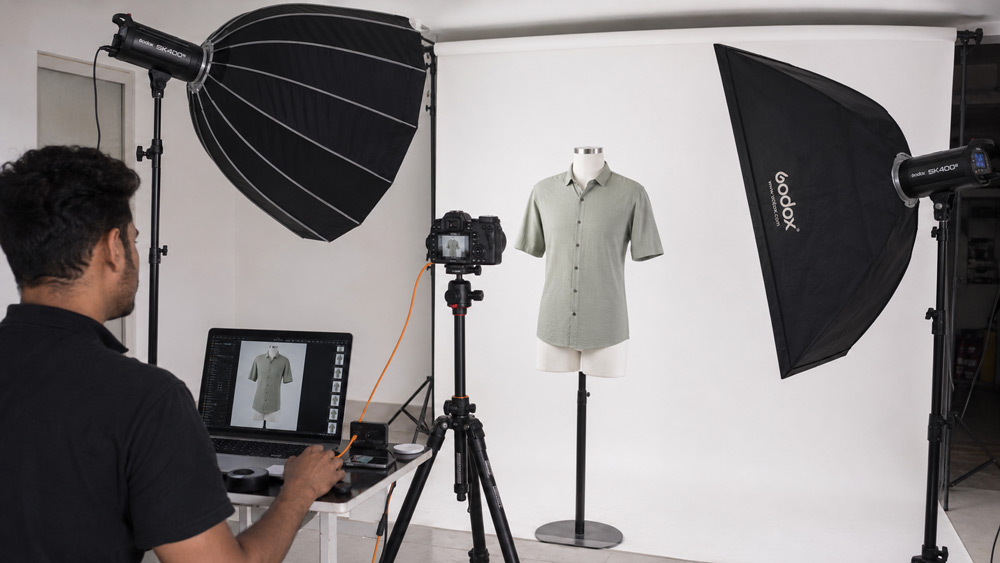
Every clothing SKU we shoot at Uniqs Studio moves through the same 8-angle apparel product photography framework, no matter the category. These angles cover marketplace compliance, fit visualisation, editorial storytelling and social-first content — so one shoot feeds every downstream channel. Below is the exact shot list our creative team hands to the photographer on Day 1 of a catalogue shoot. If you follow only one section of this guide, follow this one.
Notice how the shot list balances function (marketplace angles) with emotion (lifestyle and detail). This dual-purpose approach is what separates a compliant catalogue from a converting one. We built it after years of running large-scale garment photography for ecommerce projects and cross-checking listing performance data with clients.
Shot 1 — Front Hero Shot (Primary Marketplace Image)
The front hero is the primary marketplace image and does 60–70% of the click-through work. Shoot it straight-on, centred, on pure white (RGB 255,255,255) for Amazon, or on-model for Myntra/Ajio. Frame the garms with the full silhouette visible, ~10% negative space top and bottom. Keep the lens at chest height for ghost mannequin, at hip height for on-model. This one frame decides whether the buyer clicks your listing or the competitor’s.
Shot 2 — Back Full-Length Shot
The back shot reveals construction — yoke, pleats, back panel prints, embroidery, drop hem. Shoot at the same distance and lens as the hero for perfect angle consistency. This is a mandatory angle on Myntra and Ajio for most apparel categories. Missing this shot is one of the top reasons apparel listings get rejected on first upload.
Shot 3 — Left Side Profile
The left side profile shows drape, fit and volume — critical for A-line dresses, blazers, kurtas and oversized tees. Shoot at chest/hip height with the outfits perfectly steamed. On a ghost mannequin, use a small pin at the shoulder to hold the silhouette clean without wrinkles.
Shot 4 — Right Side Profile
The right side balances asymmetric details, side-slits, pocket placements and side-seam finishing. For SKU photography, always shoot both sides even if the garment looks symmetric — asymmetry only reveals itself on camera. This is one of the most-skipped shots we see in unstructured shoots.
Shot 5 — Ghost Mannequin / Invisible Mannequin Shot
The ghost mannequin (invisible mannequin) shot gives the garment 3D dimension without a human presence — no styling bias, no model licensing, pure product. It is the marketplace industry’s favourite hero format for shirts, kurtas, jackets, blazers and structured tops. Our team composites the neck, inner label and cuff separately during retouching to give the invisible mannequin effect its signature clean depth. Read the deeper breakdown in our ghost mannequin photography service page, and if you sell delicate categories, see our ghost mannequin guide for innerwear and loungewear.
Shot 6 — Flat Lay / Knolling Shot
The flat lay (or knolling) shot styles the garment flat with props, tags and accessories — perfect for Instagram, Pinterest and homepage banners. It works especially well for soft basics, kidswear, loungewear and accessory-heavy sets. Shoot top-down from a boom arm, natural or top-hard light, ivory or textured backdrop. Our flat lay photography team maintains a props library specifically for apparel styling.
Shot 7 — Detail & Texture Shots (Stitch, Trim, Fabric)
Detail shots are where premium brands separate themselves from basic sellers. Use a 90mm–100mm macro lens to capture stitch density, fabric weave, buttons, zippers, embroidery, prints and care labels. Buyers on Nykaa Fashion and premium D2C stores rely on these crops to judge quality before purchase. We usually shoot 2–4 detail crops per SKU depending on garment complexity. This is the reason our clients see fewer returns — the customer sees the fabric texture before they buy, not after they unbox.
Shot 8 — Lifestyle / On-Model Contextual Shot
The lifestyle shot places the outfit on a real model in a contextual environment — home, cafe, street, studio backdrop with props. This shot fuels Amazon A+ content, Instagram reels, ad creatives and D2C hero banners. It is emotion-first, not spec-first. For brands debating in-studio vs environmental backdrops, our comparison of fashion photography studio vs outdoor shoots breaks down the trade-offs.
📥 Download the Free Apparel Shot List PDF
The exact 1-page shot list our crew tapes to the shoot monitor. Print, tick, ship your catalogue.
Get it on WhatsApp →SKU-Type Shot List: Category-Wise Apparel Product Photography Requirements
A shirt and a lehenga are both clothing, but they need very different apparel product photography treatments. The number of shots, styling depth, lighting approach and post-production workload changes with the SKU category. Below is how Uniqs Studio adapts the master shot list for the five biggest apparel categories we shoot in Delhi NCR. This category logic is baked into every quote we send — attire complexity drives shot count, not garment count alone.
Menswear Shot List (Shirts, Trousers, Suits, Ethnic)
Menswear is structured and repeatable — perfect for ghost mannequin dominance. Shirts, trousers and blazers need 6–8 shots: front, back, both sides, ghost mannequin, one detail (collar/cuff/button), plus one styled lifestyle if the brand is D2C. Ethnic menswear like kurtas and sherwanis needs 8–12 shots with extra detail crops on embroidery. Our menswear crew ties into our broader male model photography team when on-model shots are on the list.
Womenswear Shot List (Dresses, Tops, Sarees, Kurta Sets)
Womenswear needs the deepest shot list — construction is more varied, drape matters more, and styling variations sell. A dress usually needs 8–10 shots; a saree 10–14; a kurta set 8–12. The shot list must include a movement/twirl frame for A-line and flared silhouettes. This is where a strong fashion photographer and stylist earn their rate — one poorly draped saree can flatten an entire listing. Our team routinely combines this workflow with dedicated model photography for hero campaigns.
Kidswear Shot List (Infants, Toddlers, Tweens)
Kidswear is flat-lay dominant because kid modelling adds cost, complexity and consent overhead. A typical infant/toddler SKU needs 6–8 flat lays with props (soft toys, blocks, bibs) plus one ghost mannequin on a mini form. For tween sizes, on-model becomes viable and drives conversions. Prop library, warm palette and clean cotton backdrops are non-negotiable for this category.
Innerwear, Loungewear & Activewear Shot List
Innerwear and loungewear demand the most modest, taste-sensitive shot list — ghost mannequin heavy, with detail crops on fabric weave, elastic finish and stitch. Activewear needs an extra motion/stretch shot to communicate performance. For Indian marketplaces, both categories must avoid over-suggestive framing. Uniqs Studio’s dedicated approach for these categories is documented in our innerwear ghost mannequin guide.
Bridal & Ethnic Heavy Garment Shot List
Bridal is the heaviest shot list: 12–18 shots per SKU including full on-model, close-up embroidery macros, back detail, dupatta styling, jewellery-paired frame, and often a video. Ghost mannequin alone rarely does justice to heavily embellished lehengas and bridal kurta sets. Our bridal ghost mannequin photography guide covers the hybrid workflow we recommend for this category.
Marketplace-Wise Shot List for Apparel Product Photography
Every Indian marketplace has its own quirks — hero background rules, aspect ratios, angle mandates and mannequin policies. One universal shot list, four export presets, is how our production team keeps things sane. Below is the practical shot list mapping we follow when a client sells across Amazon, Myntra and Flipkart at the same time. Get the framework right and you never re-shoot for a new channel — you just re-export.
Amazon India Apparel Shot List Requirements
Amazon India requires a pure-white background hero image (RGB 255,255,255), minimum 1000px longest side, product occupying 85% of the frame. Our recommended Amazon shot list: 1 front hero (white BG), 1 back, 2 sides, 1 ghost mannequin, 2 detail crops, plus 3–5 lifestyle/A+ images. Reference the official Amazon Seller Central image guidelines for the latest specs before every catalogue drop.
Myntra & Ajio Apparel Shot List Requirements
Myntra and Ajio prefer on-model imagery with a neutral seller-grey or off-white backdrop, model-facing standard poses, and 5–6 mandatory angles per SKU including a movement/walking frame for select categories. Ghost mannequin is accepted for select basics but not preferred as the hero. Model comp-cards must be pre-approved. Our team routinely aligns catalogues with Myntra’s partner portal style guide for zero-rejection uploads.
Flipkart, Meesho & Nykaa Fashion Shot List
Flipkart accepts both ghost mannequin and on-model hero, with a white or light-grey BG, and typically 4–6 angles per SKU. Meesho is the most flexible — front, back and one lifestyle work for most reseller SKUs. Nykaa Fashion is the strictest on premium execution — expect editorial-grade retouching, 8+ images per SKU and macro detail on fabric texture.
D2C Website (Shopify) Shot List Requirements
D2C stores give you creative freedom but also demand the deepest shot list — hero, back, side, ghost mannequin, flat lay, 2–4 detail crops, 2–3 lifestyle frames, plus a 360° spin or product video. Homepage banners and PDP cards need separate crops. Our approach mirrors what we recommend in our clothing photography for D2C playbook.
Apparel Shot Type Reference Table
| Shot Type | Purpose | Best For | Marketplace Fit |
|---|---|---|---|
| Front Hero | Primary click-through image | All SKUs | Amazon, Flipkart, Meesho |
| Back Full-Length | Construction & back detail | All SKUs | Myntra, Ajio (mandatory) |
| Side Profile (L/R) | Fit, drape, volume | Dresses, blazers, kurtas | Myntra, Ajio, D2C |
| Ghost Mannequin | 3D dimension, no model | Shirts, kurtas, jackets | Amazon, Flipkart, D2C |
| Flat Lay | Editorial, social | Basics, kidswear, sets | D2C, Instagram, Pinterest |
| Detail Macro | Fabric, stitch, trim | Premium, ethnic, bridal | Nykaa Fashion, D2C |
| Lifestyle On-Model | Emotion, A+ content | Fashion, ethnic, bridal | Amazon A+, D2C, ads |
| 360° Spin | Interactive fit view | Structured outerwear | D2C, premium ecommerce |
Ghost Mannequin vs Flat Lay vs On-Model: Which Shot Fits Your SKU?
This is the single most common question new apparel brands ask us. The honest answer: none of the three is universally best — each solves a different problem. Ghost mannequin sells fit and structure without model licensing. Flat lay sells editorial mood and works beautifully on Instagram. On-model sells context, aspiration and body-fit trust. The mature apparel brands we work with combine all three in one shot list, with the split decided by SKU category and channel. Our detailed comparison of ghost mannequin vs model vs flat lay covers the numbers.
Decision Matrix — When to Use Each Style
Use ghost mannequin for shirts, kurtas, jackets, blazers, dresses with structure. Use flat lay for basics, tees, kidswear, loungewear, accessory sets. Use on-model for lifestyle-driven categories — dresses, ethnic wear, bridal, activewear where fit and movement matter. When in doubt, ghost mannequin + one lifestyle covers 80% of use cases and controls budget. Our team frequently blends this with editorial vs commercial vs catalogue model photography depending on the brand tier.
Ghost Mannequin vs Flat Lay vs On-Model — Feature Comparison
| Feature | Ghost Mannequin | Flat Lay | On-Model |
|---|---|---|---|
| Relative Cost | ₹₹ | ₹ | ₹₹₹ |
| Turnaround | Fast | Fastest | Slower |
| Fit Visualisation | Strong | Weak | Strongest |
| Conversion Impact | High | Medium | Highest |
| Best SKU Type | Structured | Soft basics | Fashion, bridal |
| Marketplace Approval | Universal | Selective | Universal |
Pre-Production Checklist for Apparel Product Photography
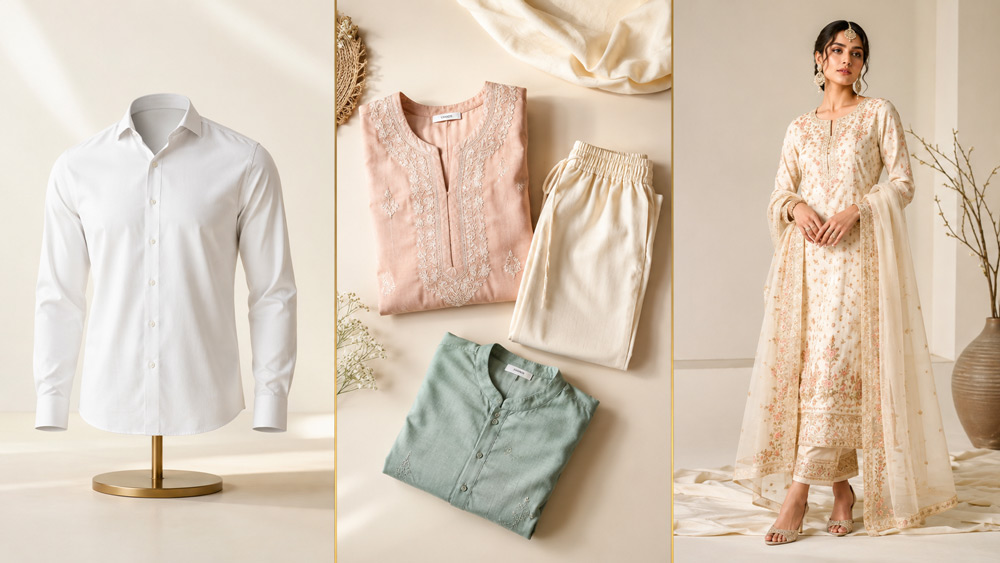
Half of every reshoot is caused by weak pre-production — under-steamed garms, wrong sample sizes, no comp cards, missing accessories. Our pre-shoot checklist below is what our production coordinator ticks off 48 hours before every catalogue day at Uniqs Studio. Following even 70% of it will visibly upgrade your outputs. This section pairs with our full model photoshoot preparation checklist when on-model shots are part of the plan.
Sample Preparation, Steaming & Styling
Every SKU must arrive steamed, tag-attached, size-verified and photographed dry (no perfume residue on delicate fabrics). Our stylists pre-pin shoulders on ghost mannequin forms, tape hidden hems, and prepare a per-SKU styling note. This one workflow change alone cuts on-set delays by 25–30%.
Studio Setup, Lighting & Tethered Shooting
Our lighting rig for apparel product photography uses 4× Godox SK 400II and 2× Elinchrom FRX 400 with 4 strip softboxes and 2 octaboxes for even, wraparound light, plus one beauty dish for on-model beauty crops. Everything is shot tethered to Capture One so the art director approves each frame live. Cameras: Canon R10 and Sony A7R V, with a 50mm for full-lengths and a 100mm macro for detail. Read more on our end-to-end approach in our garment photography services page.
Model Casting, Fit Approval & Comp Cards
For on-model SKUs, the model must be fit-approved on sample size (typically S or M) before the shoot day. Comp cards, measurement sheets and Aadhaar-linked booking are locked 48 hours prior. Our model photography portfolio guide walks through what a fit-ready comp card should include, and our casting-to-campaign guide covers the full booking flow.
Post-Production Checklist: From Raw Files to Marketplace-Ready Images
The shot list ends when the shutter clicks — the shot list result ends when the retoucher exports the final file. Post-production is where consistency is won or lost. Our post team follows a fixed sequence for every apparel product photography delivery, tuned to the marketplace or D2C stack the images will live on.
Clipping Path, Background Removal & Colour Correction
Every marketplace hero needs a clean clipping path and pure-white background. Colour correction is done against a physical grey card shot at the start of each SKU. We match sample-to-screen tolerance within 3%, which matters especially for solid-colour clothing where marketplace algorithms flag mismatches. This is baked into our default apparel workflow.
Retouching Standards for Fabric, Skin & Detail
Our retouching rule of thumb: fabric texture stays real, skin stays natural, wrinkles disappear only if unintentional. Over-retouched apparel imagery is one of the fastest ways to lose customer trust — which is why we always recommend real professional apparel product photography over AI-generated garment images. AI-generated attire fails on fabric truthfulness and causes returns; real photos build trust.
Image Export, WebP Optimization & File Naming Convention
Files are exported in JPG (marketplace) and WebP (D2C) with clear naming — brand_SKUcode_angle_variant.jpg. Aspect ratios per channel: 1:1 for Amazon, 3:4 for Myntra, 4:5 for Instagram. Correct file naming saves catalogue managers hours during bulk upload.
How Many Images Per SKU? The Uniqs Studio Recommended Framework
The direct answer: most ecommerce apparel SKUs need 6 to 10 images — front hero, back, side, ghost mannequin, flat lay, detail, and one lifestyle. Basic tees can ship with 4–6; premium and bridal SKUs may need 12–18. Listings with 6+ images convert 2× better than listings with 3 or fewer — this is consistently backed by marketplace analytics.
| SKU Category | Minimum | Recommended | Premium |
|---|---|---|---|
| T-Shirt | 4 | 6 | 8 |
| Shirt | 5 | 7 | 10 |
| Kurta / Kurta Set | 6 | 8 | 12 |
| Saree | 7 | 10 | 14 |
| Dress | 6 | 8 | 10 |
| Kidswear | 4 | 6 | 8 |
| Innerwear / Loungewear | 4 | 6 | 8 |
| Bridal Lehenga | 10 | 14 | 18 |
360° Spin & Video Requirements in Modern Apparel Product Photography
Marketplace search rankings and D2C conversion rates now favour listings with video and 360° spin. A 15–30 second product video showing fabric movement, drape and one styled walk lifts add-to-cart by 20–30% on premium apparel. Our video team pairs the still shot list with a matching video shot list on the same day so you get both without doubling the budget. Our ecommerce video production team handles this end-to-end.
Behind the scenes: how Uniqs Studio runs a full apparel product photography shot list on a catalogue day.
Apparel Product Photography Pricing in Delhi NCR (Per SKU Guide)
Apparel product photography in Delhi NCR typically ranges ₹399 to ₹1,499 per SKU depending on shots per garment, ghost mannequin inclusion, on-model requirements, retouching level and turnaround. Uniqs Studio serves brands across Delhi, Gurgaon, Noida, Faridabad and Ghaziabad. For a deeper cost breakdown, see our fashion photography cost guide.
Basic
₹399/SKU
- 4 shots per SKU
- Flat lay only
- 1 detail crop
- Basic retouching
- 5-day turnaround
- Marketplace formatting
Standard
₹799/SKU
- 6 shots per SKU
- Ghost mannequin + flat lay
- 2 detail crops
- On-model optional
- Standard retouching
- 3-day turnaround
Premium
₹1,499/SKU
- 10 shots per SKU
- Ghost mannequin + on-model
- 4 detail crops
- 360° spin included
- Advanced retouching
- 48-hour turnaround
Enterprise
Custom
- 12+ shots per SKU
- Full editorial + video
- 6 detail crops
- Bridal / heavy ethnic
- Editorial retouching
- Priority turnaround
Common Mistakes That Ruin Apparel Product Photography Shot Lists
Even experienced brands slip up. These are the top 6 shot list mistakes we see when new clients come to us for reshoots — usually after a catalogue rejection or a return-rate spike:
- No shot list at all — improvising on set kills consistency.
- Skipping the back shot — Myntra and Ajio reject the SKU.
- Using AI-generated garment imagery — customers spot the fabric fakery and return the item.
- Only one detail crop for premium categories — kills perceived quality.
- Wrong background for Amazon — anything but pure white 255 gets flagged.
- No steaming on the sample — wrinkles cost hours in retouching or force a reshoot.
Why Brands Choose Uniqs Studio for Apparel Product Photography
At Uniqs Studio, Satyam and the team have delivered 50,000+ SKUs across Delhi NCR — from single-founder D2C labels to marketplace catalogue sellers running 500-SKU seasonal drops. Our shot list, workflow and retouching stack were built for one thing: catalogues that convert. If you want to compare notes on your next drop, we are one call away. See how brands work with us across clothing brand fashion photography and read how good imagery moves the needle in our post on how fashion photography increases clothing sales.
📸 Ready to shoot your next apparel catalogue?
Talk to Satyam directly. 15-minute call, honest advice, transparent per-SKU pricing.
Frequently Asked Questions About Apparel Product Photography Shot Lists
Founders and catalogue managers ask us these five questions every week. Straight answers below.
What is a shot list in apparel product photography?
A shot list is a pre-planned checklist of every camera angle, styling detail and image variation needed for a clothing SKU — front, back, side, ghost mannequin, flat lay, detail and on-model — used to ensure consistent, marketplace-ready apparel product photography.
How many images are needed per apparel SKU for ecommerce?
Most ecommerce apparel SKUs need 6 to 10 images — a front hero, back, side, ghost mannequin, flat lay, detail and one lifestyle shot. Premium and bridal SKUs may require 12 to 18 images.
What is the best shot list for Amazon, Myntra and Flipkart apparel listings?
For Indian marketplaces, the ideal shot list includes a white-background front hero, back, both sides, a ghost mannequin, a detail close-up and one lifestyle image — meeting Amazon, Myntra, Flipkart, Ajio and Nykaa Fashion specifications.
Ghost mannequin or flat lay — which is better for apparel product photography?
Ghost mannequin is better for structured garments like shirts, kurtas and jackets because it shows fit and dimension. Flat lay works best for soft basics, kidswear and accessories. Most brands use both in their shot list.
How much does apparel product photography cost per SKU in Delhi NCR?
Apparel product photography in Delhi NCR typically costs ₹399 to ₹1,499 per SKU depending on shots per garment, ghost mannequin, on-model requirements, retouching level and turnaround time. Contact Uniqs Studio at +91-8076745824 for a custom quote.
Conclusion & Next Steps
A great apparel product photography shot list is not glamorous — it is boring, printed, taped to the monitor and ticked with a pencil. That is exactly why it works. Get the 8 non-negotiable angles right, map them to your marketplace, pre-produce properly and post-produce with discipline. Do that consistently and your catalogue starts converting harder while your reshoot bills drop. If you want the Uniqs Studio team to run this playbook for your next clothing drop in Delhi NCR, we are ready when you are.