
Saree photography for ecommerce is the hardest apparel brief we shoot, and also the one that pays back fastest when it is done right. A saree is six yards of unstitched fabric, so a buyer cannot judge it from a folded packshot: they need to see how it falls when draped, how the pallu opens, how wide the border is and whether the zari really shines. That is why we treat it as a specialised branch of on-model fashion photography rather than a simple product shoot.
In this guide, Satyam and the team at Uniqs Studio share the exact process we use in our Kalkaji studio in Delhi for saree brands, ethnic wear sellers and D2C labels: how to prepare and drape a saree, which shooting method suits your catalogue, the 10 shots every listing needs, and how to light silk, cotton, georgette and organza without losing colour. After 9+ years of ecommerce production for 500+ D2C brands and marketplace sellers, these are the rules we follow on every saree catalogue.
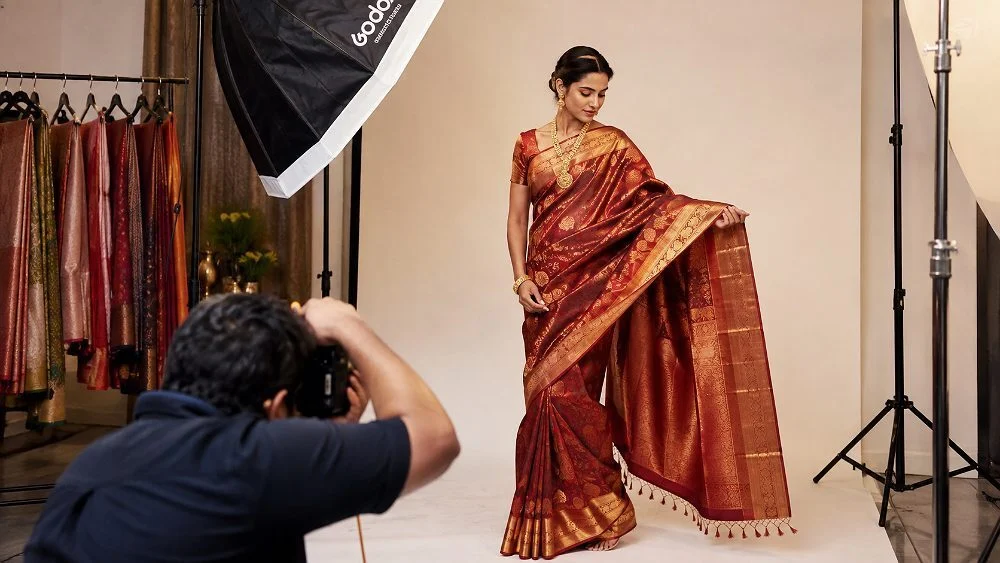
- Saree photography for ecommerce must show drape, pallu, border and blouse piece, not just colour.
- Steam, pre-pleat and pin the saree before the model steps on set; preparation decides most of the final look.
- Use a model for the hero images, then add ghost mannequin or flat lay shots for consistency and detail.
- Shoot a fixed 10-image set per saree so every listing in the catalogue looks uniform.
- Light zari and silk from the side with large soft sources and colour-check every frame against the real fabric.
What makes saree photography for ecommerce different from other apparel?
A saree has no fixed shape until it is draped, so the photographer has to create the garment’s shape on set. Good saree photography for ecommerce therefore combines styling skill (pleats, pallu, pinning) with product accuracy (true colour, readable border, visible fabric texture).
A kurta or a shirt looks broadly the same on every body. A saree changes completely with the drape, the length of the pallu, the width of the pleats and even the way the model holds her arm. Two sellers can list the identical Banarasi saree and get very different results, simply because one photo shows a stiff, bunched drape and the other shows smooth pleats and an open pallu with the motifs facing the camera.
There is also more information to communicate. A buyer wants to know the body colour, the border colour and width, the pallu design, whether a blouse piece is included and what it looks like, the fabric weight and the sheen. That is at least five separate visual questions, and a single front image cannot answer all of them. This is why saree product photography needs a planned image set rather than one hero photo.
Why is saree photography for ecommerce linked to returns?
In our experience, most saree returns come from three gaps between the photo and the parcel: colour that looked different on screen, a border that turned out narrower than expected, and fabric that felt lighter or shinier than the image suggested. Every one of these is a photography problem. When the listing shows a true-colour detail shot, a full-length border and a close-up of the weave, the buyer’s expectations match what arrives.
How should you prepare a saree before the photoshoot?
Steam the full six yards, finish the fall and pico, iron the blouse piece separately and pre-fold the pleats before the model arrives. A well-prepared saree drapes in ten minutes; an unprepared one can take forty and still look creased on camera.
Preparation is where most of the quality in saree catalogue photography is actually created. Silk and tissue sarees hold fold lines from packing, and those sharp creases show up badly under studio lights. We steam from the inside of the fabric, keep the steamer moving and never press zari directly with a hot iron, because metallic threads can dull or pucker.
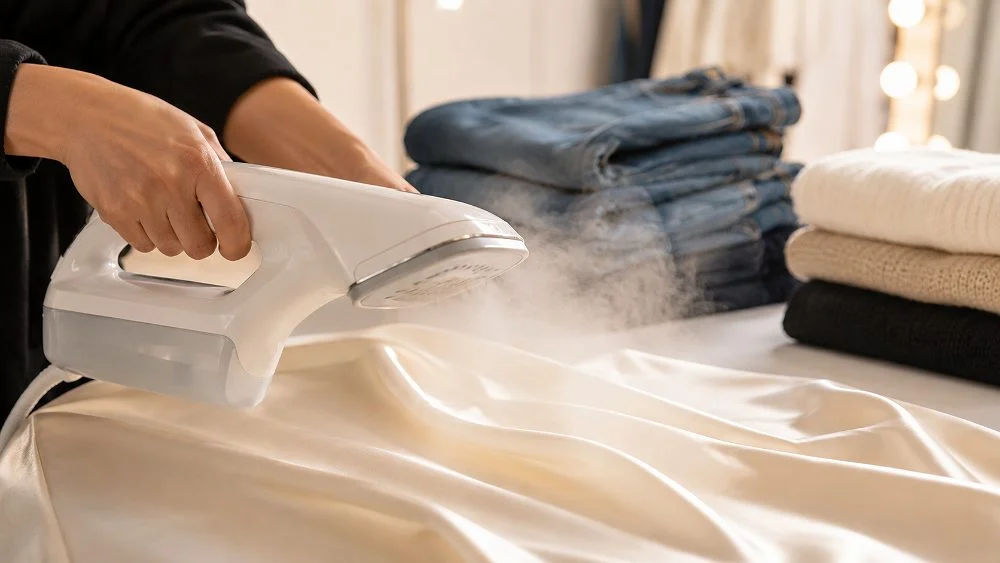
- Check the saree length and finish. Confirm the fall is stitched and the pico edging is done. An unfinished edge flares and curls in the pleats.
- Separate the blouse piece. If the blouse piece is attached, note where it is cut so it can be shown in its own detail image.
- Steam in sections. Body first, then pallu, then border. Hang the saree on a rack for 15 minutes so the fabric settles.
- Pre-fold the pleats. Fold 5–7 even pleats on a table and hold them with two clips so the stylist only has to tuck and pin on set.
- Prepare the base. A matching or neutral petticoat and a fitted plain blouse keep the drape smooth and stop bunching at the waist.
If your team ships garments to us, our garment preparation guide explains packing, labelling and steaming in more detail. For sarees, we also ask brands to send one spare plain blouse in the model’s size, because a well-fitted blouse changes how the whole drape looks.
Which saree draping style works best for a product photoshoot?
For most ecommerce listings, a neat Nivi drape with an open, pinned pallu works best because it shows the body, pleats, border and pallu in one frame. Regional drapes are lovely for campaign images, but they hide parts of the saree that buyers need to see.
Saree draping for photoshoot work is not the same as draping for an event. At a wedding, the goal is comfort and grace through the day. On set, the goal is to show the product clearly in a still image, so we exaggerate a few things: the pleats are flatter and more even, the pallu is longer and spread wider, and everything is pinned so the fabric does not shift between frames.
How many pleats look best in saree photography for ecommerce?
We usually fold 5 to 7 front pleats of equal width, roughly four fingers wide each. Fewer pleats look sparse; more pleats make the front look bulky on camera. The pleat edges should line up from waist to hem, and the stylist checks them after every pose change because they shift as the model moves.
Which pallu styles should a saree model shoot include?
- Open pallu over the arm: the pallu is spread over the forearm so the full design faces the camera. This is our default for the second image.
- Pleated pallu on the shoulder: neat, formal and good for showing the border running down the back.
- Back pallu fall: the pallu hangs straight down the back, used for the back view to show its length and end design.
Where should the pins go?
Pin the pleats at the waist, the pallu at the shoulder, and add one hidden pin under the arm if the pallu is spread open. Pins should never be visible in the final image. Our retouching team removes small marks, but a pin that pulls the fabric creates a visible ripple that is hard to fix later, so placement matters on set.
Model, ghost mannequin or flat lay: which method fits your saree catalogue?
Use a live model for hero and drape images, because a saree only shows its true fall on a body. Add mannequin or flat lay shots when you need consistent, budget-friendly detail images across a large catalogue.
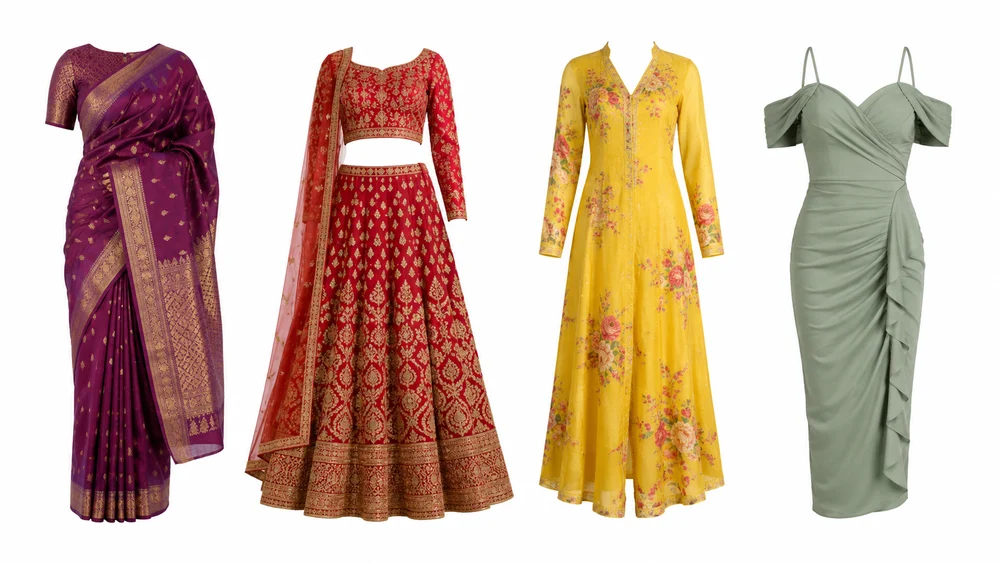
Most saree brands we work with use a mix for their saree photography for ecommerce. The model images sell the look; the supporting images sell the details. A draped saree on a dress form is a good middle option for large catalogues of everyday cotton or printed sarees, and ghost mannequin shoots for apparel keep every SKU at the same angle and scale, which makes a category page look organised.
| Method | Best for | Shows drape? | Watch out for |
|---|---|---|---|
| Live model | Silk, designer, wedding and festive sarees; hero images | Yes, fully | Needs a skilled stylist and fitted blouse |
| Mannequin drape | Large catalogues of cotton, printed and daily-wear sarees | Partly | Drape can look stiff without careful pinning |
| Flat lay / fold | Border, pallu and blouse piece detail; packaging shots | No | Cannot be the only image type |
| Hanging / spread | Showing full length and pallu design | No | Needs a tall backdrop and wide lens distance |
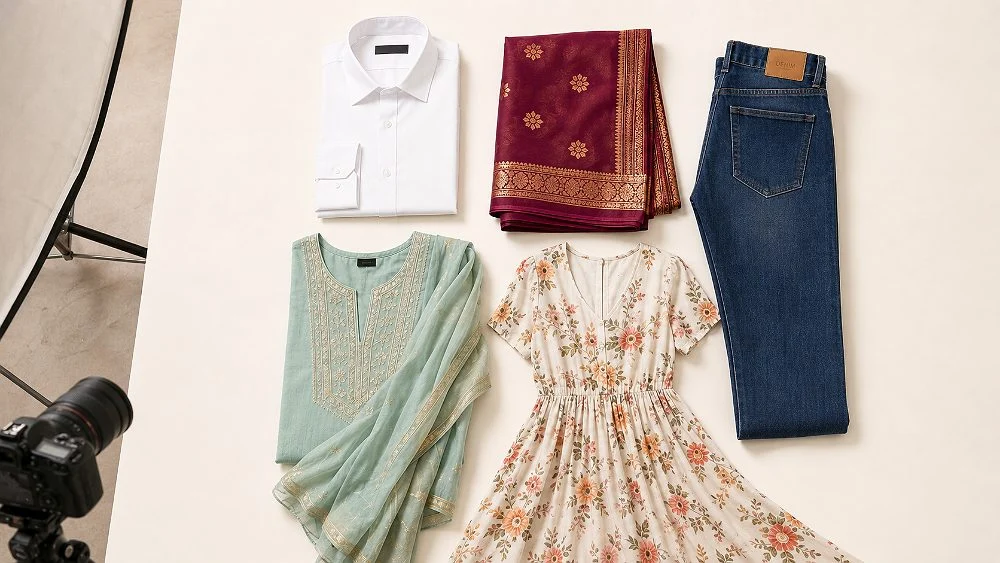
For the folded and spread shots, top-down flat lay photography gives a clean view of the border, the pallu end and the blouse piece side by side. We fold the saree so that the pallu design and the border sit on top, and we place the blouse piece slightly overlapping, never hidden underneath.
What are the 10 shots every saree listing needs?
A complete saree listing answers every visual question a buyer has: overall look, drape, pallu, border, blouse, fabric and scale. These 10 shots are the set we shoot for each saree, in the order we recommend uploading them.
In saree photography for ecommerce, not every marketplace shows all ten images on the first screen, but the order still matters, because buyers swipe in sequence. Start with the shots that sell the look, then move to the ones that remove doubt. This structure follows the same thinking as our wider ecommerce fashion shot list, adapted for unstitched drapes.
- Full-length front, draped. Model faces the camera, pleats straight, pallu on the shoulder. This is the main image and the one that must be colour-perfect.
- Open pallu, three-quarter angle. Pallu spread over the forearm so the full design faces the lens.
- Back view. Shows the pallu fall, its length and the border running down the back.
- Side or walking pose. Gives a sense of movement and how the fabric flows.
- Pallu close-up. The pallu design filling most of the frame, flat and in focus.
- Border close-up. A straight section of border with a little body fabric, so buyers can judge its width.
- Fabric texture macro. The weave, the zari, the print or the embroidery at close range.
- Blouse piece. Either the stitched blouse on the model or the unstitched piece shown flat.
- Folded flat lay. The saree folded with border and pallu on top, the way it will arrive.
- Short video or reel. A 20–30 second clip of the model turning and opening the pallu.
The tenth “shot” is a video because a saree’s fall and sheen are easier to judge in motion. A short clip of the model turning once and lifting the pallu answers questions that still images cannot, especially for silk and tissue sarees.
How do you shoot a pallu close up shot that shows real detail?
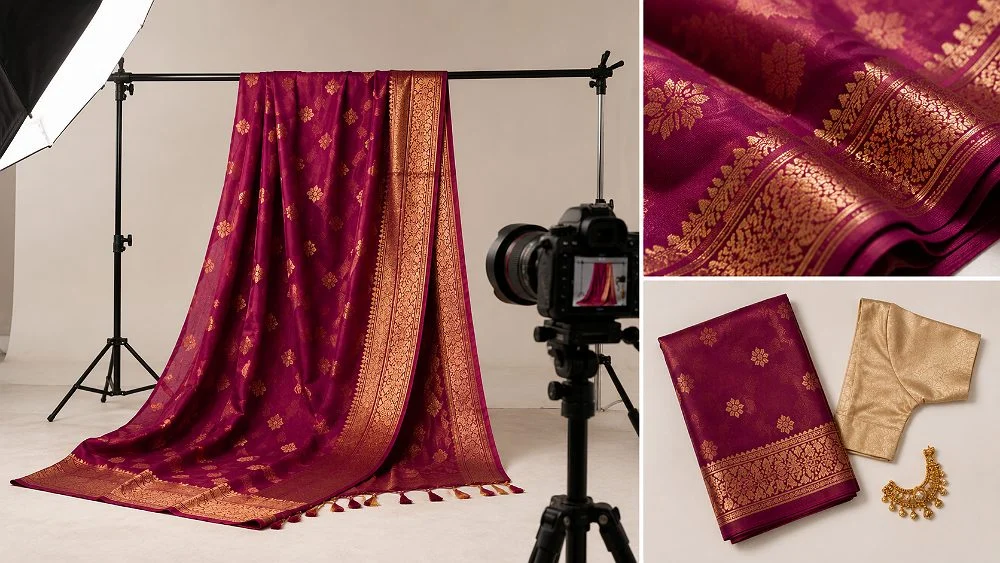
Lay or hang the pallu flat, light it from the side with a large soft source so the weave and zari catch the light, and keep the camera exactly parallel to the fabric. A good pallu close up shot is sharp edge to edge and shows true colour, not glare.
The pallu is usually the most decorated part of the saree and the part buyers zoom into. If the image is soft, tilted or washed out by reflections, the buyer assumes the work is cheaper than it is. We shoot pallu details on a clean surface or a vertical board, smoothing the fabric with clips at the back so nothing ripples.
How do you photograph zari without glare?
Zari is metallic, so a light placed straight on will turn it into white hotspots. We place a strip softbox at a low side angle so the light rakes across the threads, then use a white bounce card on the opposite side to lift the shadows. Rotating the fabric a few degrees often changes zari from flat to glowing, so we test two or three angles before locking the shot.
How do you keep saree colours accurate?
Every saree shoot at our studio starts with a grey card or colour chart in the first frame under the final lights. Our editors correct the whole set from that reference and then compare the screen with the physical saree under daylight-balanced light. Magentas, rani pinks, teal and bottle green drift most often, so we check those colours twice.
How should you light silk, cotton, georgette and organza sarees?
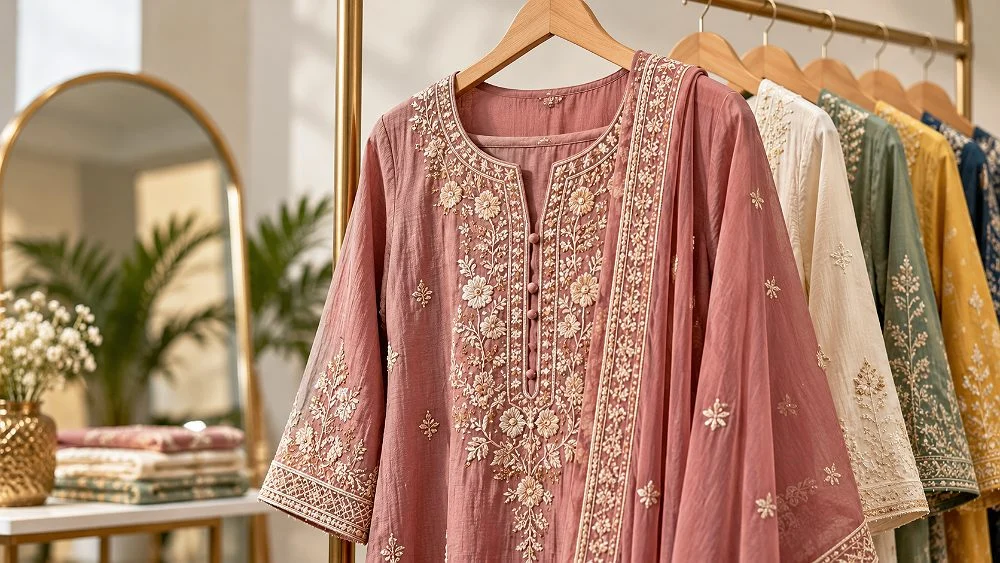
Match the light to the fabric: soft side light for silk and zari, broad even light for cotton and prints, and backlight or rim light for sheer georgette and organza. One lighting setup for every saree is the fastest way to make half your catalogue look flat.
In our studio we work with large strip softboxes, octaboxes and a beauty dish for model shoots, and we adjust their position for each fabric family. The table below is the starting point we use; the final setup is always tuned after a test frame on the actual saree.
| Fabric | Light setup | What it reveals | Risk to avoid |
|---|---|---|---|
| Banarasi, Kanjeevaram silk | Large soft key at 45°, strip light from the side | Sheen, zari, weave depth | Hotspots on zari, colour shift in deep reds |
| Cotton, handloom | Broad, even front light with fill | Print clarity, texture | Flat, lifeless look if too frontal |
| Georgette, chiffon | Soft key plus a gentle rim light from behind | Flow, translucency | Fabric looking cheaper if see-through is hidden |
| Organza, tissue | Backlight or side light, low power | Sheer layers, glow | Blown highlights and lost edges |
| Embroidered, sequinned | Raking side light, small fill | Raised work, sparkle | Sequins flaring into white spots |
How much styling and jewellery should a saree photo have?
Keep styling minimal and supportive: simple earrings, a slim bangle or two and neat hair that keeps the neckline and shoulder clear. The saree must remain the hero; heavy jewellery and dramatic makeup belong in campaign images, not catalogue listings.
A saree model shoot for ecommerce is a balance. With no styling at all, a festive silk saree can look plain and under-valued. With too much, the buyer starts looking at the necklace instead of the border. We usually choose jewellery in the same metal tone as the zari (gold with gold, silver with silver) and keep the hair in a low bun so the pallu on the shoulder stays visible.
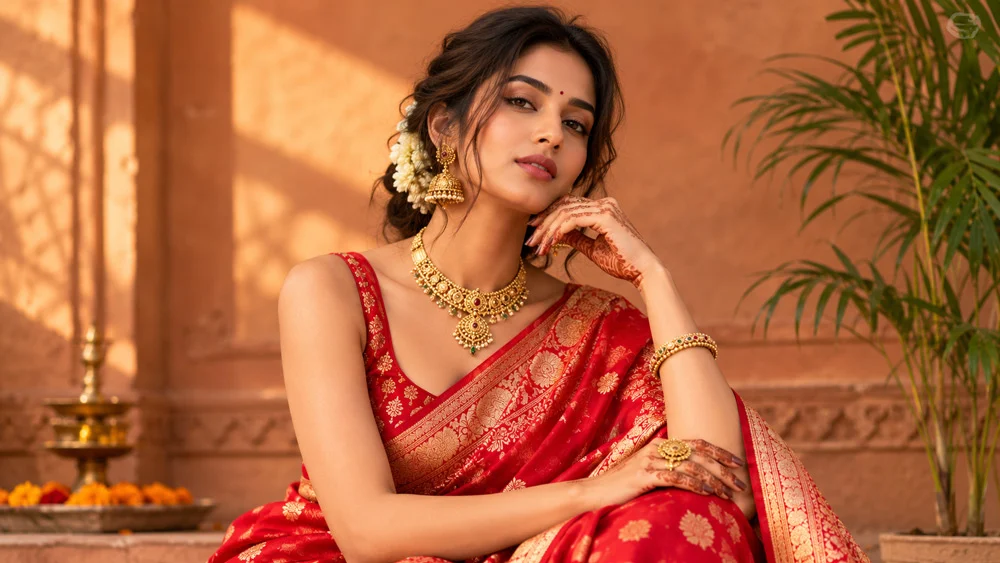
- Catalogue images: plain or white background, minimal jewellery, natural makeup, neutral footwear hidden by the hem.
- Lifestyle or A+ images: warmer backgrounds, props like a brass diya or florals, fuller jewellery.
- Blouse styling: show the actual blouse piece where possible; a mismatched blouse misleads buyers.
What do Amazon, Myntra and Meesho expect from saree images?
Most Indian marketplaces want a clean main image with the product filling the frame, no added text, watermarks or collages, and true colour. Supporting images can show details, styling and fabric. Always check the latest category guidelines in your seller panel, because they change.
Each platform words its rules differently, and they are updated from time to time, so treat your seller dashboard as the final reference. If you sell on Amazon, the image requirements inside Amazon’s seller programme explain main-image background and size rules for the clothing category. For Myntra and Meesho, the catalogue upload panels list current dimensions and the QC checks that most often reject images.
What stays constant is the buyer. Across platforms, saree shoppers zoom into the pallu and border, compare colour with the reviews and look for a draped image before they decide. A listing built on the 10-shot set above covers all three marketplaces with only small crops and exports. If you also sell handloom sarees, the government’s India Handloom Brand programme is worth knowing, and a close-up of the weave helps support genuine handloom claims visually.
What mistakes make saree listings look cheap or cause returns?
The biggest mistakes are uneven pleats, a hidden pallu, colour drift, no border or blouse detail and only one image per saree. Each one either lowers perceived value or creates a gap between the photo and the parcel.
- Bunched pleats and a creased drape: the saree looks worn or low quality even when it is new.
- Pallu folded away: the most decorated part of the saree never appears in the listing.
- Over-saturated colour: “brightening” photos in editing is a common cause of colour-related returns.
- No scale reference: a border close-up with no body fabric makes width impossible to judge.
- Mixed backgrounds and angles: a catalogue shot over different days without fixed settings looks inconsistent.
- Using the same blouse for every saree: buyers expect the blouse shown to match the blouse piece they receive.
If your current catalogue has several of these problems, you do not always need a full reshoot. Often the main image is fine, and adding the pallu, border and fabric close-ups is enough to lift the listing. This is something Satyam reviews with brands on a quick call before quoting.
How much does a saree photoshoot for online selling cost?
At Uniqs Studio, model photography is ₹400 per product for 5–6 angles, and supporting ghost mannequin, flat lay and video work is priced per image or product as listed below. Your final cost depends on how many sarees you shoot and which image types you need.
For a typical saree photoshoot for online selling, brands combine model photography for the draped images with flat lay or mannequin images for details, and add a reel or garment video for the hero styles in the collection.
| Shoot type | Images | Turnaround | Price |
|---|---|---|---|
| Model Photography | 5–6 angles | 4–5 days | ₹400 / product |
| Ghost mannequin | 1 angle | 3–4 days | ₹250 / image |
| Flat lay | 2–3 angles | 6 days | ₹290 / product |
| Jewellery (ring, earring) | 2–3 angles | 4–5 days | ₹300 / product |
| Ecommerce Reels Video | 20–25 seconds | 4–5 days | ₹900 / product |
| Garment Video with Model | 25–30 seconds | 4–5 days | ₹1,200 / garment |
Prices are per product/image as listed; call or WhatsApp +91-8076745824 for bulk catalogue quotes.
Planning a festive or wedding collection? Call Satyam on +91-8076745824 or send your saree list on WhatsApp at +91-8076745824, and the team will suggest the right image mix for your budget.
Should you use AI model images instead of a real saree shoot?
For sarees, real photography is still the safer choice. AI tools struggle with pleat structure, pallu fall, border continuity and zari patterns, and any invented detail becomes a reason for a return.
AI-generated model images can look convincing at thumbnail size, but sarees expose their weaknesses quickly. Generated drapes often have pleats that merge, borders that change width halfway down, or motifs that do not match the real weave. When a buyer opens the parcel and the pallu looks different, the trust loss hurts your ratings as well as that one order.
Our advice to saree brands is simple: use real photos of the real saree for every listing image, and treat AI as a planning tool at most, for example to test background colours before a shoot. Real ethnic wear product photography remains the strongest proof of quality you can give an online buyer.
What should your saree shoot checklist include?
Before any saree photography for ecommerce begins, confirm the preparation, styling, shot list and export settings in one checklist. It keeps every saree in the collection consistent and avoids reshoots.
- Fall and pico finished; saree steamed and hung for 15 minutes
- Blouse piece identified; matching fitted blouse and petticoat ready
- Pleats pre-folded and clipped; safety pins and clips on set
- Drape style agreed (Nivi, open pallu, back fall)
- Grey card frame shot under final lights
- 10-shot list printed and ticked for each saree
- Camera height, lens and distance fixed for shots 1–4
- Jewellery and footwear chosen to match zari tone
- Colour checked against the physical saree before export
- Exports sized for each marketplace and named by SKU
If you are building a bigger catalogue with kurtas, lehengas and sarees together, our fashion catalogue photography guide shows how to keep framing and colour consistent across categories.
Which saree photography trends matter in 2026-2027?
Short vertical videos, honest fabric close-ups and consistent catalogue framing are the trends that matter most for selling sarees online in 2026-2027. Buyers increasingly expect to see the saree move before they buy.
- Reels-first listings: 9:16 clips of a model turning and opening the pallu are now standard for festive collections.
- Macro weave shots: buyers of silk and handloom sarees zoom in to check authenticity.
- Pre-stitched and ready-to-wear sarees: these need extra images showing how they are worn and fastened.
- Neutral, soft-toned backgrounds: warm off-white and beige backdrops for lifestyle sets, white for main images.
The common thread is honesty. Saree photography for ecommerce works best when every image shows the real product more clearly, not more dramatically. That is the standard we hold ourselves to at Uniqs Studio, because a buyer who sees the real saree clearly is far less likely to feel it was “not as shown”.
Frequently asked questions about saree photography for ecommerce
Quick answers to the questions saree brands and ethnic wear sellers ask us most often.
We recommend 8 to 10 images per saree: full-length front, open pallu, back view, a side pose, pallu, border and fabric close-ups, the blouse piece, a folded flat lay and a short video where the platform allows it.
For silk, designer and festive sarees, yes, because only a draped saree shows the real fall and pallu. For large catalogues of everyday cotton or printed sarees, mannequin drapes plus flat lay detail shots are a practical, consistent alternative.
Use plain white or very light grey for the main image, as most marketplaces prefer it. Warm off-white, beige or soft-toned sets work well for lifestyle and A+ style images that show the saree in context.
Light zari from a low side angle with a large soft source, add a white bounce card opposite, and rotate the fabric slightly until the metallic threads glow without white hotspots.
Model photography is ₹400 per product for 5–6 angles with a 4–5 day turnaround. A garment video with model is ₹1,200 per garment, and an ecommerce reels video is ₹900 per product.
Yes. Brands across India courier their sarees to our Kalkaji studio in New Delhi, and we also shoot on location in Delhi, Gurgaon, Noida, Faridabad and Ghaziabad. Email [email protected] with your list to plan the shoot.
What is the next step after planning your saree shoot?
Once your shot list and image mix are clear, the next step is preparing the model, garments and schedule for shoot day. A well-planned day keeps every saree consistent and saves hours of reshoots.
Use our model photoshoot preparation checklist to organise casting, blouses, jewellery and timings before you book. If you would rather have our team handle everything, from draping to final exports, share your collection details on our contact page or email [email protected].
Uniqs Studio is an in-house ecommerce, fashion and product photography and video studio in Kalkaji, New Delhi, open Mon–Sat, 10 am–7 pm. Call Satyam on +91-8076745824, WhatsApp +91-8076745824 or write to [email protected].
Book a Saree Shoot Call +91-8076745824- Lehenga Photography for Ecommerce: Can-Can, Dupatta and Flare Shots
- Silk Saree Close-Up Photography: Macro Techniques for Handloom Brands
- Pre-Stitched Saree Photography: How to Show Fit and Fastening
- Saree Reels for Instagram and Marketplaces: 12 Video Ideas
- Kurta Set Photography for Ecommerce: Dupatta Styling and Detail Shots