
A kurti photoshoot for ecommerce is not a fashion editorial. It is a sales tool that has to answer a buyer’s questions in five or six frames: what is the length, where does the slit start, how does the dupatta fall, is the print the same colour as the photo? At Uniqs Studio we plan every kurti catalogue the same way we plan our on-model fashion photography for women’s ethnic wear: one clear shot list, one styling plan per piece, and lighting that keeps the fabric true.
This guide is written for kurti and ethnic wear brands and for marketplace sellers who list on Myntra, Amazon or Meesho. Satyam, who has run Uniqs Studio’s in-house studio in Delhi for more than 9 years, breaks down the 10 shots that sell, how to style a three-piece kurta set with a dupatta, which poses work, and the mistakes that quietly cause returns. If you already know your garments are ready, our garment preparation steps before a fashion shoot will save you a re-shoot day.
Key takeaways
- Plan the shot list before the shoot: a kurti listing needs a clean front, back, side, detail and styled frame at minimum.
- Shoot every kurta set twice: once with the dupatta draped, once without, so the kurta print and neckline are never hidden.
- Use poses that show length, slit and flare, not dramatic editorial poses that fold the fabric.
- Lock colour with a grey card and tethered capture; colour mismatch is one of the most common reasons buyers return ethnic wear.
- Add a short garment video so buyers see fall and movement before they order.
What should a kurti photoshoot for ecommerce achieve?
A kurti photoshoot for ecommerce should show the buyer the exact garment they will receive: true colour, real length, fabric texture and how every piece of the set looks when worn. Good kurti photography reduces doubt, so it lifts clicks on the listing grid and cuts returns after delivery.
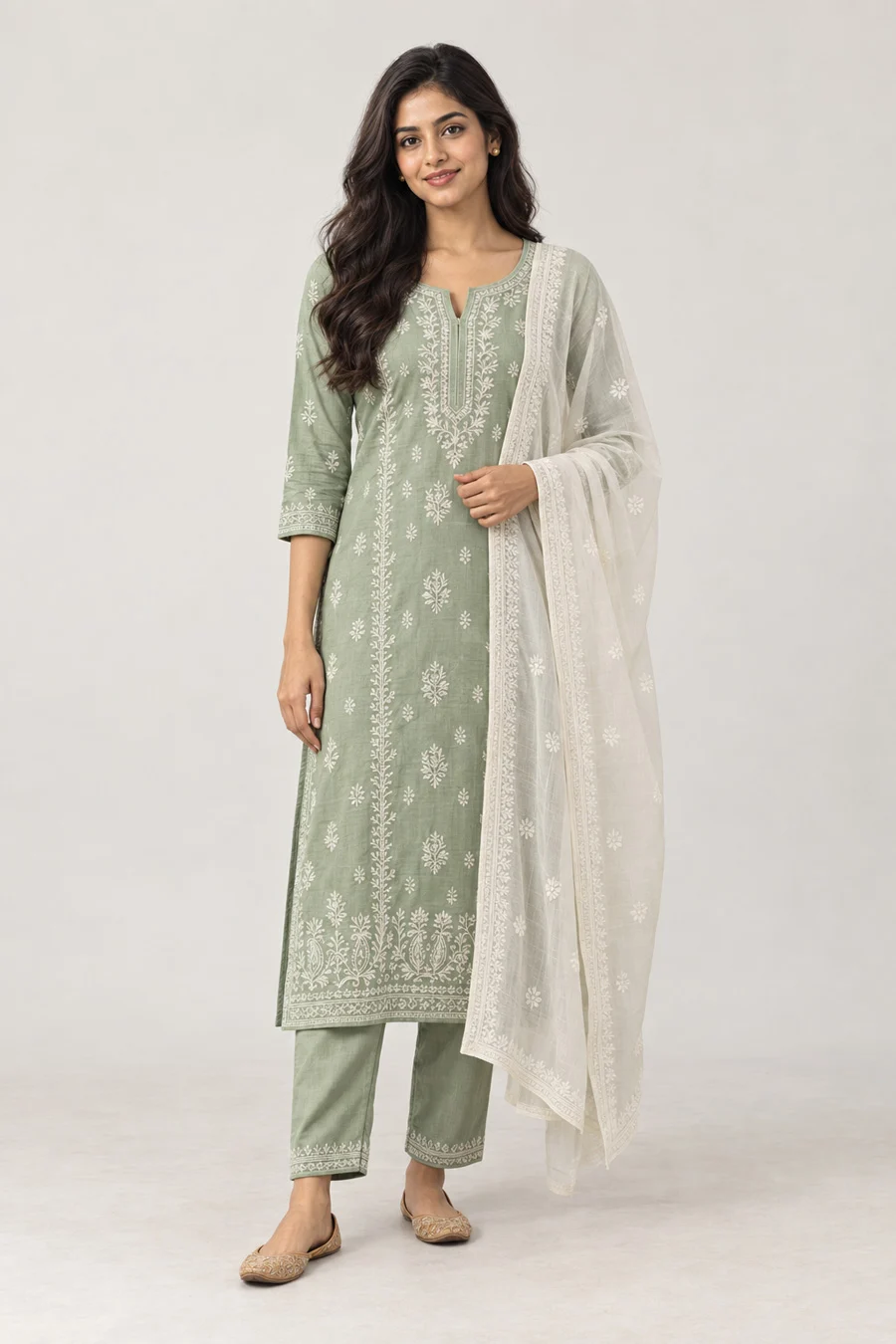
Think of the listing as a fitting room. A buyer scrolling a category page on Myntra or Meesho sees one thumbnail; if that thumbnail shows a cropped hem or a dupatta covering the yoke, she has no reason to tap. Once she does tap, the gallery has to answer the questions a shop assistant would: “Is it calf-length or knee-length?”, “Is the dupatta chiffon or cotton?”, “Does the print continue on the back?”
That is why we treat kurti product photos as information first and mood second. Mood matters for the hero image and for ads, but the supporting frames must be plain, honest and consistent across every SKU in the catalogue. When colourways of the same style are shot with identical framing, the listing grid looks like a brand, not a pile of uploads.
Marketplaces set the technical floor. Amazon’s product image requirements on Seller Central ask for a main image on a pure white background with the product filling most of the frame, while fashion-first platforms prefer portrait frames on a light, even backdrop. Meesho’s QC has its own rules too, which we covered in the Meesho image rules for passing catalogue QC. Your shoot plan has to meet the strictest platform you sell on.
How is kurti photography different from other garment shoots?
Kurti photography is different because most kurtis are sold as sets with two or three pieces, and the dupatta can either sell the look or hide the product. Kurtis also depend on details such as yoke embroidery, side slits, sleeve length and hem borders that a single front frame cannot show.
A western top is usually one piece shot in three angles. A kurta set is a kurta, a bottom (straight pants, palazzo, salwar or sharara) and often a dupatta. Each piece has its own fabric and sometimes its own print. If the photographs only show the outfit as a whole, the buyer cannot judge the bottom’s width or the dupatta’s border, and that uncertainty becomes a “not as expected” return.
- Length matters more: kurtis range from short tunic to ankle-length anarkali, so every listing needs one uncropped full-length frame.
- Silhouettes vary: straight, A-line, anarkali, kaftan and angrakha cuts need different poses to show their shape.
- Details sell: mirror work, gota patti, thread embroidery and hand block prints need macro detail shots.
- Fabric drape: rayon, cotton, chanderi and georgette each fall differently, which is why ethnic wear ecommerce photography needs movement or video.
We follow the same discipline here that we use for sarees, but with a different shot list. A saree is about the drape and pallu; a kurti photoshoot for ecommerce is about the set, the fit and the finishing details. Treating them the same is one of the most common planning mistakes we see from new ethnic wear brands.
Which 10 shots should every kurti photoshoot for ecommerce include?
Every kurti listing should have a full-length front, back, side, a three-quarter angle, a styled dupatta frame, a no-dupatta frame, two detail close-ups, a bottom-wear frame and a movement shot. Together these ten frames answer almost every question a buyer asks before ordering.
Not every marketplace displays ten images, so we shoot all ten and then pick the best five to seven for each platform. The extra frames are not wasted; they feed your website, Instagram and ads. Here is the kurti photoshoot shot list we work from at Uniqs Studio.
| # | Shot | What it answers | Where to use |
|---|---|---|---|
| 1 | Full-length front, dupatta draped | The complete look and set | Main/hero image |
| 2 | Full-length front, no dupatta | Kurta print, neckline, yoke | Image 2 |
| 3 | Full-length back | Back print, zip or tie-up, hem | Image 3 |
| 4 | Side profile | Length, slit height, fit | Image 4 |
| 5 | Three-quarter angle | Silhouette and flare | Image 5 or ads |
| 6 | Neckline and yoke close-up | Embroidery, buttons, finish | Detail slot |
| 7 | Sleeve and hem border close-up | Lace, gota, print border | Detail slot |
| 8 | Bottom-wear frame (waist to feet) | Pant or palazzo width, hem | Set listings |
| 9 | Dupatta spread or held open | Dupatta border and size | Set listings |
| 10 | Movement or twirl frame | Fabric fall and flare | Gallery, reels, ads |
Shot 2 is the one most sellers skip and later regret. When the dupatta is draped over both shoulders in every frame, the yoke embroidery you paid for is invisible. Shot 8 matters for kurta sets because buyers often care as much about the palazzo or pant as the kurta. For a broader view across categories, our ecommerce fashion shot list for apparel shows how this structure adapts to other garments.
How many images should a kurti listing show?
Use at least five images per listing and ideally seven: shots 1, 2, 3, 4 and 6 are the minimum. If the platform allows video, a 20 to 30 second clip does more for fabric-led kurtis than two more still frames. We usually pair the gallery with short garment videos shot on the same day, so lighting, styling and model stay identical across stills and video.
How do you style a kurta set and dupatta for the camera?
Style a kurta set by fitting the kurta first, then the bottom, and only then adding the dupatta in a drape that reveals the neckline. Shoot the main frame with the dupatta and repeat key angles without it, so buyers see both the full look and the kurta’s own design.
On set, our stylist fits the kurta with small back clips so the side seams sit straight and the hem falls evenly. Clips never show from the front, and we note how much was pinned so the size chart stays honest. A garment that is pinned to look two sizes smaller is a return waiting to happen, so we only correct the drape, never the fit.
Which dupatta styling works best for a photoshoot?
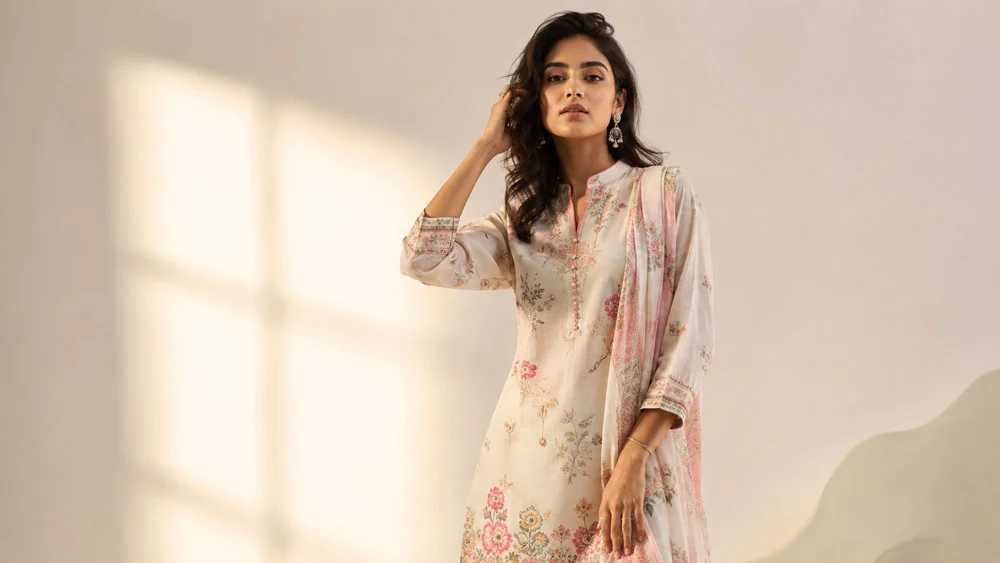
The right dupatta styling for a photoshoot depends on the fabric and the neckline. Sheer dupattas look best on one shoulder so light passes through; heavy dupattas with borders work best held open so the border is visible. Here is how we choose:
| Drape | Best for | Shows | Avoid when |
|---|---|---|---|
| One-shoulder fall | Chiffon, organza, net | Neckline + dupatta texture | Embroidery is on the shoulder |
| Both shoulders, open front (U-drape) | Printed cotton and mulmul | Full yoke and dupatta border | Kurta has a busy yoke |
| Held open behind arms | Bordered or heavy dupattas | Full dupatta size and border | Model looks stiff; keep arms relaxed |
| Neck wrap (front V) | Casual sets and lifestyle frames | Styled, everyday look | Main image; it hides the kurta |
| Over the forearm | Festive and anarkali sets | Kurta flare + dupatta together | Dupatta is plain and dull |
How should the bottom wear be styled in a kurta set photoshoot?
In a kurta set photoshoot the bottom must be pressed, hemmed to the model’s height and visible to the ankle. Palazzos need a slight step or walk pose so their width shows; straight pants look best in a still front pose with feet hip-width apart. Footwear should be plain juttis or nude flats so nothing pulls attention from the hem.
Jewellery stays minimal for catalogue frames: small studs or jhumkas that match the set’s tone. Heavy necklaces cover the neckline, and bangles clatter in video. For lifestyle frames we can style more freely, but the catalogue set always comes first.
Which kurti model poses help sell more?
The best kurti model poses are simple standing poses that keep the garment flat to the camera: a relaxed front stance, a soft three-quarter turn, a side profile and a gentle walk. Poses that cross arms, bend sharply or sit on the floor fold the fabric and hide the length.
Our direction on set is “relaxed, not posed”. The model keeps her shoulders level and arms slightly away from the body, so the kurta’s side seams are visible. A small weight shift onto one leg adds life without twisting the hem. For anarkalis and A-lines we add a slow half-turn so the flare opens up naturally.
- Front stance: feet hip-width, arms loose, chin level. Used for shots 1 and 2.
- Three-quarter turn: body 30–45 degrees from camera, face toward lens. Shows silhouette.
- Side profile: one hand lightly on the hip only if it does not lift the hem. Shows slit and length.
- Back view: hair moved to one shoulder so the back neckline and ties are visible.
- Walk-in: two slow steps toward camera for palazzo and flared sets.
- Dupatta reveal: arms opened gently at waist height so the dupatta spreads.
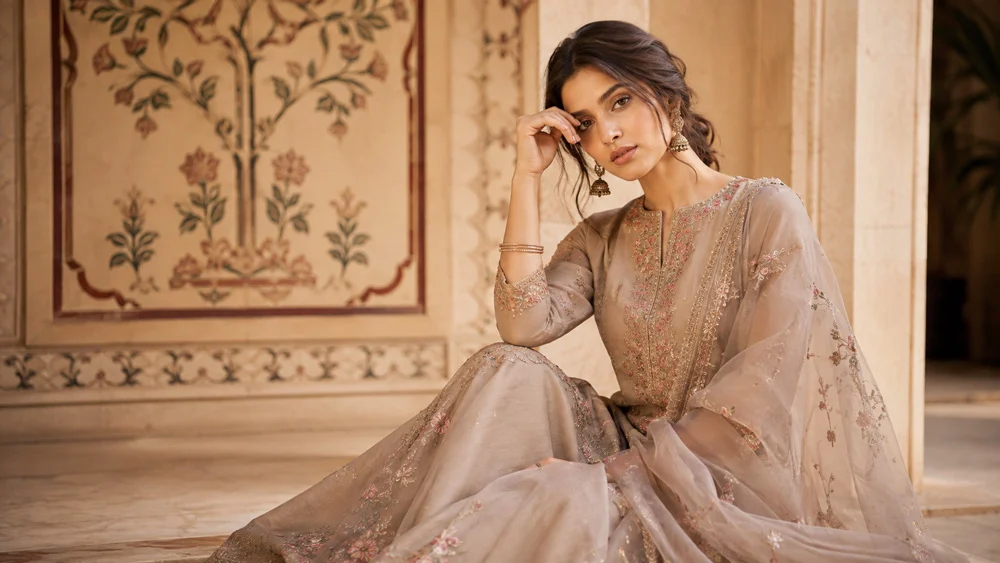
Seated and editorial poses have a place, but in the campaign set, not the product gallery. We have seen festive listings where the main image was a beautiful seated frame and buyers still asked, “What is the length?” in the reviews. The fix is simple: keep the editorial frame for ads and banners, and lead the gallery with a full-length standing frame.
How should you light and set up the studio for kurti product photos?
Light kurti product photos with large soft sources, a white or light grey seamless backdrop and a fixed camera height, so every SKU looks consistent. Soft, even light keeps prints accurate and shows embroidery without harsh shadows or hot spots on shiny fabrics.
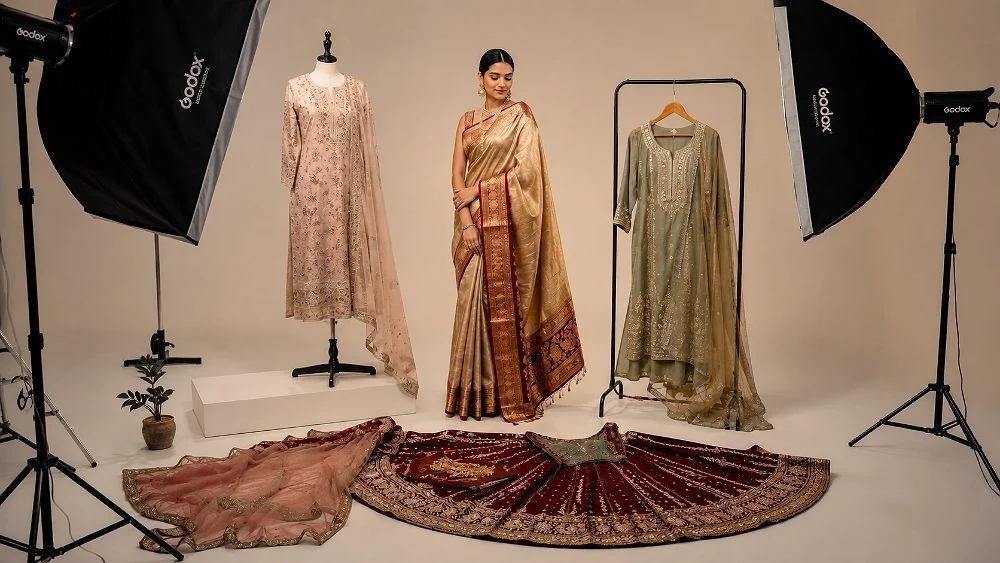
Our standard kurti setup uses a large octabox as the key light at about 45 degrees, two strip softboxes behind the model to separate her from the backdrop, and a white bounce on the fill side. For festive fabrics with zari or sequins, we lower the key light’s power and add a second diffusion layer so the metallic work sparkles without blowing out.
Which camera settings work for a kurti catalogue shoot?
For a kurti catalogue shoot we work on full-frame mirrorless bodies with a 50mm or 85mm lens at f/8 to f/11, so the whole kurta stays sharp from neckline to hem. ISO stays at base, and the camera height sits around the model’s waist so lines do not distort. Every frame is tethered to a laptop so the stylist and client can check the drape before we move on.
- Grey card: one reference frame per lighting change, so colour can be matched in editing.
- Marked floor: tape marks for the model’s feet keep framing identical across colourways.
- Locked settings: same white balance, aperture and distance for the whole catalogue.
- Crop ratio: shoot with headroom so you can export both 3:4 portrait and square crops.
When should you choose ghost mannequin or flat lay instead of a model?
Choose a ghost mannequin when you need consistent, budget-friendly shots of many kurti SKUs, and choose flat lay for styled set compositions and social media. Use a model for the main images of fashion-led kurtis, where fit and drape decide the sale.
Many ethnic wear brands mix all three. A new collection’s bestsellers get a model shoot; basic colourways of the same pattern get ghost mannequin shots that keep the shape without a model fee per style. Flat lays then fill the website’s “complete the set” and Instagram needs.
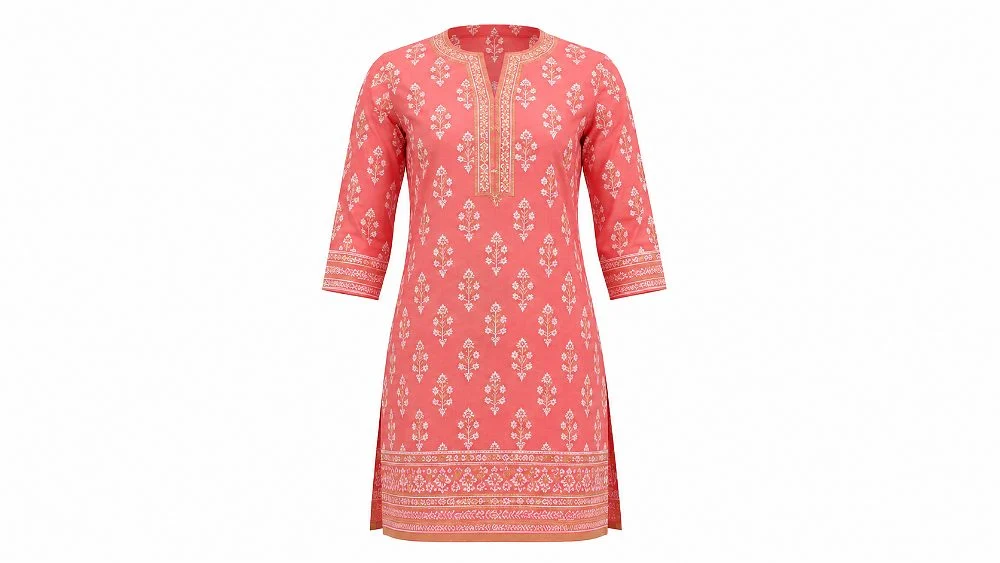
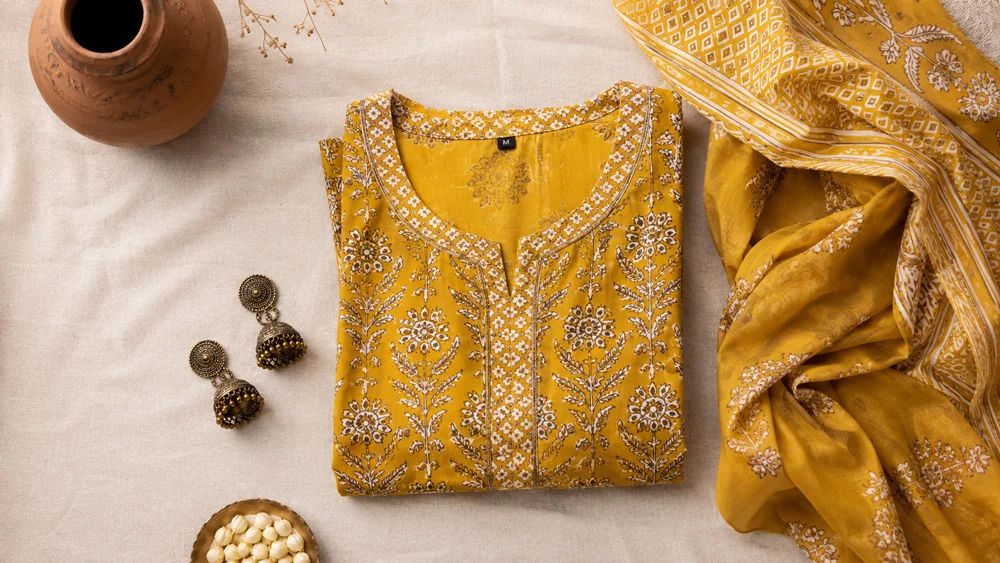
| Method | Best for | Strength | Limitation |
|---|---|---|---|
| On-model | Hero images, new collections, festive sets | Shows fit, drape and length | Higher cost per style |
| Ghost mannequin | Large catalogues, basic colourways | Consistent, clean, scalable | No movement or styling |
| Flat lay | Sets, website banners, Instagram | Shows all pieces together | Does not show fit |
A practical split we often suggest to kurti brands: shoot the top 20 percent of styles on a model, shoot the remaining colourways on a ghost mannequin, and use flat lays for festive gifting banners. The listing stays consistent, and the budget goes where it moves sales.
How do you plan a kurti photoshoot for ecommerce step by step?
Plan the shoot in seven steps: build the SKU sheet, prepare garments, fix the shot list per category, set lighting, shoot with tethered review, edit to a colour reference, and export platform-ready files. Following the same order every time keeps quality consistent across collections.
- SKU sheet: list every style, colour, size sample and which pieces come in the set. Mark hero styles that need extra frames.
- Garment prep: steam every kurta, bottom and dupatta, remove tags and loose threads, and keep one spare piece for close-ups.
- Shot list per category: straight kurtis, anarkalis and three-piece sets each get their own list from the 10-shot table above.
- Lighting and marks: set the octabox, rim lights and floor marks, then shoot a grey card frame.
- Tethered shooting: shoot each SKU in the same order, checking drape, clips and hem on the laptop after every angle.
- Editing: match colour to the physical garment under daylight-balanced light, clean creases and remove clips, keep texture natural.
- Export: deliver white-background and light-grey versions in each platform’s ratio, named by SKU and angle.
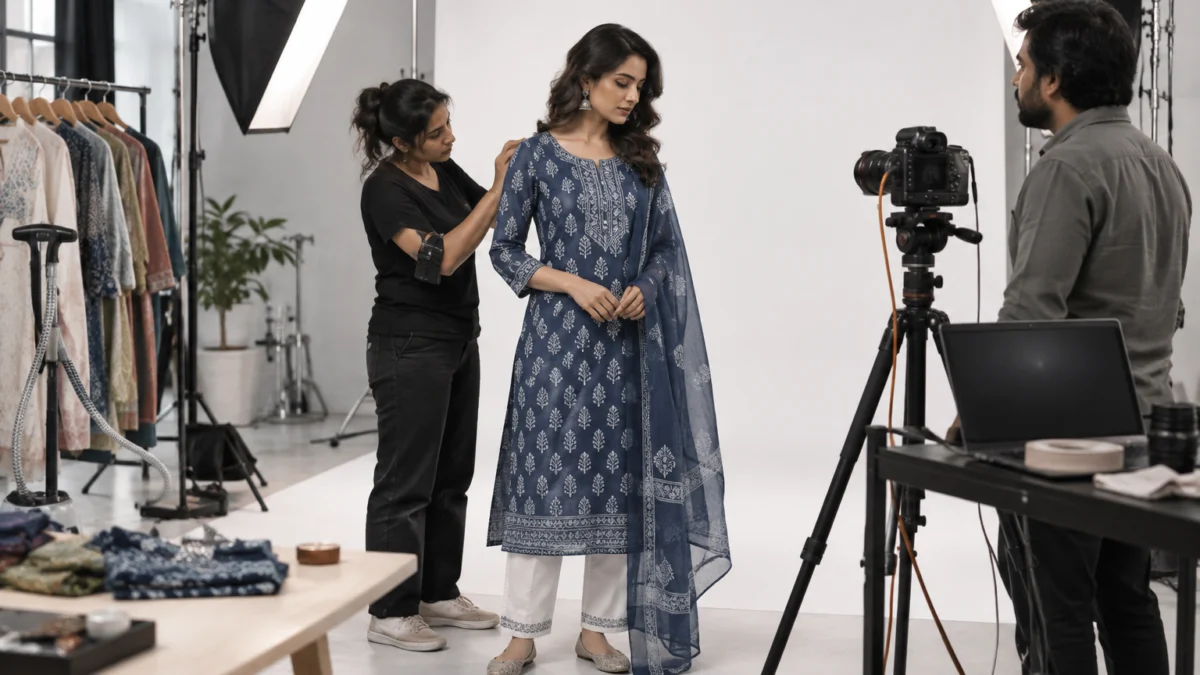
Step 2 is where most shoot days are won or lost. A crushed dupatta takes longer to fix in editing than to steam on set, and creases on rayon kurtis show up badly under soft light. Our team at Uniqs Studio steams every piece just before it goes on the model, not the night before.
What mistakes make kurti listings fail QC or get returned?
The most damaging mistakes are colour that does not match the real fabric, a dupatta that hides the kurta in every frame, cropped hems, and heavy editing that changes the fit. Each one creates a gap between the photo and the parcel, and that gap becomes a return.
- Colour drift: warm room lights or over-saturated edits turn mustard into orange and teal into green.
- Hidden kurta: no frame without the dupatta, so buyers never see the neckline or yoke.
- Cropped length: the main image cuts off at the knee, so buyers guess the length.
- Over-pinning: clipping the kurta so tight that it looks a size smaller than it is.
- Mixed backdrops: one colourway on white, another on beige, making the catalogue look untidy.
- Mismatched set: styling a kurta with a different bottom than the one actually sold in the set.
- AI-replaced models: AI outfits often redraw prints and borders, so the product no longer matches the parcel.
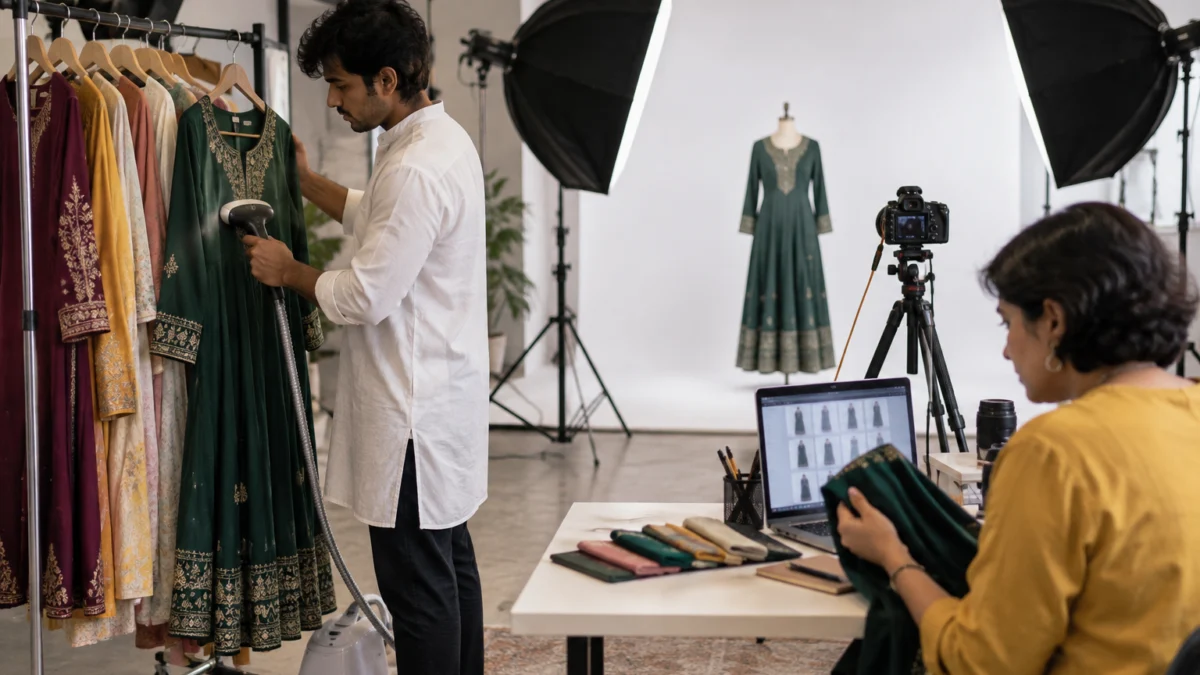
Colour is the big one for ethnic wear. Buyers choose kurtis by colour first, so a shade mismatch feels like receiving the wrong product. We compare each edited frame against the physical garment under daylight-balanced light before export. Real garments photographed honestly will always beat an AI-generated model image that redraws the print. A size chart photographed or measured on the same sample adds one more layer of trust.
Planning a kurti or kurta set catalogue? Share your SKU count and Satyam’s team will suggest the right mix of model, ghost mannequin and video. Call +91-8076745824 or WhatsApp +91-8076745824.
How much does a kurti photoshoot for ecommerce cost at Uniqs Studio?
At Uniqs Studio, model photography for a kurti is ₹400 per product for 5–6 angles, ghost mannequin is ₹250 per image and flat lay is ₹290 per product. Reels and garment videos with a model are priced separately per product or garment, as shown in the table below.
| Shoot type | Images | Turnaround | Price |
|---|---|---|---|
| Model Photography | 5–6 angles | 4–5 days | ₹400 / product |
| Ghost mannequin | 1 angle | 3–4 days | ₹250 / image |
| Flat lay | 2–3 angles | 6 days | ₹290 / product |
| Ecommerce Reels Video | 20–25 seconds | 4–5 days | ₹900 / product |
| Garment Video with Model | 25–30 seconds | 4–5 days | ₹1,200 / garment |
Prices are per product/image as listed; call or WhatsApp +91-8076745824 for bulk catalogue quotes.
For a full quote, email the SKU sheet to [email protected] or call +91-8076745824. We shoot at our studio in Kalkaji, New Delhi, and work with brands across Delhi, Gurgaon, Noida, Faridabad and Ghaziabad.
What should be on your kurti photoshoot checklist?
Your checklist should cover garments, styling, shot list, technical settings and delivery. Tick every item before the model steps on set, and the shoot day runs on time with no re-shoots.
- All kurtas, bottoms and dupattas steamed, tags removed, threads trimmed
- SKU sheet with style code, colour and pieces in each set
- Shot list per category (straight, A-line, anarkali, three-piece set)
- Dupatta drape chosen for each set; no-dupatta frame planned
- Neutral footwear and minimal jewellery ready
- Grey card frame shot; white balance and aperture locked
- Floor marks for consistent framing across colourways
- Detail shots of neckline, sleeves and hem border for every style
- Video plan: which styles get a reel or garment video
- Export sizes and file naming agreed for each marketplace
Search engines read your images too. Descriptive file names and alt text help kurti product photos show up in Google Images, as explained in Google’s image SEO best practices. Name files by style and angle, never “IMG_4521”.
Frequently asked questions about kurti photoshoots
These are the questions kurti brands and marketplace sellers ask Uniqs Studio most often before booking a shoot. Each answer is short enough to act on today.
Use at least five: full-length front, front without dupatta, back, side and one neckline detail. Seven images plus a short video is ideal for fashion-led kurtis and kurta sets.
Use a model for hero styles and festive sets where fit and drape decide the sale. Use a ghost mannequin for large catalogues and basic colourways where consistency and cost matter more.
Shoot the main frame with the dupatta draped on one shoulder, repeat the front without the dupatta, add a waist-to-feet frame for the bottom, and one frame with the dupatta held open to show its border.
A pure white background suits Amazon main images, while a light grey or off-white seamless works well for fashion marketplaces. Pick one and keep it identical across the whole catalogue.
Model photography is ₹400 per product for 5–6 angles, ghost mannequin is ₹250 per image and flat lay is ₹290 per product. Garment video with a model is ₹1,200 per garment.
Not reliably. AI tools often redraw prints, borders and embroidery, so the image stops matching the real kurti. Real photos of the actual garment build trust and reduce returns.
What is the next step after planning your kurti shoot?
The next step is to lock the shoot-day plan: model brief, styling list, timings and approvals. With the shot list from this guide and a clear preparation plan, your kurti photoshoot for ecommerce can be booked and finished in one organised day.
Next step: work through our model photoshoot preparation checklist to finalise the model brief, styling kit and shoot-day timeline. When you are ready, Uniqs Studio can take the kurtis from steamer to marketplace-ready files. You can also reach the Uniqs Studio team with your SKU sheet for a plan.
Ready to shoot your kurti collection?
Call Satyam on +91-8076745824, WhatsApp +91-8076745824 or email [email protected]. Studio: 1800/9, Kalkaji Extension, Kalkaji, New Delhi 110019 · Mon–Sat, 10 am–7 pm.