
Kids Model Photoshoot for Clothing Brands 2026-2027: Casting, Parent Consent, Short Shoot Slots & 9 Shots That Sell Kidswear
A kids model photoshoot is the fastest way to show parents how a frock, a co-ord set or a tiny kurta actually fits, moves and feels on a real child. Get it right and your listing answers the three questions every parent asks before buying: will it fit, will it be comfortable, and will my child look happy in it? At Uniqs Studio we plan these shoots as part of our model photography for kidswear, and the difference between a calm, productive shoot and a tearful, wasted day almost always comes down to preparation.
In this guide Satyam, who has led ecommerce shoots for more than 9 years and for 500+ D2C brands and marketplace sellers, walks you through casting, parent consent, child-friendly shoot slots and the nine kidswear on-model images that actually move product. Whether you sell on Amazon and FirstCry or run your own D2C store, this kids model photoshoot plan keeps the child comfortable and your catalogue consistent.
- Cast for size and temperament, not just looks: a child who fits the sample size and enjoys the set saves hours.
- Get written parent consent and follow India’s child-artist rules on hours, rest and a parent being present.
- Plan short shoot slots by age with breaks, and shoot the hero image first while energy is high.
- Lock a 9-shot list per style so every SKU looks consistent across your catalogue.
- Use real children for fit-critical images; AI child models cannot prove how a garment sits on a real body.
What is a kids model photoshoot, and why should clothing brands use real kids?
A kids model photoshoot is a planned studio session where children aged roughly 1–12 wear your samples and are photographed in a fixed set of catalogue angles. Brands use it because parents buy kidswear on fit, comfort and mood, and only a real child can show all three honestly.
Kidswear is a trust category. Parents cannot try the garment on the child before ordering, so they read every image for clues: is the neckline soft, does the frock flare when she spins, is the waistband elastic or fixed? Clear kidswear on-model images answer those clues before a buyer has to ask, which is why marketplace sellers often see fewer size-related returns once they move from mannequin-only listings to real on-model sets.
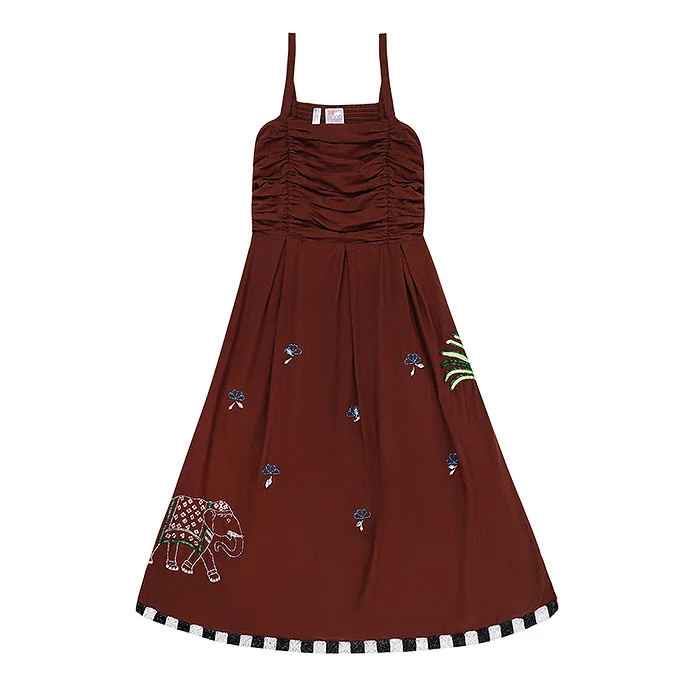
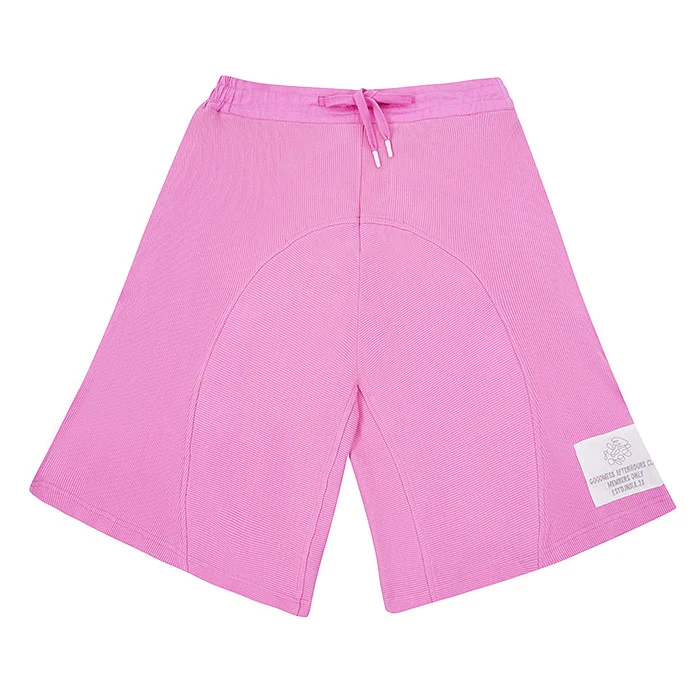
The garment-only image above is still essential; it is usually your marketplace main image. But it cannot show length on a five-year-old or how the shoulder straps sit. That is the job of the kids model photoshoot, and the two formats work best together rather than as replacements for each other.
Why does a kids model photoshoot differ from an adult model shoot?
Children have short attention spans, legal working-hour limits and a parent on set, and sample sizes change every year of age. Everything that is optional on an adult shoot — breaks, snacks, a quiet corner, toys near the camera — becomes part of the plan. The upside is that kids give natural, unposed expressions that adult models struggle to fake, and those expressions are exactly what parents respond to.
How do you cast child models for a kids clothing photoshoot?
Cast by sample size first, then by comfort in front of a camera, then by look. Ask parents for recent full-length photos with height and age, and run a short video or in-person meet so the child sees the studio before shoot day.
Most kidswear brands make samples in one or two “fit sizes”, commonly 4–5 years for girls’ and boys’ ranges and 1–2 years for infant and toddler lines. Your child model must fit that sample cleanly; a garment pinned at the back on a child is far more visible than on an adult. Ask agencies or parents for height, chest and waist measurements taken in the last month, because children outgrow their portfolio photos quickly.
- Size match: measure against your sample spec sheet, not the age label alone.
- Temperament: a quick meet tells you whether the child is curious or anxious around lights.
- Range diversity: cast 2–3 children for a large drop so one tired child doesn’t stop the day.
- Brand fit: match the look to your buyer — festive ethnic wear, everyday cotton basics or party wear each need a different energy.
- Availability: book around school hours and exams; weekend morning slots usually work best.
If you already run adult on-model fashion shoots, the casting process will feel familiar, but treat the parent as part of the booking. They decide whether the child is comfortable, and a relaxed parent usually means a relaxed child. Our broader model photoshoot preparation checklist covers the adult-side planning that still applies here.
Agency child models or friends-and-family kids?
Agency children are used to sets, follow direction and usually come with a parent who knows the routine, so they save time on large catalogues. Friends-and-family children can work for a small capsule, but plan extra time and still follow the same written consent and working-hour rules. Never cast a child simply because they were available; a poor size match costs more in retouching than it saves.
| Casting factor | What to ask for | Why it matters |
|---|---|---|
| Age & size | Age, height, chest, waist (this month) | Sample must fit without visible pinning |
| Experience | Previous shoots or a short phone video | Predicts how quickly the child settles |
| Look | Natural full-length photos, no filters | Shows real skin tone and hair for styling |
| Availability | School timings, exam weeks | Avoids tired, rushed afternoon slots |
| Parent | Who will accompany, contact number | A guardian must be present throughout |
What parent consent and permissions do you need for a child model shoot?
You need written consent from a parent or legal guardian before the shoot, a parent or guardian present on set, and compliance with India’s rules on children in the audio-visual and advertising industry. Treat it as a checklist, not a formality, and confirm the details with your own legal advisor.
India’s child labour law was amended in 2016 to allow children to take part in audio-visual entertainment, including advertisements, only under conditions set by the government’s rules. Those rules, published by the Ministry of Labour and Employment, cover permission from the district authority, limits on daily working hours with rest breaks, school not being affected, and a portion of the child’s earnings being kept aside for them. The National Commission for Protection of Child Rights has also issued guidelines on child participation in the entertainment industry. Brands, agencies and studios should read the current versions rather than relying on hearsay.
What should a child model consent form include?
A clear child model consent form protects the child, the parent and your brand. Keep it simple, in plain language, and signed before anyone steps on set.
- Child’s name, age and the parent or guardian signing on their behalf.
- Shoot date, studio address, planned start and finish time, and planned breaks.
- Exactly where images will be used: marketplace listings, your website, social media, print or ads.
- Usage period and whether the brand can reuse images in future campaigns.
- Fees, payment timing and how the child’s share is handled.
- The parent’s right to pause or stop the shoot at any moment if the child is uncomfortable.
- No changing in front of the crew: a private changing area and the parent helps with outfits.
How long should each kids model photoshoot slot be?
Keep slots short and age-based: toddlers do best in blocks of about 45–60 minutes, young children in roughly 90-minute blocks, and older kids in up to two-hour blocks, always with breaks in between. Shoot the most important image first, while the child is fresh.
These are planning guidelines, not promises; every child is different, and the legal limits on daily hours and continuous work without rest always come first. A toddler model shoot needs the most flexibility. Many toddlers are at their best right after a nap and a snack, so ask the parent about the child’s routine and book around it rather than around your crew’s convenience.
| Age group | Suggested block | Outfits per block | Break plan |
|---|---|---|---|
| 1–3 years (toddler) | 45–60 min | 3–5 | Snack and play break after every 2–3 looks |
| 4–7 years | Around 90 min | 6–8 | Short break every 30–40 min |
| 8–12 years | Up to 2 hours | 8–12 | Break every 45 min, longer break midway |
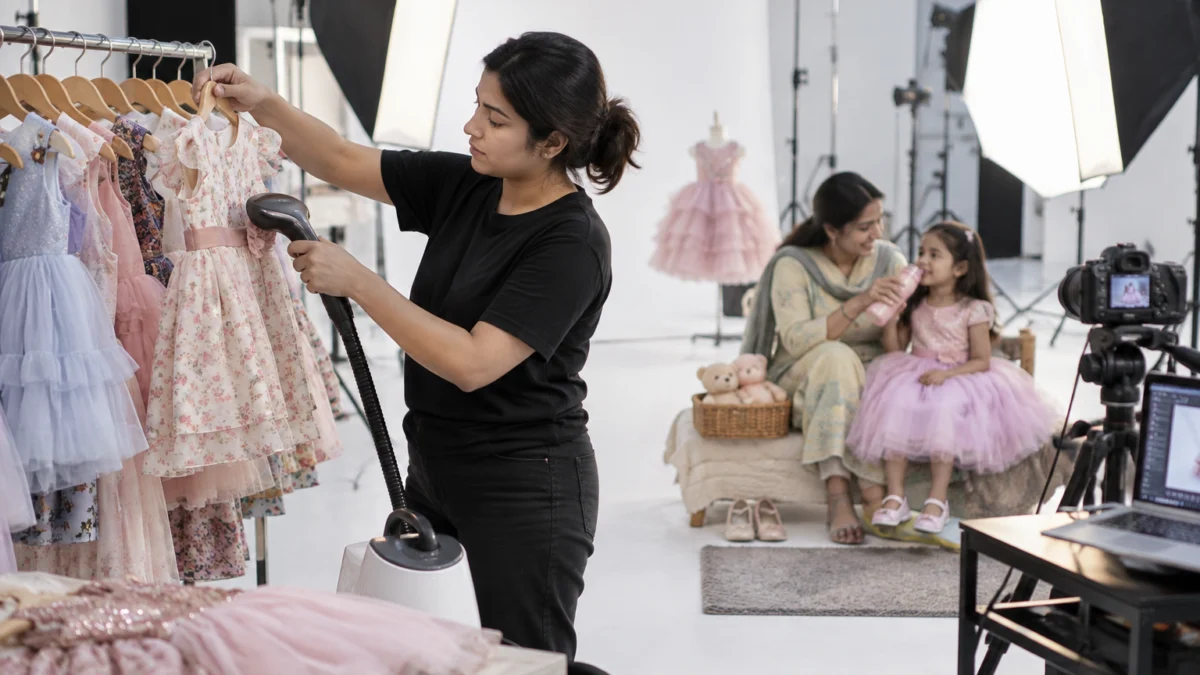
Outfit counts depend on how many angles you need per style and how quick the changes are. Pre-steam everything, pre-assemble each look on its own hanger with accessories in a labelled pouch, and keep the next outfit ready before the current one is finished. That single habit can add several looks to a slot without asking more of the child.
Which 9 shots sell kidswear in a kids model photoshoot?
Shoot nine images per style: front, back, side, movement, sitting, close-up detail, fit-in-action, styled look and a garment-only image. Together they answer fit, fabric and mood questions so parents can buy without guessing.
- Front full-length hero: the child standing naturally, arms relaxed, garment fully visible. This is your first on-model image.
- Back view: shows zips, buttons, bows and back prints — a common return reason when missing.
- Side or three-quarter turn: shows length, flare and how the hem falls.
- Movement shot: a twirl, a jump or a little walk; proves the garment allows free movement.
- Sitting or play pose: cross-legged on the floor or on a block; shows comfort and how shorts or frocks behave seated.
- Close-up detail: print, embroidery, fabric texture or a soft neckline at chest level.
- Fit-in-action: arms raised or reaching up, showing stretch and that the top doesn’t ride up.
- Styled look: with matching shoes, a hairband or a sibling in a coordinating set — great for cross-selling.
- Garment-only image: a clean product shot for the marketplace main image and size-chart reference.
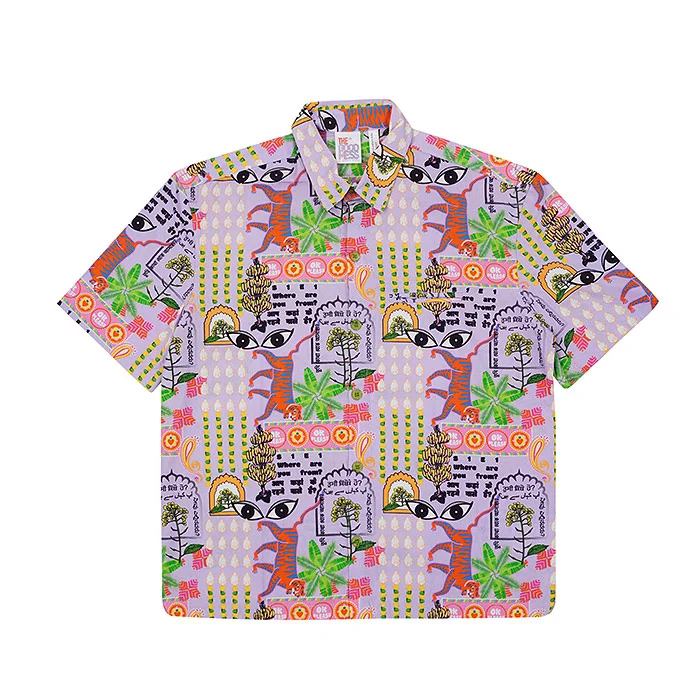
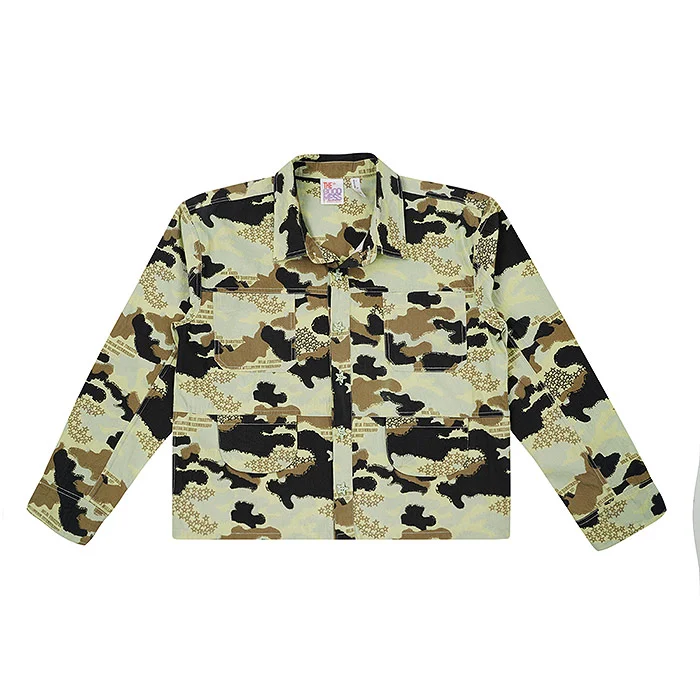
The ninth image is where many brands combine formats. Clean flat lay shots of the same garment give marketplaces the white-background main image they prefer, while the on-model images fill the gallery. If you are weighing styling options for those product-only images, our guide to garment flat lay photography styles compares them side by side.
How many images does each kids clothing photoshoot style need?
For marketplace listings, plan at least five to six on-model angles plus the garment-only image per style. For hero styles and new launches, shoot all nine. For basics sold in many colours, shoot the full set in one colour and two or three key angles in the others to keep the slot short for the child.
How do you direct kids model poses without forcing them?
Turn poses into games. Instead of “stand still and smile”, ask the child to jump on a floor sticker, show you their pockets or look for a toy beside the camera. Natural kids model poses come from play, not instructions.
- Floor marks: a bright sticker on the seamless paper gives the child a “spot” to return to.
- Eye-level camera: the photographer crouches so the child isn’t looking up at a stranger.
- Toy on the lens side: an assistant holds a soft toy near the camera for eye contact.
- One instruction at a time: “hands in pockets” then “now a big jump”, never a list.
- Praise the child, not the picture: “great jump!” keeps them engaged far longer than “nice shot”.
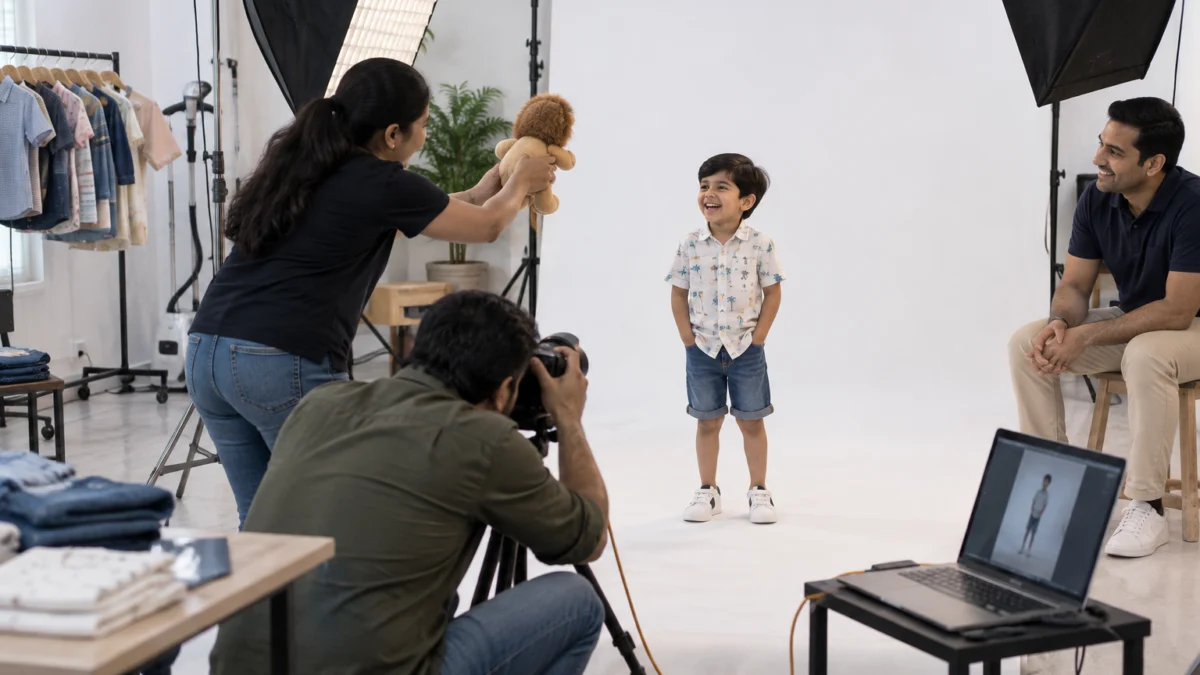
Movement shots deserve their own mini-game. Ask the child to “be a rocket” for a jump or “spin like a fan” for a frock twirl, then shoot in short bursts with a fast shutter speed. You’ll usually get one image where the fabric, the face and the pose all line up, and that frame often becomes the image parents remember.
Should you use real child models or AI child models for kidswear?
Use real children for any image that has to prove fit, fabric or size. AI child-model tools can produce attractive pictures, but they generate the garment rather than photograph it, so the fit, drape and colour may not match what arrives at the parent’s door.
AI tools are heavily marketed to kidswear sellers in 2026 because they skip casting and consent. That convenience has a cost. Parents compare the delivered garment with the listing, and when the length, colour or print scale is different, the order comes back. There is also a trust question: many parents are uncomfortable buying from listings that show synthetic children. A real kids model photoshoot records what your garment actually does on a real body.
| Factor | Real child model | AI child model |
|---|---|---|
| Fit accuracy | Shows true length, flare and stretch | Generated; may not match the garment |
| Colour & print | Colour-managed photo of the real sample | Can shift colour or redraw prints |
| Expressions | Genuine, varied, believable | Often repetitive or uncanny |
| Planning effort | Casting, consent, slots needed | Minimal |
| Parent trust | High | Mixed, especially for kidswear |
If you do experiment with AI for social posts or mood boards, keep it away from fit-critical listing images and never present AI children as real customers. Your product pages should always show the real garment on a real child.
How does a kids model photoshoot day run, step by step?
A smooth day follows six steps: arrival and settling-in, quick fittings, the hero looks first, play-based movement shots, detail and garment-only images, and a final review with the brand. The child is only on set for the parts that need them.
- Arrival and settling-in (10–15 min): the child explores the set, meets the photographer and sees the lights flash once or twice.
- Fittings: the parent helps the child into the first look in a private changing area; the stylist checks length and pins only where hidden.
- Hero looks first: front, back and side for the most important styles while energy is highest.
- Movement and play shots: twirls, jumps and sitting poses with short breaks in between.
- Detail and garment-only images: shot without the child, so they can rest or go home.
- Review: the brand checks selects on the tethered screen before the child leaves, so no reshoot is needed.
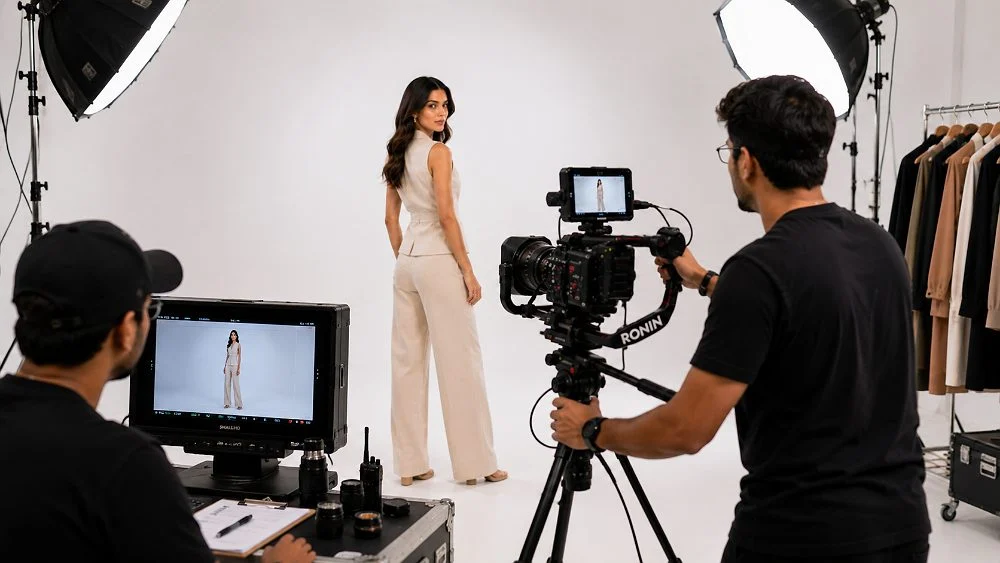
Many kidswear brands also add a short garment video to the same booking. A 20–30 second clip of a child walking or twirling shows movement better than any still. The example below shows the same garment-video format on an adult kurti set; for kidswear we keep the clip shorter and more playful.
How much does a kids model photoshoot cost with Uniqs Studio?
Uniqs Studio prices shoots per product or per image, so you pay for the catalogue you actually need. Model photography is listed at ₹400 per product for 5–6 angles; add flat lay, ghost mannequin or video only for the styles that need them.
| Shoot type | Images | Turnaround | Price |
|---|---|---|---|
| Model Photography | 5–6 angles | 4–5 days | ₹400 / product |
| Flat lay | 2–3 angles | 6 days | ₹290 / product |
| Ghost mannequin | 1 angle | 3–4 days | ₹250 / image |
| Ecommerce Reels Video | 20–25 seconds | 4–5 days | ₹900 / product |
| Garment Video with Model | 25–30 seconds | 4–5 days | ₹1,200 / garment |
Prices are per product/image as listed; call or WhatsApp +91-8076745824 for bulk catalogue quotes.
For a kidswear brief, share your style count, fit sizes and the channels you sell on, and ask for a written quote that confirms exactly what is included for casting and child models. Call +91-8076745824, message us on WhatsApp at +91-8076745824, or email [email protected] with your line sheet.
What are the most common kids model photoshoot mistakes?
The biggest mistakes are casting the wrong size, booking long afternoon slots, skipping written consent and shooting without a fixed shot list. Each one either upsets the child or produces an inconsistent catalogue.
- Casting by age label: a “5-year-old” may wear a 6–7 sample; always measure.
- Afternoon marathons: tired children give stiff poses; morning slots are kinder and more productive.
- No break plan: breaks are part of the schedule, not a reward when things go wrong.
- Too many people on set: keep the crew small and quiet; extra brand staff can watch the tethered screen.
- Unprepared garments: creased or tagged samples waste the child’s best minutes on fixes.
- Inconsistent angles: without a locked shot list, your catalogue looks patchy across sizes and colours.
- Over-editing faces: retouch the garment, not the child; parents dislike heavily smoothed kids.
What should your kids model photoshoot checklist include?
Use one checklist covering casting, consent, garments, set and post-production. Tick it off a week before, the day before and on the morning of the shoot.
- Fit sizes confirmed and child models measured against the sample spec.
- Signed child model consent forms and usage terms for every child.
- Required permissions and working-hour plan checked against current rules.
- Age-based slot schedule with breaks shared with parents.
- Every look steamed, de-tagged and assembled with accessories.
- 9-shot list printed for the photographer and stylist.
- Private changing area, snacks, water and a toy basket ready.
- Tethered review screen set up for the brand team.
- Retouching brief: garment colour accuracy first, natural skin for children.
- File naming by SKU, size and angle for marketplace upload.
Which tools make a kids fashion catalogue shoot easier?
On our set, full-frame cameras such as the Sony A7R5 and Canon R10 shoot tethered to a laptop so the brand can approve images live. Strobe lights with large strip softboxes and an octabox give soft, even light that doesn’t make children squint, and fast flash recycling helps freeze twirls and jumps. Simple extras matter just as much for a kids fashion catalogue shoot: coloured floor stickers, a step stool, a soft toy kit and a kids’ clothing rack at the child’s height.
What kidswear photography trends matter for 2026-2027?
Expect more video, more sibling and family sets, and more pressure for honest, unretouched children. Parents increasingly want to see real movement and real kids, which favours short video clips and natural expressions over stiff poses.
Marketplaces keep adding space for video and richer image galleries, and social commerce rewards short vertical clips. Coordinated sibling and parent-child sets help brands sell bundles. At the same time, the push toward AI imagery is making authentic photography a point of difference: a brand that clearly shows real children in real garments stands out when many competing listings look generated.
Frequently asked questions about kids model photoshoots
These are the questions kidswear brands ask Uniqs Studio most often before booking a child model shoot for ecommerce.
Children from about 2 to 10 years are the most common for kidswear catalogues. Toddlers need shorter, flexible slots, while older children can hold more looks per session. Always cast to your sample size rather than to age alone.
Yes. Get written consent from a parent or legal guardian that covers shoot timings, image usage and fees, keep the parent present throughout, and follow the government’s rules for children in audio-visual and advertising work. Check the current rules with your legal advisor.
Plan blocks of about 45–60 minutes with snack and play breaks after every two or three looks, and book around the child’s nap time. Shoot the hero image first while the toddler is fresh.
At least five to six on-model angles plus one garment-only image for marketplace listings. Hero styles and launches benefit from the full nine-shot list, including movement, sitting and detail images.
AI child models can look polished, but they generate the garment instead of photographing it, so fit, colour and print may not match the real product. For listing images that need to prove fit, use a real kids model photoshoot.
Model photography is listed at ₹400 per product for 5–6 angles with a 4–5 day turnaround. Flat lay is ₹290 per product and garment video with a model is ₹1,200 per garment; call +91-8076745824 for a bulk catalogue quote.
What is your next step after planning a kids model photoshoot?
Lock your fit sizes, shot list and consent forms, then compare budgets and book a slot. A well-prepared brief turns a kids model photoshoot into a calm, efficient morning for the child and a consistent catalogue for you.
Satyam and the Uniqs Studio team shoot from our in-house studio at 1800/9, Kalkaji Extension, New Delhi, and work with brands across Delhi, Gurgaon, Noida, Faridabad and Ghaziabad. Before you book, read our breakdown of model photoshoot prices and what affects them so your budget and style count line up. When you’re ready, get in touch with our team or call +91-8076745824.