
If your styles are live, your prices have not changed and your orders still slowed down, the first place to look is your Myntra seller performance metrics. Cancellations, late dispatches and returns quietly decide how much Myntra trusts your account. When we plan Myntra catalogues at Uniqs Studio, we see the same pattern again and again. If you are new to the platform, start with our Myntra seller resource hub and then come back here.
This guide is written for live Myntra sellers who are losing visibility and for ecommerce managers at fashion brands who report on account health every week. Satyam and the Uniqs Studio team have spent 9+ years producing catalogues for D2C brands and marketplace sellers. We will be honest about the split: some metrics are fixed in your warehouse, and some are fixed in your catalogue. We cover both, with the catalogue half explained from first-hand shoot experience.

Key Takeaways
- Myntra seller performance metrics are your ongoing report card: cancellations, dispatch on time, returns and customer ratings.
- Seller-side cancellations and SLA breaches are operations problems: stock sync, cut-off times and packing capacity.
- Size, colour and “looks different” returns are mostly catalogue problems that better images, fit data and video can fix.
- Exact thresholds change. Always confirm current values in your own Partner Portal dashboard, not in old blog posts.
- A weekly 20-minute review catches a falling metric long before Myntra lowers your visibility.
What are Myntra seller performance metrics and why do they matter?
Myntra seller performance metrics are the numbers Myntra uses to judge how reliably you fulfil orders and how often customers are happy with what arrives. They cover cancellations, dispatch timing, returns and ratings. Strong numbers keep your styles visible; weak numbers slowly push them down.
Think of them as a running score of promises kept. Every time a shopper places an order, Myntra is making a promise on your behalf: the product exists, it will ship on time and it will match the listing. Your metrics record how often that promise holds. A marketplace that sells fashion at scale cannot check every seller by hand, so it relies on these signals to decide which listings to show first and which sellers can take part in big sale events.
The catch is that the damage is slow and silent. You rarely get one dramatic warning. Instead, impressions taper off, a style that used to sell daily drops to page three, and the team blames pricing or ads. In our experience, the real cause is often a return reason nobody looked at, or a week of late dispatches during a rush.
How do Myntra seller performance metrics affect visibility?
Myntra does not publish an exact ranking formula, and we will not pretend to know it. What sellers consistently report is that listings from accounts with high cancellations, frequent SLA breaches or above-benchmark returns lose reach, while clean accounts keep it. That is why a Myntra visibility drop should always trigger a metrics check before you change prices or raise ad budgets. Our broader Myntra sales growth guide covers pricing and ads; this post stays focused on the metrics themselves.
Which metrics does Myntra track for sellers?
Myntra tracks four families of numbers: cancellations, dispatch and procurement timing, returns (including quality-related returns) and customer ratings. Together they make up what sellers usually call their seller score. You can see your current values in the performance section of the Partner Portal.
Labels and exact definitions change from time to time, so treat the table below as a working map rather than an official rulebook. For the current definitions, thresholds and your own numbers, log in to the Myntra Partner Portal and open the performance or account health reports.
| Metric | What it measures | Common root cause | Usually fixed by |
|---|---|---|---|
| Seller cancellation rate | Orders you cancel after the customer has paid | Stock shown on Myntra that is not really on the shelf | Operations: inventory sync |
| Dispatch / ready-to-dispatch on time | Share of orders packed and handed over within the SLA | Late picking, packing backlogs, missed courier cut-off | Operations: warehouse routine |
| Procurement SLA (where applicable) | Time taken to make stock available for an order | Made-to-order or vendor-held stock | Operations: stock planning |
| Customer return rate | Share of delivered orders sent back | Size, colour or “not as shown” mismatch | Catalogue: images, size chart, fit data |
| Product quality returns | Returns tagged as damaged, defective or poor quality | Fabric or finishing not matching the images | Product QC plus honest close-ups |
| Customer ratings & reviews | Star ratings and review text on your styles | Expectation gap after delivery | Catalogue plus product quality |
What does the Myntra seller score combine?
Sellers use “Myntra seller score” or “Myntra seller rating” as shorthand for the combined picture above. Some categories and programmes add their own conditions. A 2021 seller guide published by fulfilment partner Eshopbox on Myntra Gold seller criteria listed six metrics: GMV, seller cancellation rate, dispatch SLA, procurement SLA, return rate and product quality returns. Treat those older numbers as a sense of direction only and confirm today’s values in your dashboard.
What is the Myntra cancellation rate and how do you keep it low?
The Myntra cancellation rate is the share of orders you, the seller, cancel after they are placed. Myntra expects it to be very close to zero, because every seller cancellation is a broken promise to a paying customer. Keeping it low is mostly about honest, real-time inventory.
The same 2021 Eshopbox guide quoted a seller cancellation rate of less than 0.11% as one Gold seller condition. Whether or not today’s threshold is identical, the message is clear: the acceptable level is tiny. Ten cancellations in a month can matter far more than ten returns.
Why do seller-side cancellations happen?
- Multi-channel stock. The same kurta sells on your website, on Amazon and on Myntra, and the last piece goes twice.
- Size mapping errors. An M is mapped to the wrong SKU code, so the order cannot be fulfilled from the shelf.
- Damaged or unfinished pieces. Stock is counted before final QC, then fails at packing.
- Wrong colour variant. Two shades look identical in the images, so the warehouse cannot tell which one was ordered.
The last point is where photography quietly helps. When two colourways are photographed under the same calibrated light, the catalogue and the warehouse both see a clear difference, and the wrong-variant cancellations drop. Keep a buffer of one or two pieces on fast sellers, sync inventory at least daily, and never list a style before QC is complete.
What counts as a Myntra SLA breach on dispatch time?
A Myntra SLA breach happens when an order is not marked ready-to-dispatch, or not handed to the courier, within the time Myntra allows for your fulfilment model. Each late order counts against your dispatch metric. Repeated breaches pull your seller score down even if the customer receives the parcel.
Your exact Myntra dispatch time depends on your fulfilment model and category, and it is shown against every order in the Partner Portal. Fulfilment platforms that integrate with Myntra note that SLA values can be updated by Myntra, so read them from your own account rather than from a forum thread. The Eshopbox guide mentioned above listed a dispatch rate of at least 90% for Gold sellers in 2021.
How do you build a dispatch routine that never breaches SLA?
- Fix one daily cut-off. Pick all orders received before a set time and pack them the same day.
- Pre-pack fast movers. Fold, tag and poly-bag your top 20 styles in advance during quiet days.
- Plan sale capacity. Before big events, add packing hands and courier pickups; our EORS preparation checklist covers this in detail.
- Mark ready-to-dispatch only when the parcel is truly ready. Marking early and missing pickup creates a second breach.
- Review breaches every Monday and write the cause next to each order number.
Why is your Myntra return rate high and how do images fix it?
A high Myntra return rate usually means shoppers received something different from what they pictured: a different fit, a different colour or a different fabric feel. Those are catalogue problems. Accurate images, honest fit data and short videos close the gap before the order is placed.
Fashion will always have some returns; people try clothes on. But returns that sit above your category benchmark are a signal, and they are the one metric where catalogue quality has the most direct effect. In our work on Myntra catalogues, three reasons cover most avoidable returns: size and fit, colour, and “product looks different”. Each has a clear image fix, and fixing it also feeds the other Myntra seller performance metrics, because fewer returns usually mean better ratings too.
Which return reasons point to a catalogue problem?
| Return reason | What it usually means | Catalogue fix |
|---|---|---|
| Size too small / too large | Size chart or fit data does not match the garment | Re-measure, add model height and size worn, show side and back views |
| Colour different from image | Lighting or editing shifted the shade | Shoot under calibrated light, match colour to the physical sample |
| Product looks different | Styling hid the real length, shape or print scale | Full-length on-model shot plus a plain garment shot |
| Fabric / quality not as expected | No texture close-up, or over-smoothed retouching | Fabric macro, honest retouching, garment video |
| Wrong item received | Variants look alike in images and in the warehouse | Distinct, consistent shots per colourway and SKU |
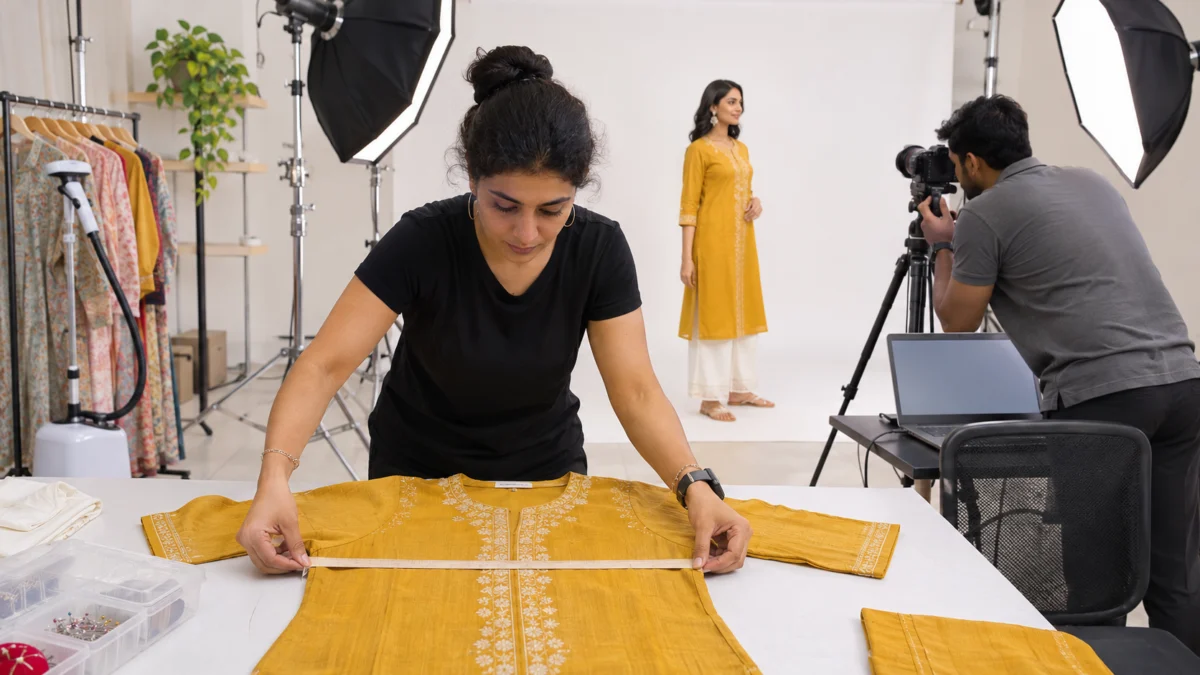
Size returns start with the chart. If your measurements are taken from samples instead of production pieces, or body and garment measurements are mixed, no photo can save the listing. Our Myntra size chart guide walks through measuring, formatting and the most common rejection fixes.
How do on-model images and video cut fit returns?
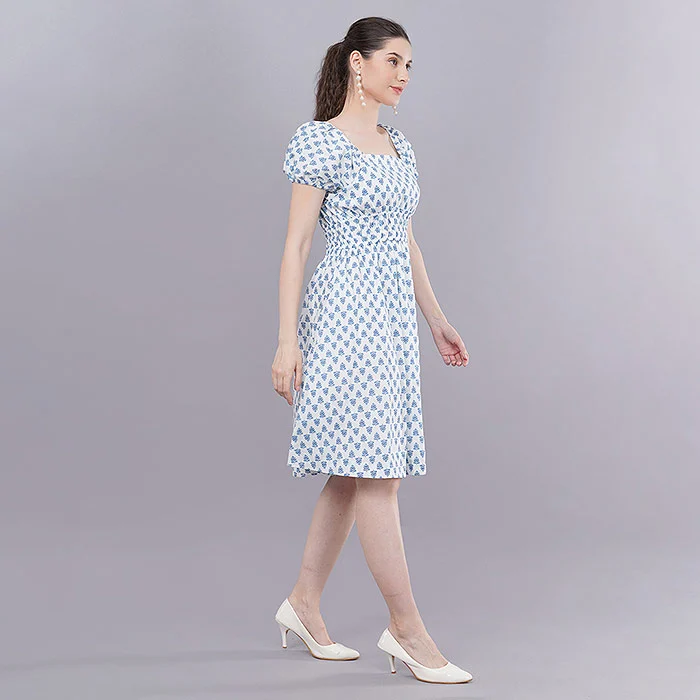
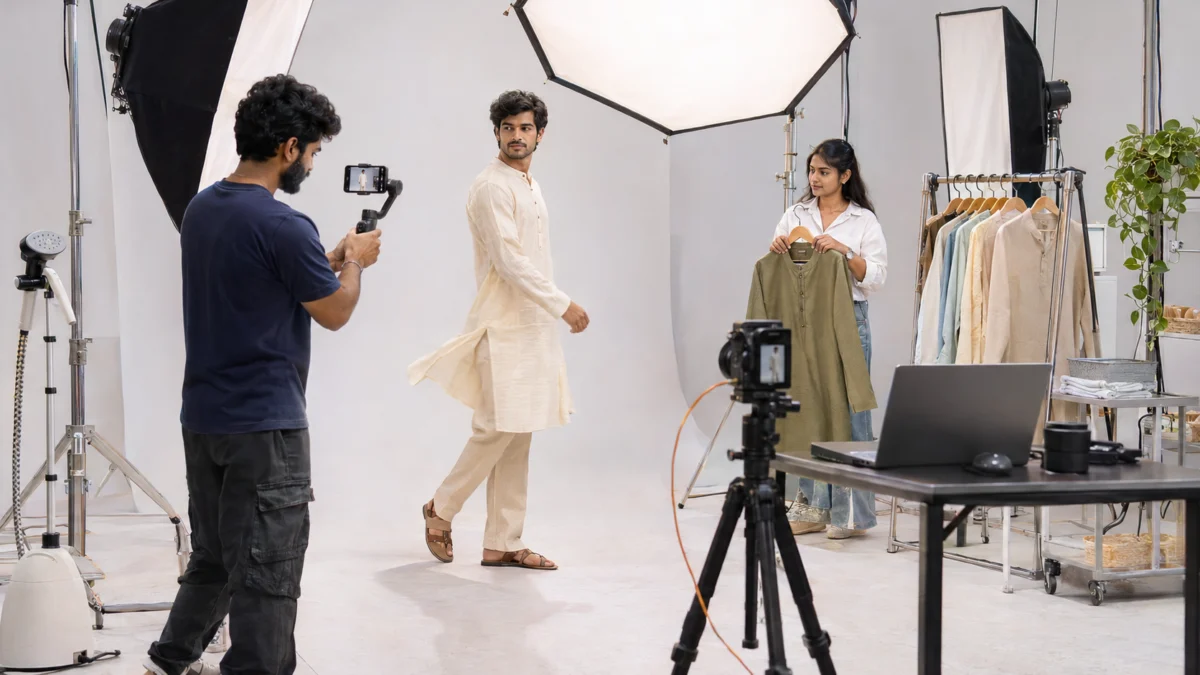
Shoppers judge fit from people, not from flat shapes. For dresses, kurtas and co-ords, on-model fashion shoots with front, side and back views, plus the model’s height and size worn in the description, answer most fit questions before checkout. A side profile shows how a dress sits at the waist; a back view shows zips, ties and length at the hem.
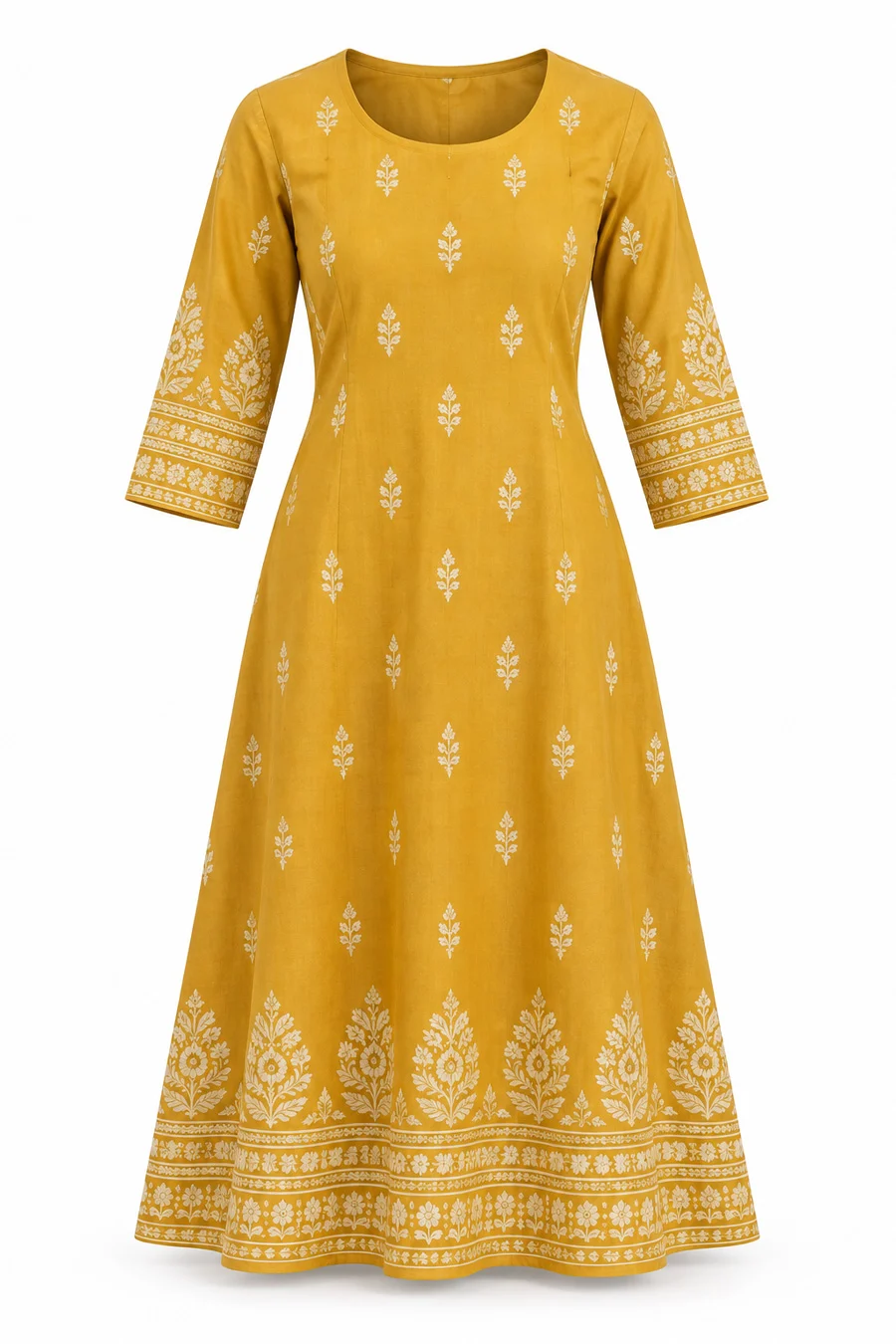
Colour returns need a different fix. For kurtas, shirts and tops you also sell on other marketplaces, ghost mannequin shots give a consistent, true-shape garment image where the colour is matched to the physical sample, with no skin tones or styling to distract the eye. Pair one plain garment image with your on-model set and “colour different from image” complaints usually fall.
Fabric and drape are hardest to judge from stills. Short garment videos of a model turning, walking and lifting a sleeve show stretch, fall and weight in a few seconds. The clip below is the kind of model video we shoot for kurti listings.
When a return still happens and the product comes back damaged or swapped, keep evidence and file a claim; our Myntra SPF claim guide explains the process.
How does a Myntra seller quality penalty lead to a visibility drop?
A Myntra seller quality penalty is the general term sellers use for the consequences of weak metrics: lower listing reach, loss of programme benefits or event eligibility, and in serious cases action on the account. It rarely arrives as one notice. It shows up as a gradual Myntra visibility drop.
Myntra does not publish a fixed penalty table for every category, and amounts or rules mentioned in blog posts are often out of date. What is consistent across seller experiences is the direction: late shipping and high cancellations hurt quickly, while high returns hurt steadily. Marketplace job descriptions even talk about defining delisting criteria for sellers with lapses in performance and quality metrics, which tells you sustained problems are taken seriously.
The practical response is the same whatever the label. Find the metric that moved first, fix its root cause, and give the account a few clean weeks. A style can recover reach once the underlying signal improves, but only if the fix is real. Re-uploading the same images, or cutting prices without fixing a return reason, usually buys a short bump and then the drop returns.
What are the 9 fixes that protect your Myntra seller performance metrics?
The nine fixes below are ordered by how quickly they usually move the numbers: operations first, because cancellations and SLA breaches hurt fastest, then catalogue fixes for returns and ratings. Work through them in order and recheck your dashboard after two to four weeks.
- Sync inventory at least daily across every channel, and keep a one or two piece buffer on bestsellers so the last unit is never sold twice.
- Audit size-to-SKU mapping for every live style; one wrong code can create a run of cancellations.
- Set a fixed daily packing cut-off and courier pickup, and mark ready-to-dispatch only when the parcel is sealed and labelled.
- Plan sale-week capacity in advance: extra packers, pre-packed fast movers and agreed pickup slots.
- Export return reasons by style every week and sort by count, not by percentage, so your biggest losses rise to the top.
- Re-measure and correct size charts for the five styles with the most size returns, using production pieces.
- Reshoot colour-problem styles under calibrated light and match the edited image to the physical sample.
- Add missing angles: side, back, fabric close-up and model height with size worn for every apparel style.
- Add a short garment video to your highest-traffic styles so shoppers can see fit and fabric move before they buy.
Fixes 1 to 4 are owned by your warehouse team. Fixes 5 to 9 sit with your catalogue team or your photography partner. Splitting ownership this way stops the common situation where everyone agrees the Myntra seller performance metrics are falling but nobody owns the fix.
How should you review Myntra seller performance metrics every week?
Block 20 minutes every Monday, open your Partner Portal reports and compare this week with the last four. Note any metric that moved, find the three styles or orders behind the change, and assign one owner and one fix to each. Small, regular checks prevent the slow slide that leads to a visibility drop.
- Seller cancellations this week, each with a written cause.
- SLA breaches and late ready-to-dispatch orders, each with a written cause.
- Return rate by style, sorted by number of returns.
- Top three return reasons for the top five returned styles.
- Quality and damage returns, checked against your QC log.
- New ratings below four stars and what the review text says.
- Listings with falling impressions, cross-checked with the metrics above.
- One catalogue action (reshoot, size chart fix or video) agreed for the coming week.
Keep the review in one shared sheet. Over a few months, the sheet becomes your own record of which fixes actually moved your Myntra seller performance metrics, which is far more useful than any generic benchmark. It also makes conversations with your account manager concrete: you can show the problem, the fix and the date.

How much does a catalogue reshoot cost to fix return-driven metrics?
You do not need to reshoot the whole catalogue. Start with the five to ten styles that drive most of your returns, and pick the shoot type that fixes their main return reason. Uniqs Studio’s standard per-product and per-image rates for apparel are listed below.
| Shoot type | Images | Turnaround | Price |
|---|---|---|---|
| Ghost mannequin | 1 angle | 3–4 days | ₹250 / image |
| Flat lay | 2–3 angles | 6 days | ₹290 / product |
| Model Photography | 5–6 angles | 4–5 days | ₹400 / product |
| Ecommerce Reels Video | 20–25 seconds | 4–5 days | ₹900 / product |
| Garment Video with Model | 25–30 seconds | 4–5 days | ₹1,200 / garment |
Prices are per product/image as listed; call or WhatsApp +91-8076745824 for bulk catalogue quotes.
Send your top-returned styles to Satyam on WhatsApp at +91-8076745824 or call +91-8076745824, and we will suggest the shoot type for each one.
Myntra seller performance metrics FAQs
These are the questions Myntra sellers ask us most often about metrics, visibility and returns. Short answers first; the sections above have the detail.
They are the numbers Myntra uses to judge seller reliability: seller cancellation rate, dispatch and procurement SLA adherence, return rate, product quality returns and customer ratings. You can see your current values in the Partner Portal.
As close to zero as possible. A 2021 Eshopbox guide listed a seller cancellation rate below 0.11% as one Gold seller condition. Thresholds can change, so check the current target in your own dashboard.
Each late order counts against your dispatch metric. Occasional breaches are recoverable, but repeated breaches weaken your seller score and can reduce listing visibility or event eligibility.
Check your metrics first. A rise in cancellations, SLA breaches or returns on key styles is a common cause. Stock-outs, catalogue holds and price changes are the next things to rule out.
Yes, for returns caused by size, colour or “product looks different”. True-colour images, full-length on-model shots with side and back views, fabric close-ups and short garment videos set accurate expectations before the order.
Yes. Uniqs Studio is an in-house ecommerce, fashion and product photography and video studio in Delhi that shoots on-model, ghost mannequin, flat lay and garment video for marketplace sellers. Call +91-8076745824 or email [email protected].
What should you do next after checking your Myntra seller metrics?
Fix the operations metrics this week, then plan a focused reshoot for the styles that drive most of your returns. The order matters: cancellations and SLA breaches hurt fastest, returns hurt longest.
Next step: plan that reshoot with our fashion photography for Myntra guide, which covers model selection, poses, angles and the image set Myntra shoppers expect. When you are ready, call Satyam on +91-8076745824 or email [email protected].
Catalogue images that protect your Myntra metrics
Uniqs Studio is an in-house ecommerce, fashion and product photography and video studio in Kalkaji, New Delhi, trusted by 500+ D2C brands and marketplace sellers. We shoot on-model, ghost mannequin, flat lay and garment video for sellers across Delhi, Gurgaon, Noida, Faridabad and Ghaziabad.
Email: [email protected] · Mon–Sat, 10 am–7 pm · 1800/9, Kalkaji Extension, Kalkaji, New Delhi 110019