
An activewear model photoshoot has one job that a regular catalogue shoot does not: it must prove that leggings, sports bras, joggers and dry-fit tees stretch, stay put and move with the body. At Uniqs Studio we plan these shoots like any other model photography project, but with a different brief: casting people who can actually move, lighting that freezes a jump without motion blur, and poses that show the waistband, the seams and the four-way stretch in a single frame.
This guide is written for activewear and athleisure D2C brands and sportswear sellers on Myntra and Amazon who want product pages that answer the buyer’s real questions: “Will it go see-through in a squat? Does the waistband roll? Will it look this good on me?” Satyam has spent 9+ years shooting apparel for more than 500 D2C brands and marketplace sellers, and the casting rules, shutter speeds and 10 poses below are exactly what our Kalkaji studio team follows on a gymwear day.
Key Takeaways
- Cast models with real training experience — a believable squat, lunge or jump sells stretch better than any caption.
- Freeze motion with short strobe flash duration and 1/500s or faster shutter, and shoot in bursts.
- Every activewear SKU needs a front fit shot, a back shot, a stretch pose, a movement shot and a fabric close-up.
- Add a 20–30 second garment video: buyers trust leggings more after they see them move.
- Keep colours true and the backdrop clean so the same images work on Myntra, Amazon and your own website.
What Is an Activewear Model Photoshoot and How Is It Different from a Fashion Shoot?
An activewear model photoshoot is an on-model shoot for gymwear, yoga wear, running gear and athleisure where the images must show performance: stretch, compression, sweat-friendly fabric and freedom of movement. A normal fashion shoot sells style; an activewear shoot sells function and style together, so poses, casting and lighting all change.
In a kurta or dress shoot, the model mostly stands, walks or turns. In a gymwear photoshoot she squats, lunges, reaches overhead and jumps, because that is how the buyer will use the product. Each of those movements pulls the fabric in a different direction, and the camera has to record it sharply. That is why our team treats activewear as its own category, with its own shot list and its own lighting plan, rather than reusing a western-wear template.
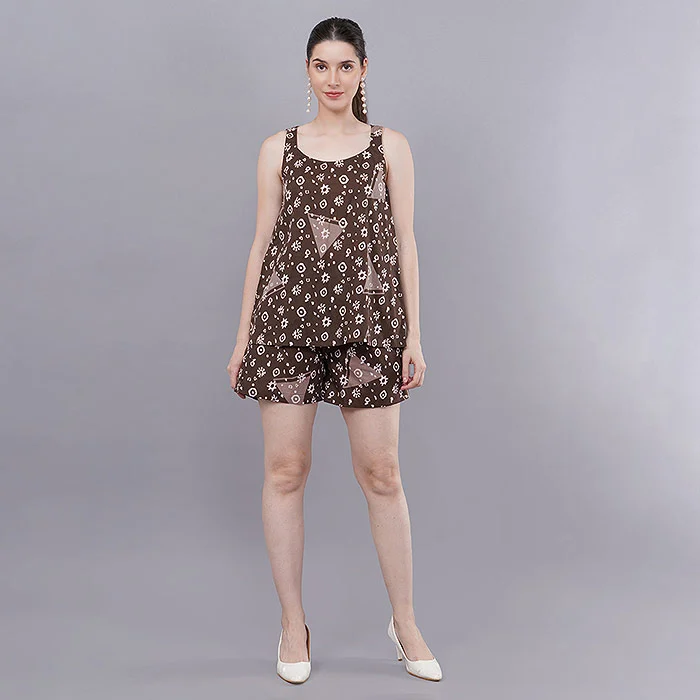
There is also a buyer-psychology difference. Someone buying a party dress imagines an occasion. Someone buying gym leggings imagines a workout, and they worry about practical things: squat-proof opacity, a waistband that does not roll, seams that do not chafe. Your sportswear model photography should answer those worries visually, before the buyer reaches the size chart or the reviews.
Why Does Activewear Need Movement, Stretch and Fit Proof in Photos?
Because activewear buyers cannot touch the fabric, the photos must do the “stretch test” for them. Images that show the garment under real movement reduce doubt about fit, opacity and comfort, which helps conversion and cuts size- and expectation-related returns.
Marketplaces already push sellers in this direction. Amazon’s product image requirements ask for clear, accurate images that fill the frame, and Myntra’s catalogue team rejects images where the product is unclear or badly lit. For activewear, “accurate” also means showing how the product behaves. A legging photographed only standing still tells the buyer nothing about whether it moves with a deep squat.
- Stretch proof: a lunge or deep squat shows four-way stretch and recovery at the knee and seat.
- Fit proof: front, back and side shots on a model of clearly stated height and size show length and rise.
- Opacity proof: a well-lit squat from behind under neutral light reassures buyers about see-through worries.
- Function proof: overhead reaches show a sports bra or crop top staying in place.
From what we see across our sportswear catalogue shoots, brands that add even two movement frames per SKU get far fewer “not as expected” comments than brands that only upload standing poses. You do not need dramatic gym sets for this; a clean white studio, a grey mat and a model who can hold good form is enough.
How Do You Cast Athletic Models for an Activewear Model Photoshoot?
Cast for movement first and looks second: choose models who train regularly, can hold a squat or plank with clean form, and match your brand’s real size range. A fit, believable model makes every activewear model photoshoot frame more convincing than a tall runway model who has never done a lunge.
What body types should an activewear brand cast?
Match your size chart and your buyer, not a stereotype. If your leggings run from XS to 3XL, shoot at least two sizes — one sample size and one larger size — so buyers can picture the fit. For athleisure collections we usually cast one lean, toned model and one curvier or broader model, and we always note model height and size worn in the listing copy.
Can the model actually move?
Ask for a short phone video during casting: two squats, a forward lunge, a downward dog and a small jump. You will see immediately whether the knees track straight, whether the back stays neutral and whether the movement looks natural. Yoga wear needs flexibility; running and gym wear need power and balance. Clean form also protects the garment’s look — a collapsed knee in a lunge creates ugly folds at the crotch.
Male models for gymwear and joggers
Men’s training tees, compression tops and joggers need a model with shoulders and arms that fill the garment without stretching the print. For these days we brief the team the same way as our male model photography shoots: posture, grooming and a natural, confident expression. A slight sweat sheen with glycerine spray can work for lifestyle frames, but keep catalogue frames dry and clean.
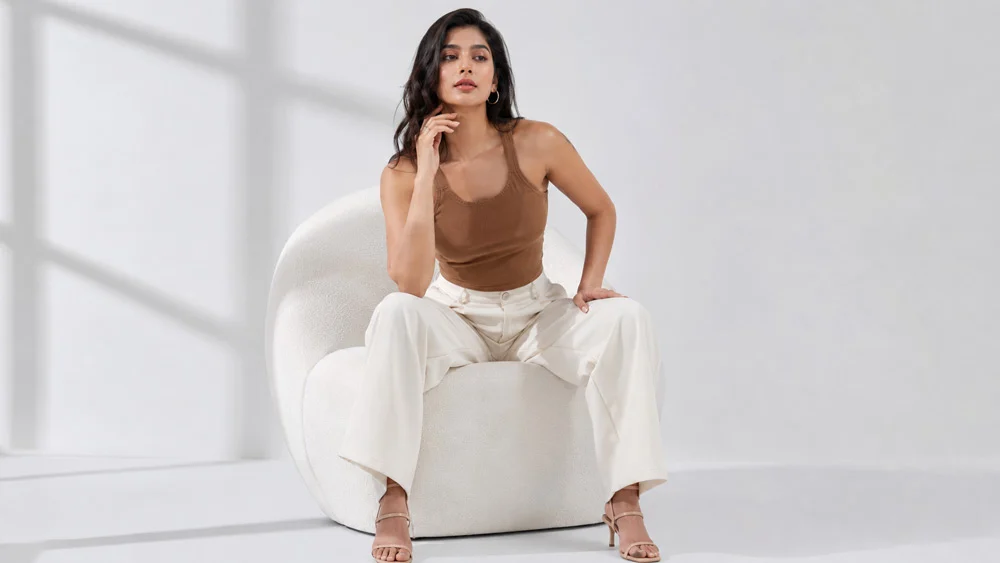
For a deeper look at how we move from shortlist to final booking, our post on model casting for fashion brands walks through briefs, test shoots and usage rights step by step.
How Should You Prepare Gymwear Before the Shoot?
Prepare activewear by size-matching every sample to the model, steaming out fold lines at low heat, and checking colour and opacity under the studio lights a day before. Synthetic performance fabrics show creases and shine faster than cotton, so prep decides half the result.
- Size-match: leggings that are one size too big bunch at the ankle; one size too small make the fabric shine and go thin at the knees.
- Steam carefully: polyester-spandex blends need low steam from a distance. Never iron prints or reflective logos.
- Lint and pilling: roll every black and navy piece; dark knits show every speck under strobes.
- Opacity test: ask the model to squat under the shooting light and check from behind on the tethered screen.
- Hidden clips only for standing shots: clips pull fabric in a way that looks wrong in movement frames, so remove them before squats and jumps.
If your team is new to sample prep, our step-by-step guide on garment preparation for fashion photography covers steaming, tagging and SKU labelling in more detail. For activewear, add one more rule: wash nothing before the shoot unless the brand asks — a washed sample may lose its fresh, matte finish.
How Do You Light and Shoot Movement Shots Without Blur?
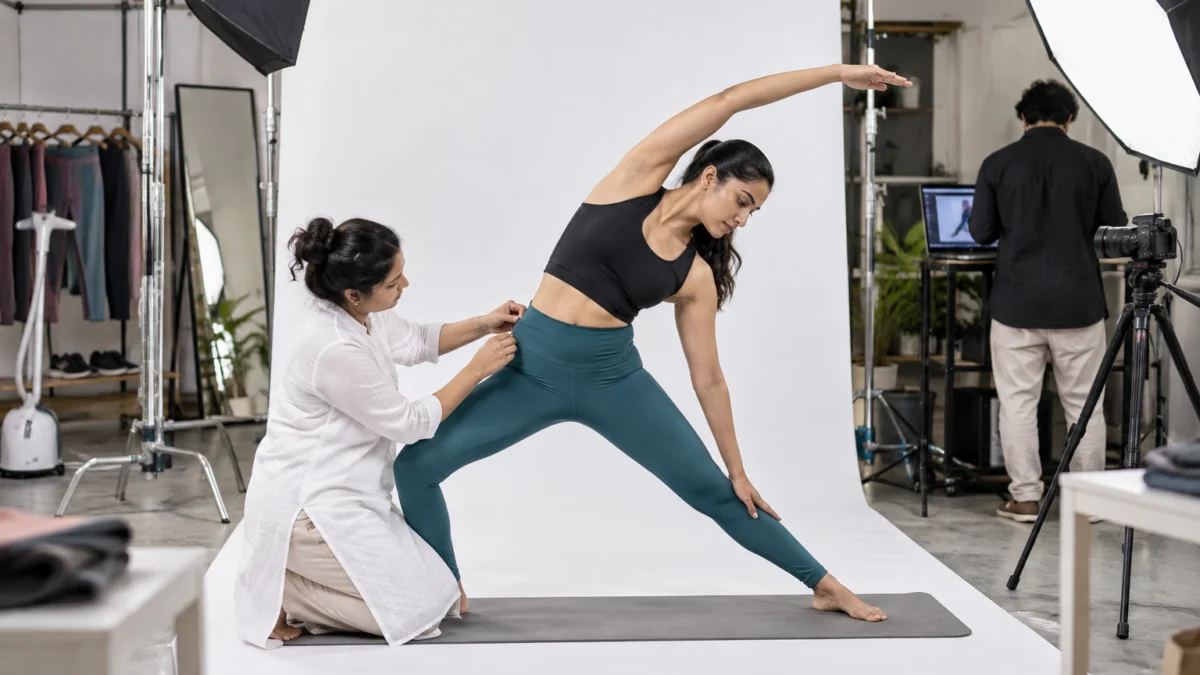
Use studio strobes with a short flash duration, a shutter of 1/500s or faster, and continuous burst shooting so you can pick the frame where fabric and form look best. Light the white backdrop separately so the model stays crisp and the background stays clean.
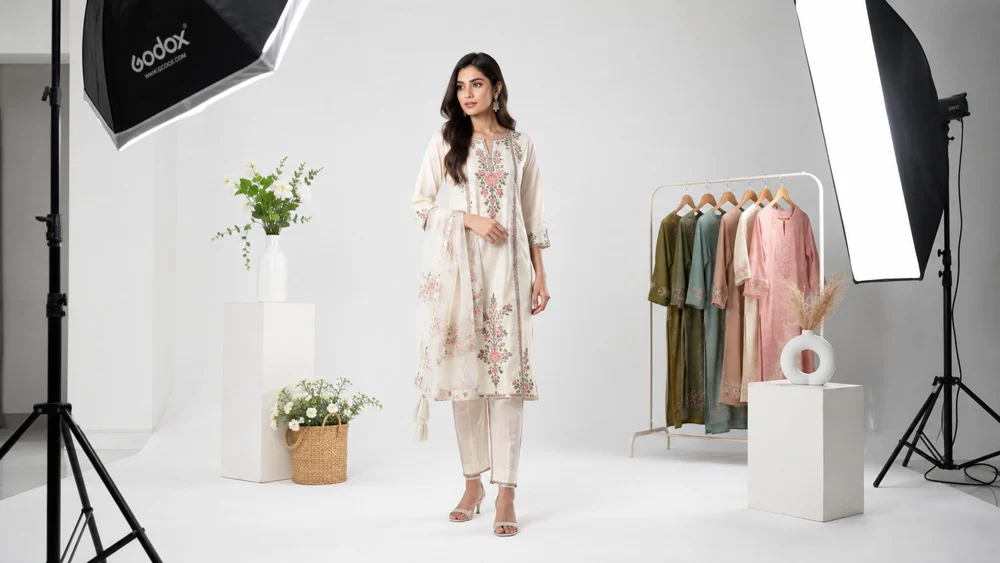
Movement is where most gymwear photos fail. On a regular catalogue day a 1/160s shutter is fine because the model is still. In a jump, the hands and feet blur at that speed, and the fabric ripples look smeared. Our setup for an activewear model photoshoot uses two strip softboxes as side lights to sculpt muscles and seams, one large octabox in front as the key, and separate background heads to keep the white even.
| Shot type | Shutter / flash | Aperture | Tip |
|---|---|---|---|
| Standing fit (front, back, side) | 1/160s, normal power | f/8–f/11 | Camera at hip height to avoid stretching or shortening legs |
| Squat, lunge, stretch | 1/250s, lower power for shorter flash | f/8 | Shoot slightly from the side to show the knee and seat stretch |
| Jump, run, high knee | 1/500s+ with short flash duration | f/5.6–f/8 | Burst mode; pre-focus on the spot where the model lands |
| Fabric close-up | 1/200s | f/8 with macro or 100mm | Raking side light to show knit texture and mesh panels |
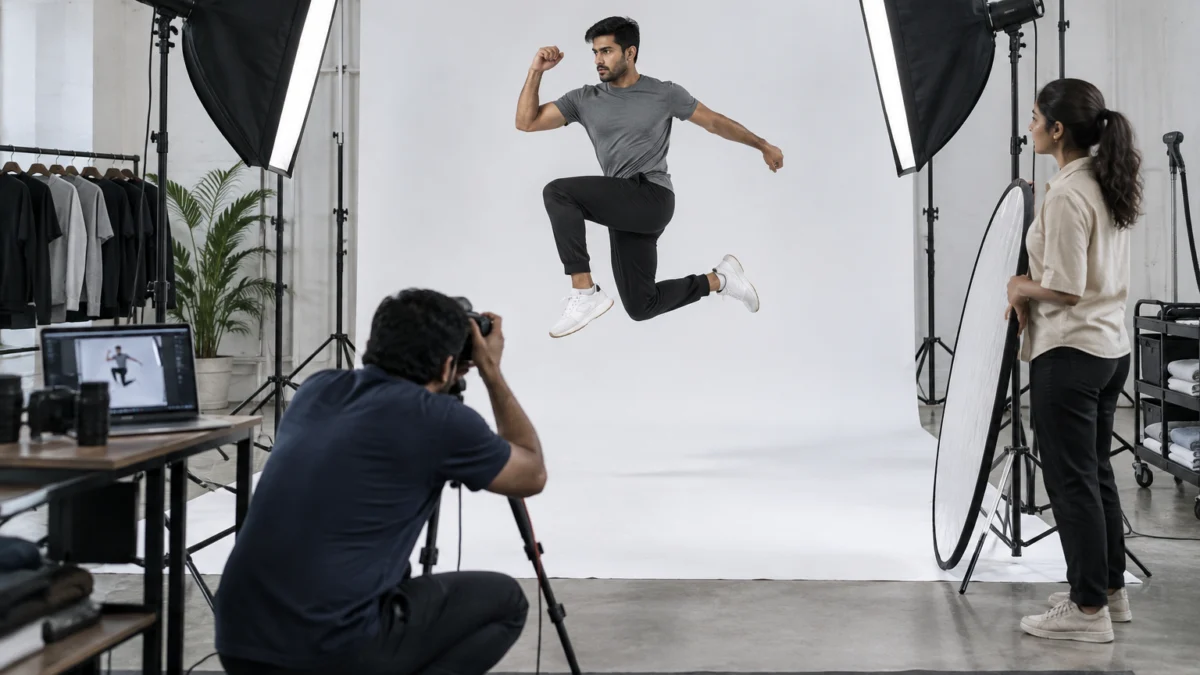
Two more practical rules. First, shoot tethered so the stylist can zoom into every burst and spot a rolled waistband or twisted seam before the model repeats the move. Second, plan 4–6 repetitions per movement; the best frame is rarely the first one. Our lighting kit — full-frame Canon and Sony bodies with Godox and Elinchrom strobes on strip boxes and octaboxes — is set up exactly for this kind of repeat-and-check workflow.
Which 10 Poses Show Stretch and Fit in Activewear?
The 10 most useful gym wear model poses are: front fit, back fit, side profile, deep squat, forward lunge, overhead reach, side stretch, downward dog, high-knee run and mid-air jump. Together they prove fit, stretch, coverage and movement for leggings, bras, joggers and tees.
Fit poses (1–3): the activewear model photoshoot base
- Front fit: feet hip-width, arms slightly away from the body so the waistband and side seams are visible. This is your main image.
- Back fit: same stance from behind; shows seat contour, back seams and racerback straps.
- Side profile: a quarter turn with weight on the back leg; shows rise, length and how the top sits at the hip.
Stretch poses (4–8): proof of performance
- Deep squat: shot from a 45° rear angle; the single best opacity and stretch proof for leggings.
- Forward lunge: shows knee stretch and that the waistband stays high when the torso moves.
- Overhead reach: arms fully up; proves a sports bra or crop top does not ride up.
- Side stretch: a wide stance and side bend; shows four-way stretch across the waist.
- Downward dog or low plank: the classic yoga wear photoshoot frame; shows coverage at the neckline and seat.
Movement poses (9–10): energy and lifestyle
- High-knee run: captured mid-stride; shows that shorts and joggers do not ride up.
- Mid-air jump: the hero frame for banners and A+ modules, full of energy and fabric movement.
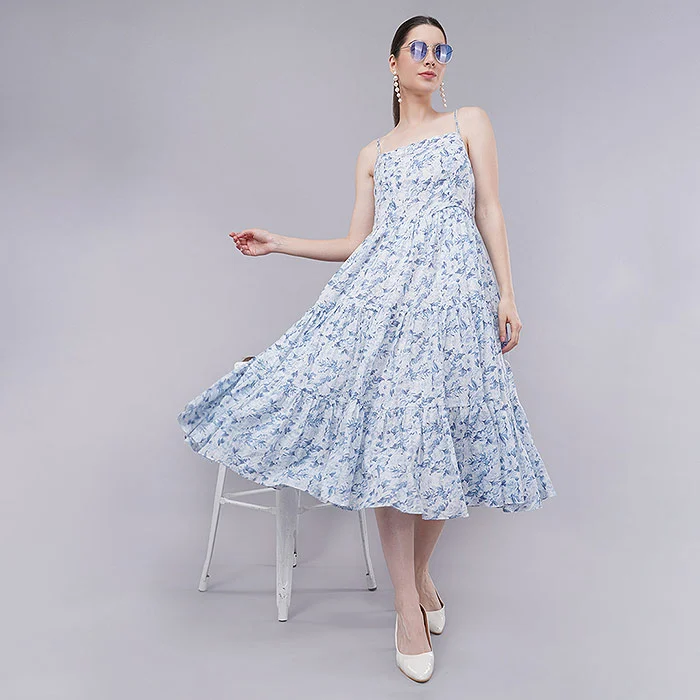
You do not need all 10 poses for every SKU. A pair of leggings needs 1, 2, 4, 5 and 7; a sports bra needs 1, 2, 6 and 8; joggers need 1, 2, 3, 9 and 10. Building this into a written shot list before the shoot saves hours on the floor, and our ecommerce fashion shot list guide shows how to lay that out per SKU.
Which Shot List Should Every Activewear SKU Have?
Every activewear SKU should have at least five to seven images: front fit, back fit, side, one stretch pose, one movement pose, a fabric or detail close-up, and a size/model-info frame. This covers what Myntra and Amazon buyers scroll for and gives your website and ads enough variety.
| Product | Must-have frames | Detail shot |
|---|---|---|
| Leggings / tights | Front, back, side, deep squat, lunge | Waistband, pocket, gusset seam |
| Sports bra | Front, back, overhead reach, downward dog | Strap and band, removable pads |
| Joggers / track pants | Front, back, side, high-knee run, jump | Drawcord, zip pocket, cuff |
| Training t-shirt / tank | Front, back, side, overhead reach | Mesh panel, fabric texture |
| Co-ord / athleisure set | Front, back, walk, seated or relaxed pose | Fabric and stitching |
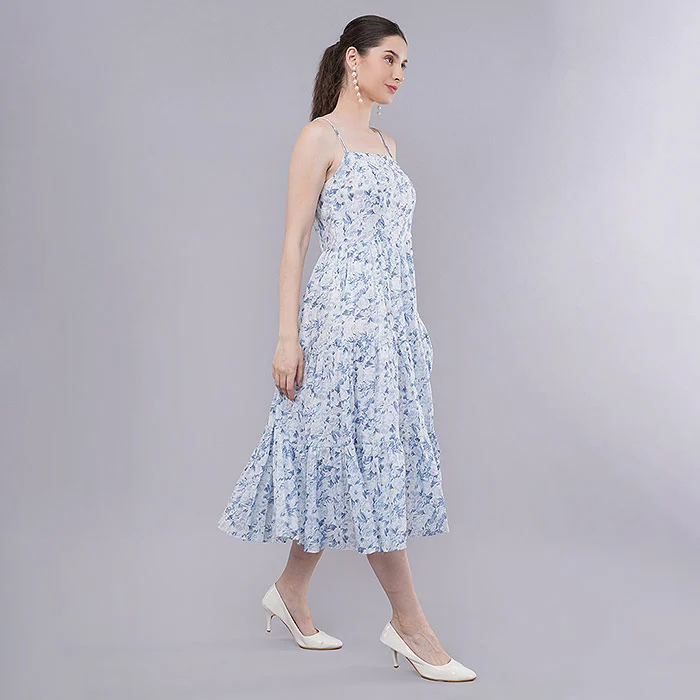
Keep the backdrop and crop identical across colourways. When a buyer switches from black to olive leggings on the listing, the pose and framing should stay the same so the only change is colour. This consistency is what makes a sportswear catalogue shoot look premium on a mobile grid, and it also helps image search: Google’s image SEO best practices reward clear, relevant images with descriptive file names and alt text.
Should You Add Video to an Activewear Model Photoshoot?
Yes — a 20–30 second model video is the most convincing stretch proof you can add. A short clip of a squat, a stretch and a walk shows fabric recovery and fit far better than stills, and the same footage works for listing videos, Reels and ads.
We usually shoot video on the same day, straight after the stills, so the styling and lighting match. A typical sequence is a 360° turn, two squats, a lunge and a short jog in place. For brands that want a full video plan across listings and social, our ecommerce video production team can script and cut multiple formats from one session.
For men’s joggers, cargos and track pants, a slow walk towards the camera with a turn shows drape and fit at the hem. The clip below is a menswear example of that walking style.
How Much Does an Activewear Model Photoshoot Cost at Uniqs Studio?
At Uniqs Studio, model photography for activewear is ₹400 per product for 5–6 angles with a 4–5 day turnaround. Reels and garment videos with a model are priced separately, and ghost mannequin or flat lay can be added for accessories and multi-packs.
| Shoot type | Images | Turnaround | Price |
|---|---|---|---|
| Model Photography | 5–6 angles | 4–5 days | ₹400 / product |
| Ecommerce Reels Video | 20–25 seconds | 4–5 days | ₹900 / product |
| Garment Video with Model | 25–30 seconds | 4–5 days | ₹1,200 / garment |
| Ghost mannequin | 1 angle | 3–4 days | ₹250 / image |
| Flat lay | 2–3 angles | 6 days | ₹290 / product |
| Footwear | 4–5 angles | 5 days | ₹245 / product |
Prices are per product/image as listed; call or WhatsApp +91-8076745824 for bulk catalogue quotes.
What Mistakes Ruin Gymwear Photos?
The biggest mistakes are shooting only standing poses, using models who cannot hold good form, letting dark fabrics turn shiny or flat, and editing colours away from the real product. Each one makes buyers doubt the fit or the fabric, which hurts conversion and invites returns.
- No movement frames: buyers cannot judge stretch from a standing photo alone.
- Poor form: rounded backs and caved knees create folds that look like bad fit.
- Hot spots on synthetics: hard light makes nylon and polyester shine like plastic; use large modifiers.
- Black crushed to pure black: leggings lose all seam and texture detail; lift the shadows carefully.
- Over-smoothing skin and fabric: heavy retouching removes the knit texture buyers want to see.
- AI-generated models: they cannot show real stretch or real fit, and buyers notice. Real models on real samples always win trust.
- Different crops per colour: the listing looks messy and the buyer cannot compare colourways.
Most of these are fixed before the shutter is pressed, not in editing. That is why Satyam insists on a tethered check of the first squat and the first jump for every SKU — if the waistband rolls or the fabric shines, the team fixes it on set rather than spending an hour on retouching later.
Activewear Model Photoshoot Checklist: What to Tick Before Shoot Day
Use this checklist a week before your activewear model photoshoot. It covers samples, casting, the shot list, lighting and delivery formats so nothing is missed on the day.
- All samples received, tagged by SKU and matched to the model’s size.
- Models cast with a movement test video; sizes and heights noted for the listing.
- Shot list per SKU with poses numbered from the 10-pose list above.
- Strobe setup tested for 1/500s jumps and burst shooting.
- Grey mat, resistance band or small props ready for yoga and gym lifestyle frames.
- Opacity test done for every legging colour under studio light.
- Video plan confirmed: 360° turn, squat, lunge, walk.
- Delivery sizes confirmed for Myntra, Amazon and your website.
If you prefer to hand over this planning, email your SKU list to [email protected] and our team will send back a numbered shot list and a call sheet. You can also find our studio address and hours on the Uniqs Studio contact page.
What Activewear Photo Trends Matter for 2026-2027?
The trends that matter are real bodies in real movement, short vertical videos on every listing, consistent studio grids for marketplaces, and honest, lightly retouched skin and fabric. Buyers are getting better at spotting fake images, so authenticity now sells.
- Size-inclusive casting: showing two body types per style is becoming the norm for D2C activewear brands.
- Vertical-first video: 9:16 clips that work on listings, Reels and Shorts from one shoot.
- Clean studio plus one lifestyle frame: white-background consistency for the grid, one gym or yoga mood frame for storytelling.
- Fabric macro shots: mesh, ribbing and moisture-wicking knits shown in close-up.
- Real over AI: brands are moving back to real models after AI images caused fit complaints and returns.
The common thread is trust. An activewear brand photoshoot India buyers believe is one where the model, the movement and the colours are all real. That is exactly what a well-planned studio day delivers.
Activewear Model Photoshoot FAQs
Quick answers to the questions activewear and sportswear brands ask us most before booking a shoot.
Plan five to seven images per SKU: front, back and side fit shots, one stretch pose, one movement pose and a fabric close-up. Uniqs Studio’s model photography package covers 5–6 angles per product.
A deep squat shot from a 45° rear angle is the best single stretch and opacity proof for leggings. Add a forward lunge to show knee stretch and waistband hold.
Use strobes at lower power for a short flash duration, a shutter of 1/500s or faster, pre-focus on the landing spot and shoot in bursts, then pick the sharpest frame.
No. AI models cannot show how your real fabric stretches, recovers or fits, which is exactly what activewear buyers check. Real models on real samples build more trust and cause fewer fit complaints.
At Uniqs Studio, model photography is ₹400 per product for 5–6 angles with a 4–5 day turnaround. Garment video with a model is ₹1,200 per garment and ecommerce reels are ₹900 per product.
Yes. We schedule women’s and men’s looks in blocks with separate models, keeping the same lighting and crop so the whole collection looks consistent on your website and marketplace listings.
What Is the Next Step After Planning Your Activewear Shoot?
Once your poses, casting and shot list are clear, the next step is shoot-day preparation: samples, call sheet, model briefs and delivery formats. Getting this right turns a good plan into a smooth, on-time shoot.
Uniqs Studio shoots activewear, sportswear and athleisure from our in-house studio in Kalkaji and covers brands across Delhi, Gurgaon, Noida, Faridabad and Ghaziabad. When you are ready to lock the details, work through our model photoshoot preparation checklist, then call Satyam on +91-8076745824 or message us on WhatsApp +91-8076745824 to book your activewear model photoshoot.
Ready to show real stretch and fit?
From casting athletic models to burst-shot jumps and 9:16 videos, Uniqs Studio handles your full gymwear photoshoot in one studio day. Call +91-8076745824 or email [email protected].