
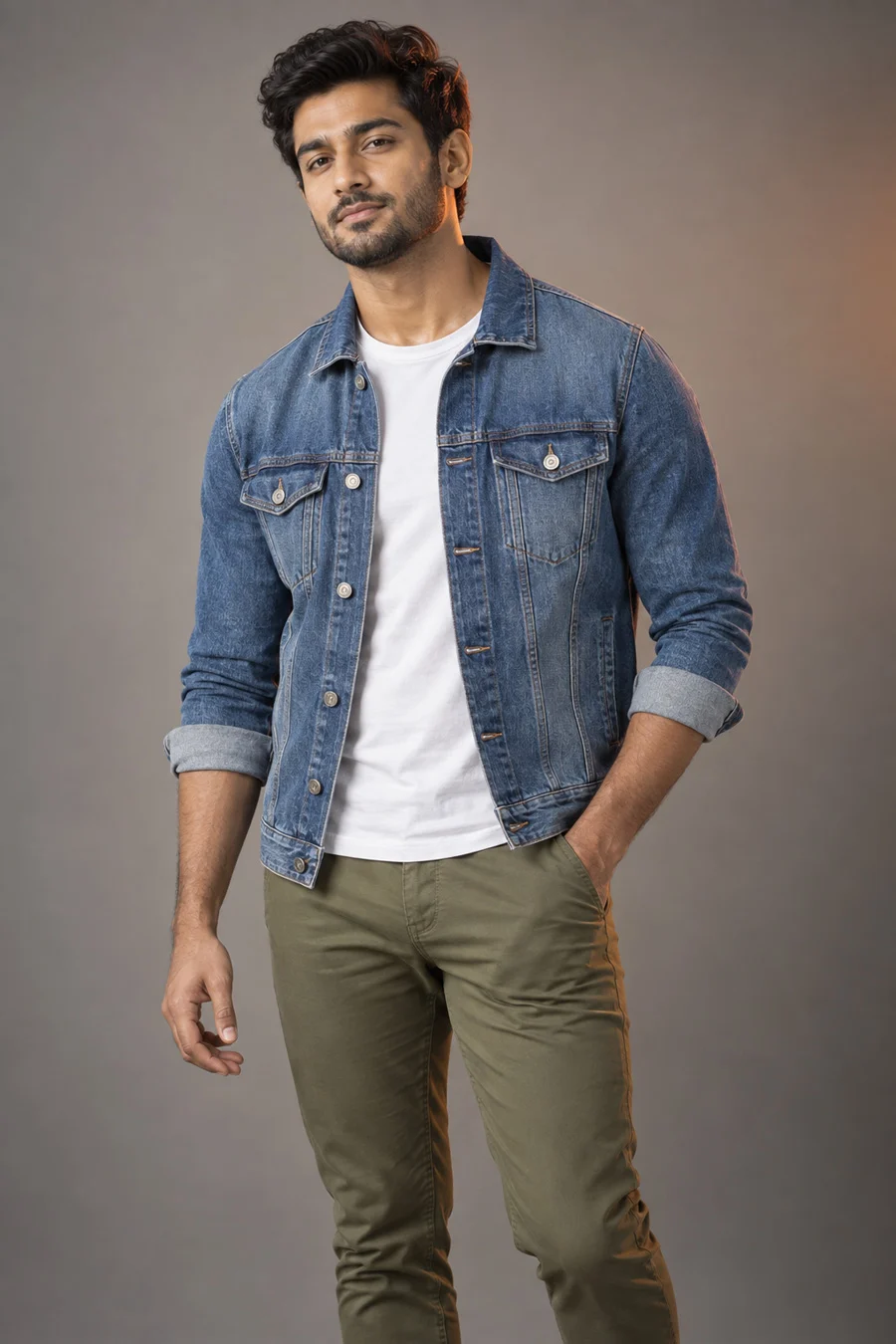
Every October, our sherwani photography calendar fills with the same request: “We have a new groom collection, and the photos need to look like the garment costs what it costs.” That is exactly what sherwani photography has to solve. At Uniqs Studio we handle this as a specialised male model shoot, because a sherwani is heavy, structured, layered and covered in hand embroidery that a flat, rushed catalogue image simply cannot carry.
In this guide, Satyam shares what nine-plus years of ecommerce production have taught us about groom wear photoshoots: which male model poses sell, how to light zari and zardozi without blowing out the gold, which close-ups buyers zoom into, and how to plan a wedding-season catalogue before the Oct–Feb rush. If you run a menswear ethnic label or a wedding wear brand, this is the playbook we follow in our Delhi studio.
- Sherwani photography needs a slower, more structured shoot than shirts or kurtas: steaming, pinning and layering alone can take longer than the camera work.
- Eleven poses cover almost every listing need — from the straight front catalogue frame to the seated “baraat-ready” lifestyle frame.
- Embroidery close-up photography with raking side light is what convinces a buyer to pay a wedding-season price.
- Pair model images with ghost mannequin or flat lay detail shots and one short garment video for the strongest listing.
- Plan and shoot the groom collection 6–8 weeks before the first big muhurat dates so listings are live and indexed in time.
What Is Sherwani Photography and How Is It Different From a Regular Menswear Shoot?
Sherwani photography is the on-model and detail photography of long, structured groom wear — sherwanis, achkans, bandhgalas and indo-western sets — for ecommerce and catalogues. It differs from a shirt or kurta shoot because the garment is heavier, layered, embellished and highly reflective, so styling, posing and lighting all need more control.
A cotton shirt forgives a lot. A sherwani does not. The fabric is usually silk, brocade, velvet or a raw-silk blend; the panels are interlined and stiff; and the surface carries zari, zardozi, sequins, resham or mirror work that flashes the moment a light hits it at the wrong angle. One bad angle and a premium wedding garment looks like costume wear.
There is also more inventory per look. A single sherwani SKU often ships with an inner kurta, churidar or dhoti pants, a stole or dupatta, sometimes a safa, a brooch and mojaris. Buyers want to see each component clearly, which is why sherwani photography blends a full-length model shot, layered detail frames and component close-ups into one listing.
Which garments fall under groom wear photography?
For catalogue planning we group groom wear into four families, because each one poses differently on the model:
- Classic sherwani — knee- or calf-length, high collar, full front button placket; needs vertical, upright poses.
- Achkan and bandhgala — shorter, sharper tailoring; shows best in crisp front and three-quarter frames.
- Indo-western sets — asymmetric drapes, cape layers or jacket-kurta combinations; need movement and walking poses.
- Jodhpuri and reception suits — closer to formal tailoring; benefit from seated and hands-in-pocket frames.
Why Does Sherwani Photography Matter So Much in the Wedding Season?
Because groom wear is a high-ticket, once-in-a-lifetime purchase made mostly from images. Between October and February, buyers compare dozens of listings in one sitting, and the brand whose photos show embroidery, fit and colour most honestly wins both the order and fewer returns.
On marketplaces like Myntra and Amazon, a sherwani buyer typically zooms into three things before adding to cart: the collar and placket embroidery, the fall of the garment at the knee, and the true colour of the base fabric. If any of these is missing or misleading, the buyer either moves on or orders two sizes “to be safe” — and one of them comes back.
Good sherwani product photos also carry your brand beyond the listing. The same images feed your wedding lookbook, WhatsApp catalogue, Instagram carousels and store displays. That is why we always recommend real, professionally shot garments over AI-generated “virtual models” for groom wear: AI tools still smooth out the hand embroidery, invent buttons and change the drape, and a groom notices those differences the moment the parcel opens.
How Should You Prepare a Sherwani Before the Photoshoot?
Steam every panel, press the collar and placket, fit the garment to the model with back clips, and lay out every component — inner kurta, churidar, stole, safa, brooch and mojaris — on a labelled rack before the model steps on set. Preparation decides 70% of how premium the final sherwani photography looks.
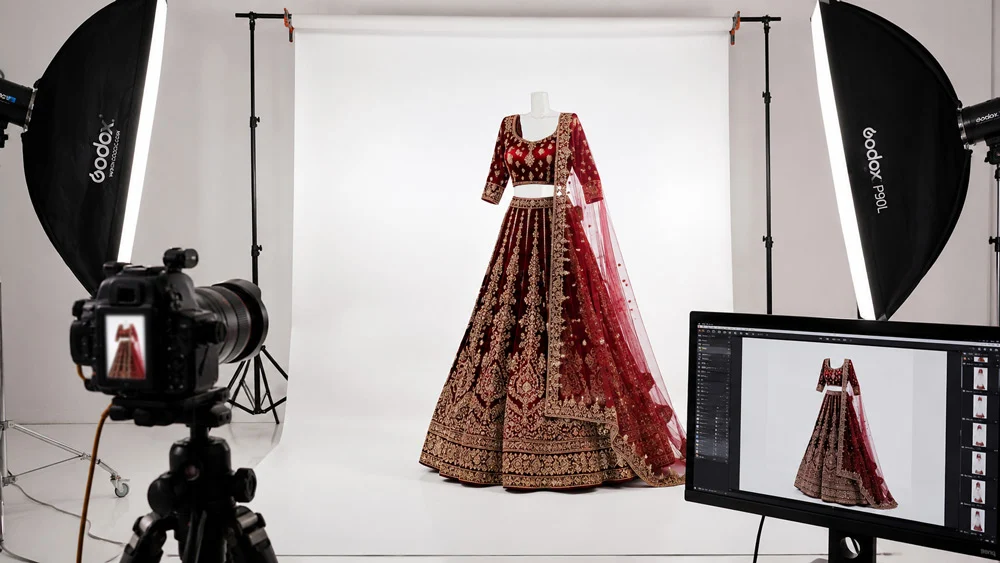
Our pre-shoot routine for groom wear is close to what we describe in our guide to garment preparation for fashion photography, with a few sherwani-specific additions:
- Steam from the inside. Steam brocade and velvet from the lining side so the pile and zari are never flattened or made shiny.
- Press the collar and placket only. A crisp collar line is the first thing the eye reads in a sherwani photo.
- Clip at the back, never the sides. Sample sizes rarely fit perfectly; we take in the back seam with clips so the front silhouette stays clean.
- Check every button. Missing or loose decorative buttons are the most common reshoot reason we see.
- Pre-drape the stole. Decide the stole drape (one shoulder, both shoulders, folded on forearm) before the model arrives, and photograph a reference.
- Match the bottom. Churidar gathers or dhoti pleats should be even; a twisted churidar ruins an otherwise perfect full-length frame.
- Label the rack. Each look gets a SKU tag with its components, so nothing is shot with the wrong stole or mojari.
Model choice matters too. For sherwanis we look for a model with a straight posture, broad but not bulky shoulders, and a neat beard or clean shave that suits your brand. A height of 5’10” to 6’1″ keeps the garment length proportionate, and we always confirm the model’s chest and shoulder measurements against your sample size before booking.
Which 11 Male Model Poses Work Best for Sherwani Photography?
The best sherwani poses are upright, calm and confident: a straight front stance, a three-quarter turn, a back view, a side profile, and a few lifestyle frames such as the cufflink adjust, the stole hold and the seated pose. Together these eleven poses show fit, length, embroidery and personality without hiding any part of the garment.
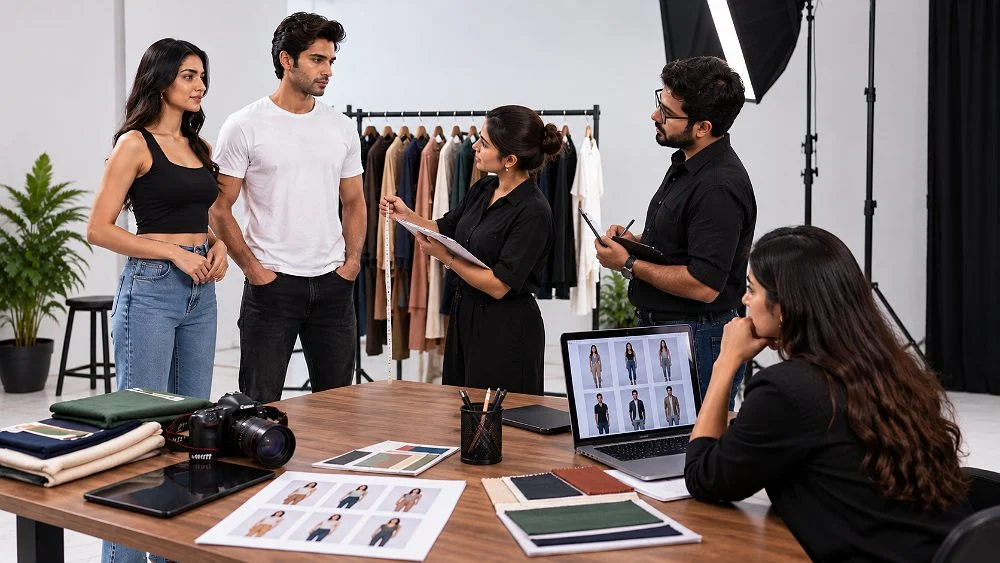
These are the poses we build into every sherwani model photoshoot. Marketplaces usually need the first four; the rest power your A+ content, lookbook and social media.
Catalogue poses (the non-negotiables)
- Straight front, arms relaxed. Feet hip-width apart, hands loosely at the sides or lightly touching the placket. This is your main image and must show the full garment from collar to mojari.
- Three-quarter turn. Body turned 30–45 degrees, weight on the back leg, chin slightly towards the lens. It shows the side seam, the fall and the depth of the garment.
- Full back view. Many sherwanis carry yoke or hem embroidery at the back; buyers want to see it and the fit across the shoulders.
- Side profile. Reveals length, the slit and how the sherwani sits over the churidar — essential for fit-conscious buyers.
Detail and lifestyle poses
- The cufflink or sleeve adjust. Brings the sleeve embroidery and button detail into the frame naturally.
- Collar touch. One hand lightly at the collar, chin up; frames the neckline work beautifully.
- Stole hold. The stole draped over one shoulder and held at the edge, showing the stole border and its colour pairing.
- Walking stride. A slow mid-step frame that shows how the hem moves — especially good for indo-western and cape styles.
- Hands clasped in front. The classic “ready for the pheras” stance; calm and regal, ideal for lookbooks.
- Seated on a carved chair or pouffe. Shows how the garment sits and folds — buyers ask about this more than you would expect.
- Over-the-shoulder look. Back three-quarter with the face turned to the camera; pairs well with back embroidery.
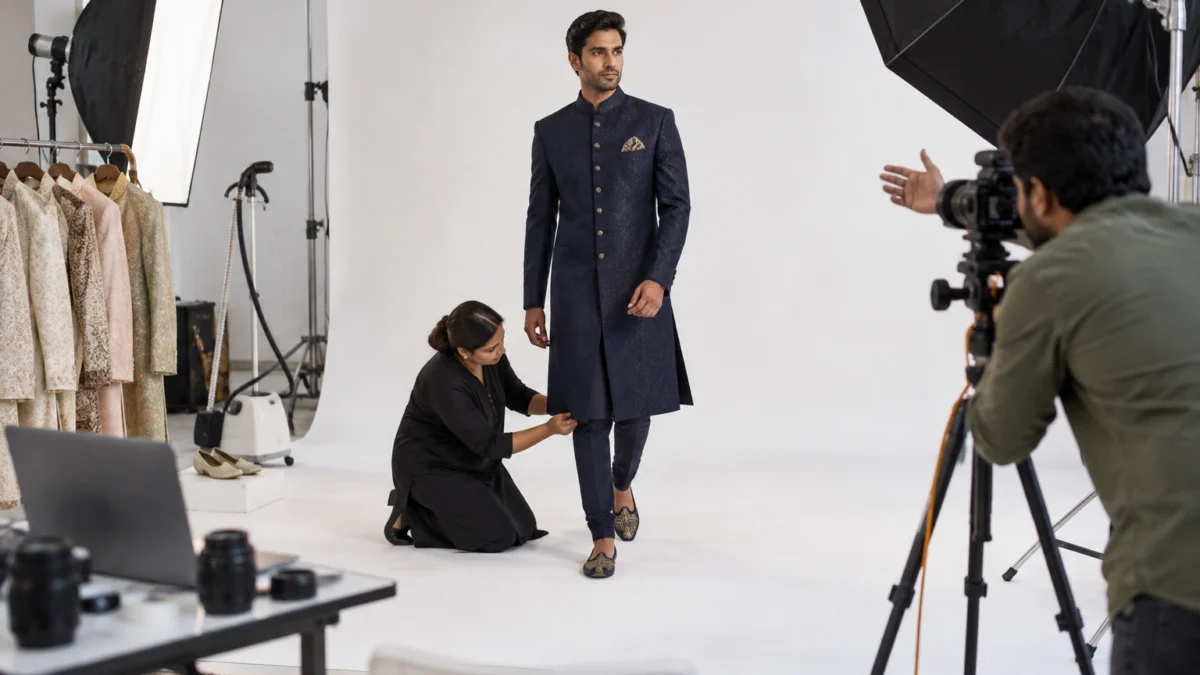
In sherwani photography, expression matters as much as the pose. We direct models towards a soft, assured look rather than a big smile — groom wear sells dignity. If you also sell shirts, kurtas and denim, the poses we cover in our model shoot checklist of poses and angles work alongside this list, so your whole menswear catalogue looks consistent.
How Do You Shoot Embroidery Close-Up Photography for Sherwanis?
Use a macro or short-telephoto lens, a small aperture around f/8–f/11, and a low raking side light so each stitch casts a tiny shadow. Shoot the collar, placket, cuffs, yoke and hem separately, and keep the base fabric colour accurate with a grey card in the first frame.
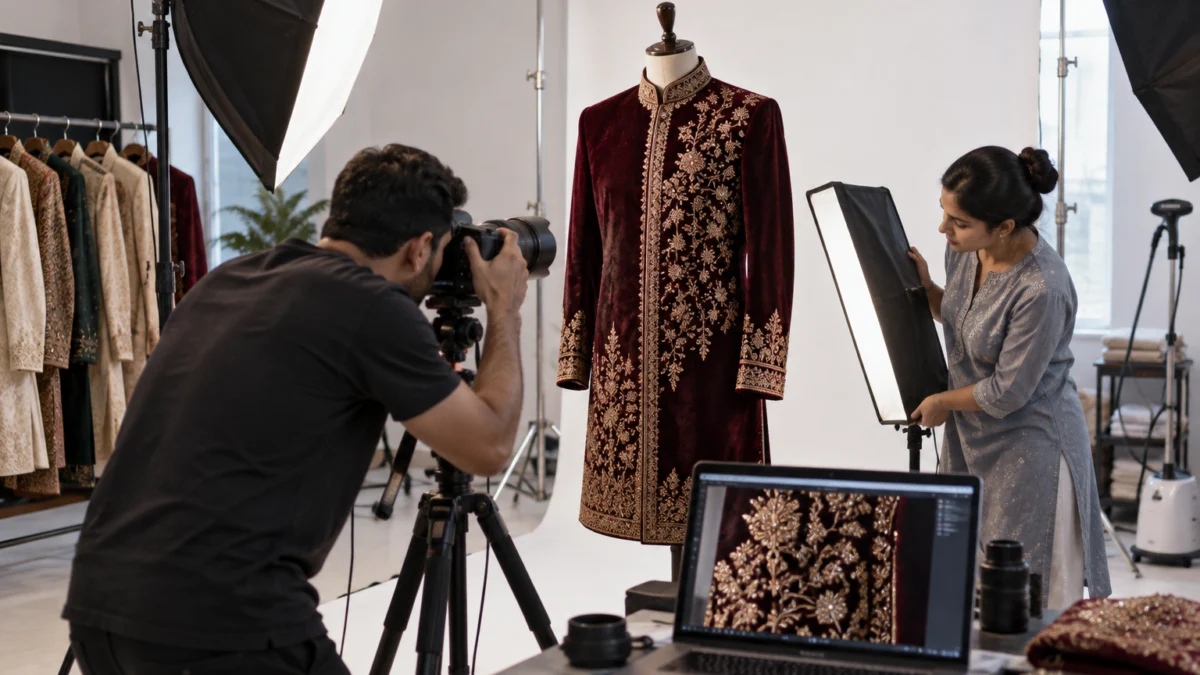
Embroidery is where a sherwani earns its price, and it is the part generic product photos most often flatten. In our studio, embroidery close up photography follows a fixed sequence so nothing is missed:
- Collar and neckline — straight-on, filling about 70% of the frame.
- Placket and buttons — a vertical crop showing three to four buttons and the work around them.
- Cuff and sleeve border — shot on the model’s arm or on a stand.
- Yoke, back or hem motif — whichever carries the signature work.
- Fabric macro — a very tight frame of the base weave, so buyers can judge silk, velvet or brocade texture.
Lens and settings for sherwani photography close-ups
A 100mm macro lens is our default for detail work, with a 50mm used for wider panel shots. We keep the aperture between f/8 and f/11 so raised zardozi stays sharp front to back, and on very dimensional work we focus-stack two or three frames. The camera stays on a tripod and tethered, so the stylist and the client can check every stitch at 100% on screen.
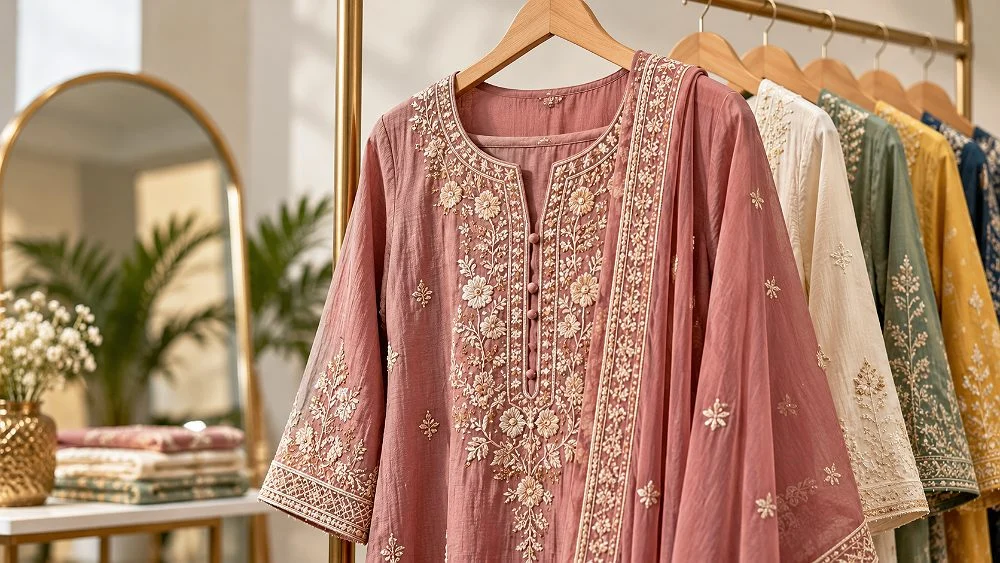
How to keep gold zari from looking flat or blown out
Metallic thread reflects light like a tiny mirror. Front light turns it into flat white blobs; no light turns it brown. We angle the key light 30–45 degrees to the side and slightly above, add a white bounce on the opposite side, and expose for the brightest metallic highlights rather than the base fabric. A polarising filter, used partly rather than fully, cuts glare while keeping a little sparkle — fully cross-polarised zari looks dead and dull.
What Lighting Setup Works Best for Sherwani and Groom Wear Photoshoots?
A large octabox as the key light, two strip softboxes as rim lights to separate dark fabrics from the background, and an evenly lit white or light-grey backdrop. This setup flatters the model, keeps embroidery dimensional and produces consistent images across a whole groom collection.
Our standard sherwani photography setup uses Godox SK400II strobes for the backdrop and fill, with Elinchrom heads in strip softboxes for rim light and a large octabox as the key. For full-length frames we use a full-frame mirrorless body such as the Sony A7R V at around 70–85mm, with the camera at the model’s waist height so the garment does not look shorter or wider than it is.
| Light | Modifier | Position | Why it matters for sherwanis |
|---|---|---|---|
| Key | Large octabox | 45° front-left, slightly above eye level | Soft, even light on face and front panel |
| Rim ×2 | Strip softboxes | Behind the model, both sides | Separates velvet and dark silks from the background |
| Fill | White bounce or V-flat | Opposite the key | Opens shadows in pleats without killing texture |
| Background | Two strobes with reflectors | Aimed at the backdrop | Clean white for marketplaces, consistent across SKUs |
| Detail | Small strip box | Low and to one side | Raking light for embroidery close-ups |
For darker colours — bottle green, maroon, navy and black velvet — we raise the rim lights and expose about a third of a stop brighter, then bring the background back down in post. Pastel and ivory sherwanis are the opposite: we reduce fill so the embroidery does not wash into the base fabric.
What Shots Should a Sherwani Catalogue Include?
A complete sherwani listing needs 7–9 images: front, three-quarter, back and side on model, two or three embroidery close-ups, one component or flat shot of the full set, and one lifestyle frame. Add a short garment video wherever the platform allows it.
This is the sherwani photography order we deliver for most wedding collection shoots for men. It follows the logic of our broader ecommerce fashion shot list, adapted for heavy, multi-piece groom wear:
| # | Shot | Purpose | Best used on |
|---|---|---|---|
| 1 | Straight front, full length | Main image, overall look | Marketplace main image, website PLP |
| 2 | Three-quarter turn | Fit and depth | Gallery slot 2 |
| 3 | Back view | Back embroidery, shoulder fit | Gallery slot 3 |
| 4 | Side profile | Length and slit | Gallery slot 4 |
| 5 | Collar and placket close-up | Craft and quality | Gallery, A+ content |
| 6 | Cuff or hem close-up | Secondary embroidery | Gallery, social carousels |
| 7 | Full set laid out or on mannequin | Shows every component | Gallery, WhatsApp catalogue |
| 8 | Lifestyle or seated frame | Emotion and occasion | Lookbook, banners |
| 9 | Short garment video | Movement and fall | Listing video slot, reels |
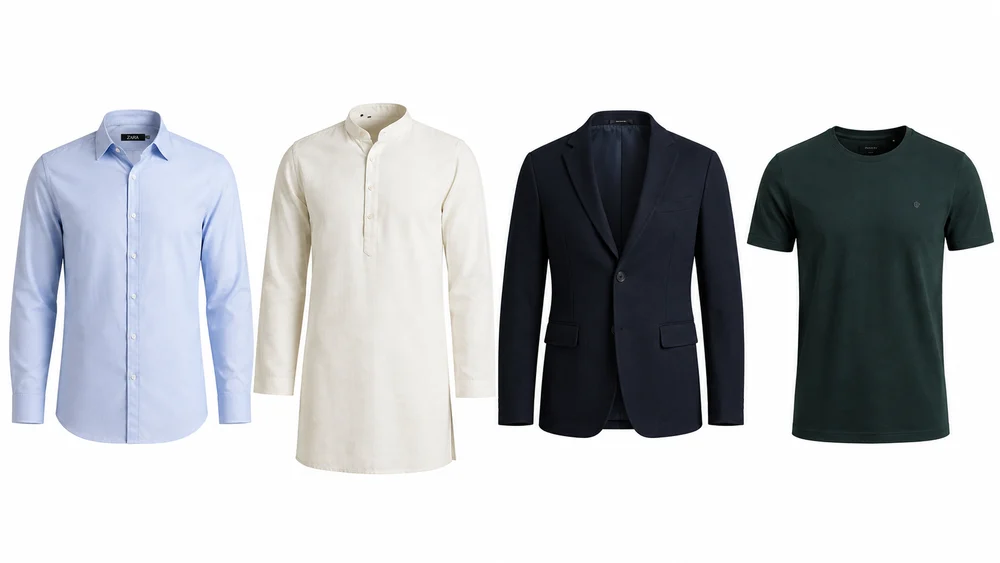
Should You Shoot Sherwanis on a Model, Ghost Mannequin or Flat Lay?
Use a male model for the main and gallery images, because groom wear is bought on how it looks on a person. Add ghost mannequin or flat lay shots for components and colour variants. Most wedding wear labels get the best result from a model-first mix.
| Method | Best for | Strengths | Limitations |
|---|---|---|---|
| On male model | Main image, poses, lifestyle | Shows fit, length, proportion and attitude | Needs casting, styling and more shoot time |
| Ghost mannequin | Inner kurta, jackets, colour variants | Clean 3D shape, consistent across SKUs | No sense of how it fits a real body |
| Flat lay | Full set layout, stoles, accessories | Shows every component in one frame | Heavy sherwanis can look flat and creased |
When a label has 30+ colourways of the same cut, we often shoot two or three hero colours on the model and the rest as clean ghost mannequin shots. It keeps the catalogue consistent and the budget sensible, while the model images still do the selling for the whole range.
If your collection also includes bridal lehengas or coordinated couple outfits, a combined day of on-model fashion shoots with a male and a female model saves time and gives you matching lookbook frames for the wedding season.
How Do Videos and Reels Help Sell Sherwanis and Groom Wear?
A 20–30 second garment video shows what still photos cannot: how the sherwani falls when the groom walks, how the embroidery catches light, and how the stole moves. It is the closest thing to a trial room for an online buyer.
For groom wear, we keep the video simple: a slow 360-degree turn, a short walk towards the camera, a cufflink or stole moment, and a tight pan across the embroidery. These short garment videos are shot on the same set and day as the stills, so the lighting and colour match perfectly across your listing, reels and ads.
How Much Does a Sherwani Photoshoot Cost at Uniqs Studio?
Model photography at Uniqs Studio is ₹400 per product for 5–6 angles with a 4–5 day turnaround, and a garment video with a model is ₹1,200 per garment. Detail and component shots can be added with ghost mannequin or flat lay rates from the table below.
| Shoot type | Images | Turnaround | Price |
|---|---|---|---|
| Model Photography | 5–6 angles | 4–5 days | ₹400 / product |
| Ghost mannequin | 1 angle | 3–4 days | ₹250 / image |
| Flat lay | 2–3 angles | 6 days | ₹290 / product |
| Ecommerce Reels Video | 20–25 seconds | 4–5 days | ₹900 / product |
| Garment Video with Model | 25–30 seconds | 4–5 days | ₹1,200 / garment |
| Footwear | 4–5 angles | 5 days | ₹245 / product |
Prices are per product/image as listed; call or WhatsApp +91-8076745824 for bulk catalogue quotes.
What Mistakes Ruin Sherwani Product Photos?
The most common mistakes are wrinkled or poorly fitted garments, flat front lighting that kills embroidery, wrong colour on maroon and gold, and missing component shots. Each one makes an expensive sherwani look cheaper than it is and pushes up returns.
- Skipping the steam. Creases on velvet and brocade show up even more in high-resolution zoom.
- Loose fit at the chest. A sample one size too big makes the model look like he is wearing a borrowed garment.
- Cropping the mojaris. Buyers want the full look; always leave space below the feet in the main image.
- Front flash only. Flat light turns zari into white patches and hides raised work.
- Colour drift. Maroon going brown or ivory going yellow is the number-one reason for “colour not as shown” returns.
- Over-retouching. Smoothing fabric texture to plastic removes the very handcraft buyers are paying for.
- Busy props. Heavy mandap-style sets distract from the garment in catalogue images; save them for the lookbook.
Colour accuracy is worth a special mention in sherwani photography. We shoot a grey card at the start of every look, calibrate the tethered monitor before the shoot and compare the screen to the physical garment under daylight-balanced light before signing off. It is a small step that saves a lot of awkward customer calls.
What Pro Tips Make a Groom Wear Shoot Look Premium?
Shoot the hero colour first, lock the lighting for the whole collection, and plan detail frames around the garment’s signature embroidery rather than a fixed template. Consistency across SKUs is what makes a groom collection look like a premium brand.
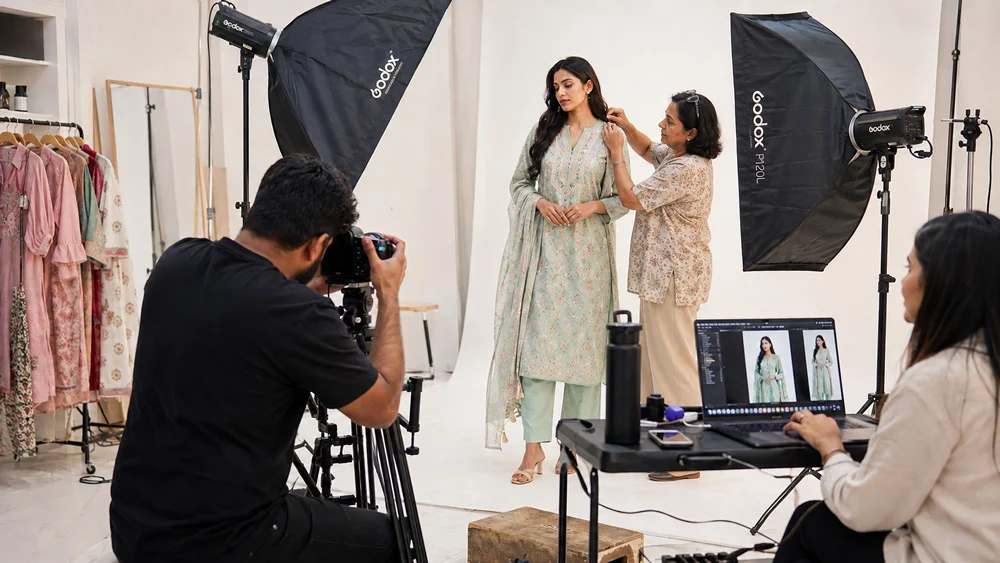
- Lock the set. In sherwani photography, once the hero look is approved, we mark light stands and camera position on the floor so every sherwani in the collection is shot identically.
- Shoot colourways back to back. Same cut, same pose, different colour — it makes your listing grid look clean and professional.
- Brief the model on fabric weight. Heavy velvet sherwanis need slower movement; fast moves create unflattering folds.
- Plan for vertical crops. Leave headroom and footroom so the same frame works for 3:4 marketplace slots and 9:16 reels.
- Keep a styling log. Note the stole drape, brooch position and safa colour for each SKU so reshoots and restocks match.
Most Uniqs Studio groom wear projects come from labels that already sell kurtas and Nehru jackets and are adding a wedding line. If that is you, start with eight to ten hero styles on the model, shoot the rest as component and detail shots, and expand the model coverage once you see which styles convert.
How Do You Plan a Wedding-Season Sherwani Catalogue? (Checklist)
Work backwards from the first big wedding dates: finalise samples eight weeks out, shoot six weeks out, and have listings live and indexed at least four weeks before the peak. Use the checklist below to keep the shoot on track.
- Samples in the right size for the model, with all components (inner kurta, churidar, stole, safa, brooch, mojaris).
- Shot list per SKU agreed — model poses, close-ups, component shots and video.
- Model cast and measurements matched to sample sizes.
- Styling references printed: stole drape, button styling, accessories.
- Colour references shared, especially for maroon, gold, ivory and pastel styles.
- Marketplace image specs confirmed for each channel you sell on.
- File naming and SKU mapping agreed before delivery.
- Video plan ready: which styles get a garment video or reel.
For channel-specific specs, check the official image and catalogue guidelines on the Myntra Partner Portal, and for your own website, follow Google’s image SEO best practices so your sherwani images can also be discovered in Google Images.
What Sherwani Photography Trends Should Brands Watch in 2026-2027?
Expect lighter pastel and ivory sherwanis, more indo-western cuts, more video-first listings, and cleaner, minimal studio styling. Buyers increasingly want to see real texture and real fit, which favours genuine studio photography over synthetic imagery.
- Pastels and tone-on-tone embroidery — harder for sherwani photography than bold colours because the work is subtle; raking light becomes essential.
- Indo-western and cape styles — more movement-led poses and short walking videos.
- Video in every listing — a short garment clip is becoming standard for premium ethnic wear.
- Minimal sets — clean white or warm-grey backgrounds for catalogue, with richer sets kept for campaign images.
- Honest imagery — buyers and platforms are pushing back on AI-altered garment images that do not match the product delivered.
Frequently Asked Questions About Sherwani Photography
These are the questions menswear ethnic brands and wedding wear labels ask us most often before booking a groom wear photoshoot.
A strong sherwani listing uses 7–9 images: front, three-quarter, back and side on model, two or three embroidery close-ups, one full-set component shot and one lifestyle frame, plus a short garment video where the platform allows it.
For the main and gallery images, yes. Groom wear is bought on how it looks on a person, so on-model images show fit, length and proportion. Ghost mannequin and flat lay shots work well for components and extra colourways.
Light the embroidery from the side at 30–45 degrees, add a white bounce opposite, expose for the metallic highlights and use a partial polariser. This keeps the sparkle while showing the raised texture of each stitch.
At Uniqs Studio, model photography is ₹400 per product for 5–6 angles with a 4–5 day turnaround, and a garment video with a model is ₹1,200 per garment. Call or WhatsApp +91-8076745824 for bulk catalogue quotes.
Shoot about six weeks before the first major wedding dates, so listings are live and indexed at least four weeks before the peak. For an Oct–Feb season, that usually means samples ready by August or early September.
We do not recommend it for groom wear. AI tools often change embroidery, buttons and drape, which leads to “not as shown” complaints. Real studio photography shows the actual garment the buyer will receive.
What Is the Next Step After Planning Your Sherwani Photography?
Turn this guide into a shoot-day plan: confirm samples, models and the shot list, then book your studio slot before the wedding-season rush fills the calendar.
Great sherwani photography is mostly preparation, patience with embroidery and a consistent lighting setup across the whole collection. When you are ready to lock the logistics, our model photoshoot preparation checklist walks you through samples, casting, styling and delivery so your groom wear shoot day runs smoothly. You can also get in touch with the Uniqs Studio team to plan dates.