
Myntra AI Garment Video: 7 Critical Differences Between AI Model Videos and Real Fashion Shoots
A practical, category-wise guide from Uniqs Studio on when a Myntra AI garment video actually works — and when a real fashion shoot is still the smarter investment for apparel catalogue and marketplace content.
Every fashion ecommerce brand in India is asking the same question in 2026: should we invest in a Myntra AI Garment Video pipeline, or stay committed to real fashion shoots with human models and studio production? At Uniqs Studio, our Delhi NCR team has spent the last twelve months stress-testing both — AI garment videos, virtual model photography and full real fashion shoots — for D2C brands, high-SKU apparel catalogues and marketplace sellers across fashion ecommerce, Amazon, Flipkart, Myntra, Ajio, Nykaa, Meesho and Shopify. This guide gives you a straight, honest breakdown of where AI actually saves time and money, and where a real fashion shoot still protects your brand.
A Myntra AI Garment Video can be valuable for rapid, high-volume ecommerce content and product reels, while real fashion shoots remain stronger when accurate garment fit, drape, fabric movement and premium brand storytelling are critical. Most growing apparel brands benefit most from a hybrid workflow that combines both.
The reality on the ground is that AI garment video, generative AI model imagery and virtual models have moved from novelty demos into serious catalogue production tools. But so has the risk: warped prints, morphing necklines, incorrect drape and synthetic models that look nothing like the real customer. As a studio that photographs actual apparel every day, we treat AI garment video the same way we treat any other production method — a tool that must earn its place inside the workflow.
What Is a Myntra AI Garment Video?
A Myntra AI Garment Video is an AI-generated fashion video that either dresses a virtual model in a real garment image, or produces model-like motion directly from clothing source photography. Instead of booking a fashion model, studio floor and video crew, the brand uploads accurate garment photography and generates on-model movement using generative AI. The final output is a short vertical or landscape clip suitable for Myntra product listings, catalogue pages, fashion reels and performance ad creative.
It is important to separate AI model imagery (still frames) from AI model video. The video format adds new challenges — fabric motion, frame-to-frame garment consistency, believable body movement — which is exactly why marketplace sellers on apparel ecommerce platforms need a much stricter QC standard than they use for still virtual model photography.
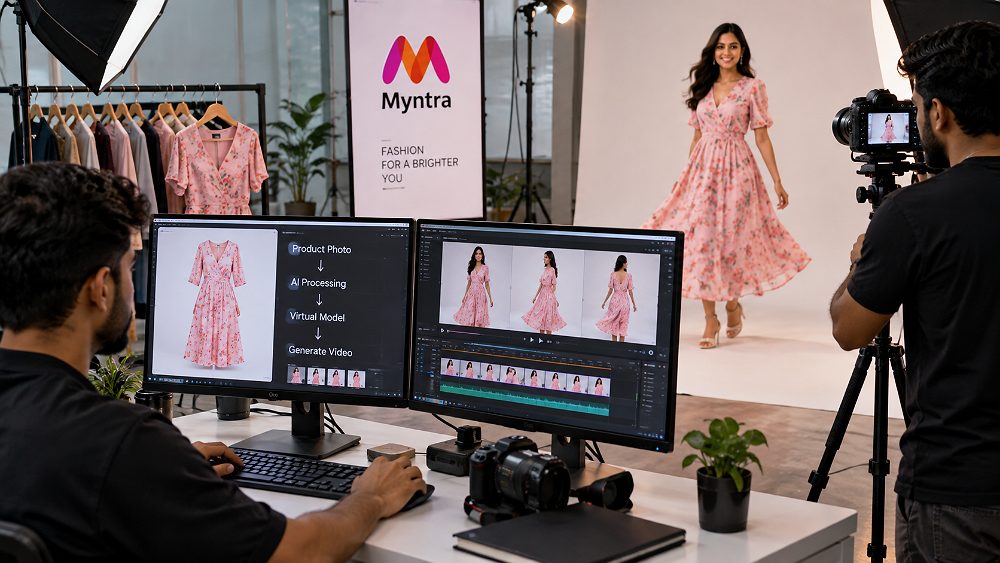
How AI Garment Video Production Works
The typical ecommerce AI video pipeline runs in six steps: capture or upload the garment, select or generate a virtual model, produce poses and movement, review garment accuracy, correct visual inconsistencies, and export ecommerce and reel-ready assets. Each step needs both machine output and human judgement — especially on print, embroidery and drape checks that a Myntra listing will fail without.
Brands that already invest in disciplined apparel product photography get much better AI output, because their source SKU library — front, back, side, detail and fabric texture — gives the AI engine a truthful reference. Rushed or low-quality source photography almost always creates AI garment video failures downstream.
AI Model Video vs Virtual Model Photography
Still virtual model photography and AI fashion video solve different problems. Still frames are used for hero images, listing thumbnails and marketplace catalogue cards. Video is used for product reels, Myntra product reels video, ad creative and social distribution. Video introduces motion physics — how a saree pallu falls, how a co-ord set flows — that stills never test.
Practically, this means a fashion brand should evaluate AI model video separately from AI stills. An AI still can look premium while the same tool produces morphing sleeves in a five-second clip. Always test both formats before you commit an entire apparel catalogue to a single AI pipeline.
Myntra AI Garment Video vs Real Fashion Shoots: Quick Comparison
Before we dig into individual differences, here is the fastest side-by-side view we use with brands during workflow consultations at Uniqs Studio. This table is deliberately built around the decision factors that matter most for fashion ecommerce, marketplace content and catalogue production across Amazon, Flipkart, Myntra, Ajio, Nykaa and Paytm.
| Decision Factor | AI Model Video | Real Fashion Shoot | Recommended For |
|---|---|---|---|
| Production speed | Very fast | Slower, scheduled | AI for catalogue speed |
| Cost at scale | Lower per output | Higher fixed cost | AI for large SKU volume |
| Large SKU catalogues | Excellent | Selective | AI-first with real hero SKUs |
| Garment fit accuracy | Variable | Truthful | Real shoot for fit-critical items |
| Fabric drape | Approximated | Real physics | Real shoot for structured garments |
| Natural fabric movement | Improving, still risky | Authentic | Real shoot for flowing fabrics |
| Model realism | Photorealistic but synthetic | Human, expressive | Real shoot for brand storytelling |
| Brand authenticity | Lower | Higher | Real shoot for premium brands |
| Creative experimentation | Very high | Limited by shoot day | AI for creative testing |
| Model consistency | Prompt-controlled | Same model, same day | Depends on campaign |
| Colour and texture control | Needs QC | Colour-managed on set | Real shoot for exact colour |
| Product reels | Fast, scalable | Premium, curated | Hybrid |
| Premium campaign content | Weaker | Strongest | Real shoot |
| Revisions | Regenerate cheaply | Re-shoot costs more | AI for iterative catalogues |
| Marketplace QC risk | Higher without manual QC | Lower with pro studio | Real shoot for compliance |
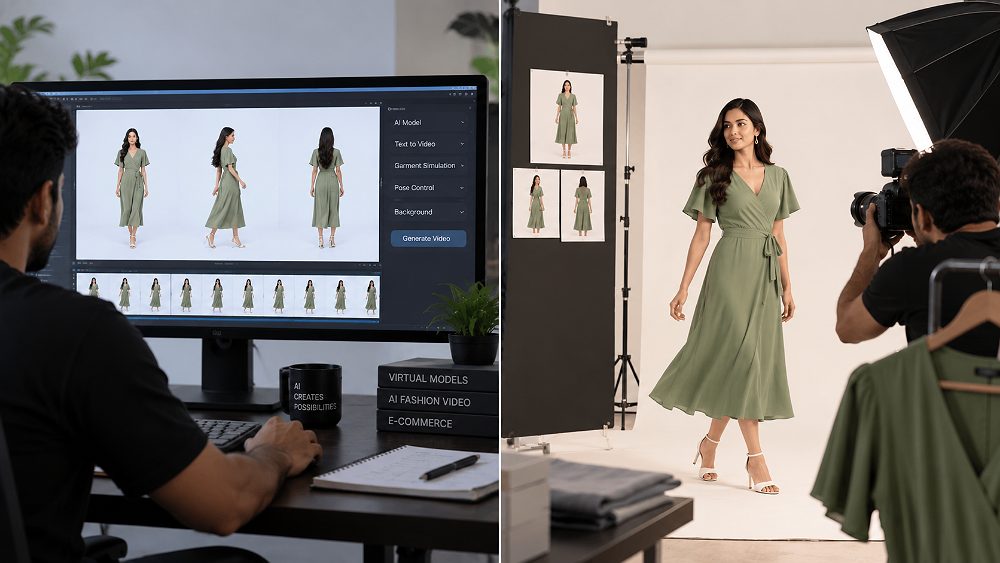
Best Fit for High-SKU Ecommerce Sellers
If your catalogue runs hundreds of colourways, rapid launches and repetitive silhouettes, an ecommerce AI video pipeline is genuinely useful. It gives you the ability to test multiple fashion reels creative directions per SKU without booking a shoot for every colour variant. For teams already using structured catalogue production, AI is a scale multiplier, not a replacement.
Best Fit for Premium and Hero Products
Premium capsule collections, hero SKUs, signature launches and fit-sensitive garments still deserve a real fashion shoot. This is where campaign storytelling, human expression and truthful garment representation drive conversions on Myntra and D2C stores. Our recommendation to premium brands is simple — protect the top 20% of your catalogue with real production even when the rest scales through AI.
7 Critical Differences Between AI Model Videos and Real Fashion Shoots
These are the seven decision axes we walk clients through at Uniqs Studio when they ask whether a Myntra AI Garment Video workflow should replace their existing fashion shoots. Read them as a checklist, not as an argument for one side.
1. Production Cost and Cost per SKU
Headline cost per video is not the right metric. What matters for fashion content production is cost per approved SKU — how much you actually spend to reach a usable, on-brand, marketplace-ready asset. A real shoot carries fixed costs for models, studio, crew, styling and retouching, but delivers a controlled, predictable output. An AI garment video costs less per generation but often needs multiple regenerations before it passes catalogue QC.
In the studio experiments we have run for D2C brands, AI wins on cost-per-generated-output but loses ground once you add QC hours, revision cycles and reshoots caused by incorrect garment details. Reviewing your real garment photography costs against approved AI outputs is the honest way to model this.
2. Turnaround Time and Catalogue Speed
AI is faster in one dimension: generation. But real speed for a Myntra seller depends on the full pipeline — briefing, generation, QC, revisions, retouching, marketplace formatting and upload. A well-run fashion photography studio often closes the gap through parallel styling, batch shooting and predictable delivery schedules.
The honest answer: AI is fastest for variants of an already-approved SKU. Real shoots are still the fastest way to get a fresh collection from concept to marketplace-ready assets when you need coordinated styling, hair, makeup and campaign direction.
3. Garment Accuracy, Fit and Drape
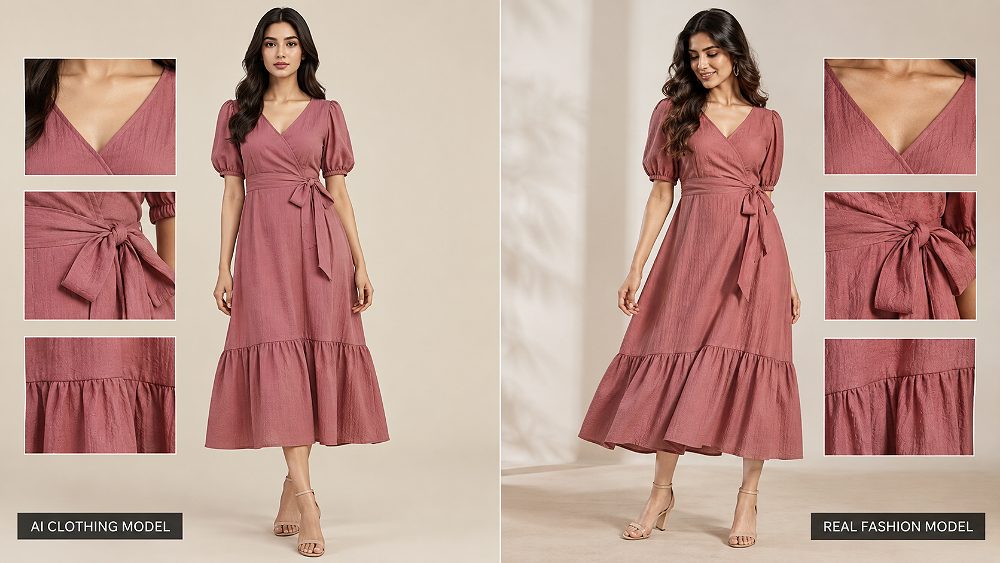
This is where AI clothing model pipelines and virtual model photography most often lose. Sleeve length shifts. Necklines change silhouette. Embroidery gets softened. Prints reflow. Buttons multiply. Pockets disappear. Fabric thickness — the difference between a linen shirt and a poplin shirt — becomes visually inconsistent. For structured garments, tailoring, sarees, lehengas and embroidered ethnic wear, this can quickly become a listing violation.
A real fashion model shoot solves this by construction: the actual garment is in front of the camera, and a good photographer captures its true garment fit, garment drape and stitch detail. Our approach at Uniqs Studio is to build a side-by-side reference test using the exact same garment shot with a real model and generated using AI — the differences are usually visible within seconds.
4. Fabric Movement and Video Realism
Still images hide problems. Video exposes them. Walking, turning, sleeve movement, dupatta flow, skirt swing — these are the moments where fabric movement in an AI garment video either sells the product or breaks trust. Frame-to-frame garment consistency is currently the hardest problem for AI video pipelines, especially with fluid fabrics and layered ethnic wear.
Real ecommerce video production still delivers the most reliable motion realism for Myntra product reels because it captures the actual physical behaviour of the fabric. If a customer is buying based on how a dress moves, the safer decision is a real shoot.
5. Model Realism, Human Trust and Brand Authenticity
Photorealism is not the same as trust. Even highly realistic synthetic models can feel emotionally flat, and shoppers on Myntra, Nykaa and Ajio increasingly recognise AI-generated faces. Facial realism, natural hands, believable body proportions and expressive posing are still stronger with a real fashion model — especially for premium brand campaigns and lookbook content.
Uniqs Studio’s position with premium clients has been consistent: AI can support the top of the funnel, but the closing moment — the visual that a customer trusts before hitting “Add to Bag” — is still owned by real human presence in most Indian fashion categories.
6. SKU Scalability and Creative Flexibility
This is where generative AI genuinely shines. AI fashion photography lets you generate multiple colourways, multiple model types, multiple backgrounds and multiple product videos from a single approved source SKU. For high-SKU brands running weekly drops, this is a serious operational advantage over booking a real shoot every time.
The right way to use this power is to lock in accurate real-world reference images first, then use AI to fan out — not the other way around. A disciplined SKU production library keeps model consistency and visual consistency intact across a large AI-scaled catalogue.
7. Marketplace Quality Control and Commercial Risk
Every marketplace — Myntra, Amazon, Flipkart, Ajio, Nykaa, Meesho, Shopify and Paytm — has its own catalogue standards, and those standards evolve. Your garment representation to the customer must remain truthful. If an AI garment video shows a neckline the actual product does not have, that is a returns problem, a review problem and a potential listing problem.
Practically, this means every AI output for marketplace content and product listing use must go through manual QC before publishing. Do not assume marketplace compliance. Always verify the latest Myntra seller and content requirements before publishing AI-generated assets — a rule we build into every Uniqs Studio fashion content production workflow.
When AI Garment Videos Make More Sense for Ecommerce Brands
There are three environments where an AI garment video pipeline consistently earns its place inside a fashion ecommerce workflow. These are the situations where we actively recommend AI-first content at Uniqs Studio.
High-SKU Catalogues and Frequent Product Drops
Basics, repeatable silhouettes, large catalogues, frequent colour launches and fast inventory testing all benefit from an AI-first content strategy. If you are running an apparel ecommerce catalogue with hundreds of live SKUs across Myntra and Amazon, real shoots for every colour variant become economically difficult. AI-based fashion branding at scale — supported by tight QC — solves this cleanly.
Myntra Product Reels and Performance Creative Testing
Vertical Myntra product reels video, multiple hook variants and social ad creative all benefit from AI’s speed. When you need ten hooks per SKU to A/B test performance, AI turns your existing catalogue assets into additional product videos at very low marginal cost. This is not a replacement for a full production — it is a creative multiplier.
For strong-performing SKUs, we recommend layering AI reel variants on top of your original real shoot. That way the highest-impression content remains real, while ad testing runs cheaper on the AI extensions.
Early Product Testing Before a Full Campaign Shoot
AI is genuinely useful as a low-cost pre-visualisation layer. Test styling, model type, backgrounds and creative directions using AI fashion photography before committing to a real fashion shoot day. This protects the shoot budget and gives the creative director confidence in the final production direction, especially when a new collection is going into fashion photography for ecommerce production.
When Real Fashion Shoots Are Still Worth the Investment
Real fashion shoots are not going anywhere. The specific scenarios where they remain the correct commercial choice are clearer today than ever — because AI has finally taken over the parts of production that were never worth a full shoot in the first place.
Fit-Sensitive and Detail-Heavy Garments
Sarees, lehengas, draped garments, tailored jackets, structured dresses, embroidered ethnic wear, sheer materials, reflective fabrics and complex prints all belong to real fashion production. This is where garment truth wins purchases — and where a professional fashion photographer protects the brand from AI-driven silhouette drift.
Premium Campaigns and Brand Storytelling
Campaigns that carry brand identity, emotional narrative, lifestyle direction, human interaction and creative story require real people. Uniqs Studio has led enough campaigns to know that this is not sentimental — it is commercial. Brands creating premium campaigns, hero product imagery or highly detailed apparel can explore professional Fashion Photography services for greater control over styling, garment presentation and brand storytelling.
Founders often ask us how much premium production actually influences conversions — the honest short answer sits inside our how fashion photography increases clothing sales breakdown.
Hero SKUs and High-Value Products
Every apparel catalogue has a small set of SKUs that generate the majority of revenue. These deserve disproportionate production investment. Real shoots for hero SKUs protect the top of your fashion ecommerce funnel — the imagery a customer sees before deciding to browse deeper. AI can safely scale the long tail behind those hero assets.
The Best Hybrid AI + Real Fashion Shoot Workflow
The strongest recommendation we give apparel brands in 2026 is not “AI vs real” — it is a tiered ecommerce content workflow. Use real shoots where garment truth matters most, and use AI garment video where speed and scale matter most, with a shared source library holding both sides together.
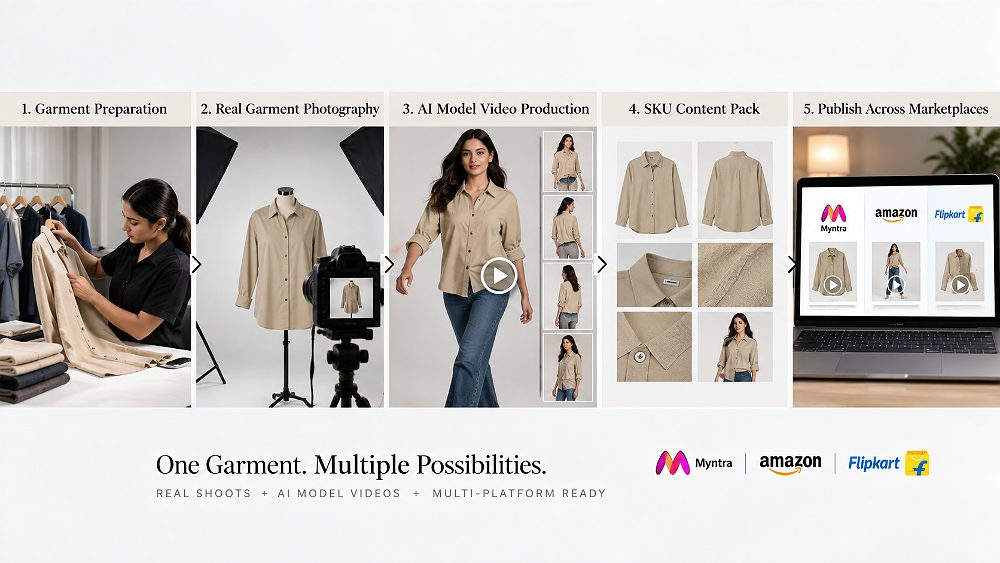
Use Real Shoots for Hero SKUs and AI for Catalogue Scale
A workable tiered framework:
- Tier A — Hero products: real model photoshoot plus premium video for signature SKUs and campaign products.
- Tier B — Core catalogue: professional garment or product capture, selective real model images, and AI video variants for reels and creative testing.
- Tier C — Long-tail SKUs: AI model imagery and AI garment video where the SKU passes garment-accuracy QC.
Build One Accurate Source Asset Library First
Before you scale any AI pipeline, invest in a clean source library — front, back, side, detail, fabric texture, accurate colour reference and true garment shape. Uniqs Studio treats this exactly like traditional garment photography, because that is what it is. The higher the quality of your source library, the lower your AI regeneration rate downstream.
Recommended Hybrid Production Sequence
- Photograph the real garment accurately on a controlled set.
- Capture detail and reference images for print, embroidery and fabric.
- Select hero SKUs for real model shoots.
- Generate AI variants for suitable catalogue SKUs.
- Generate short AI model videos for reels and testing.
- Perform garment-accuracy QC on every AI output.
- Compare each output against the physical product.
- Export marketplace and social versions for Myntra, Amazon, Flipkart, Ajio, Nykaa and Shopify.
Uniqs Studio has spent nine years building disciplined clothing product images per SKU systems for D2C brands and marketplace sellers. That same discipline — reference shot, detail shot, colour reference — is what makes an AI pipeline reliable at scale rather than experimental.
Myntra Product Reels Video Production Checklist
Below is the operational checklist our team runs whenever a client wants to use a Myntra AI Garment Video alongside their real production for reels and marketplace content. It works equally well for Amazon, Flipkart, Ajio, Nykaa and Shopify.
Source Assets to Prepare Before AI Generation
- Clean front garment image on a controlled background.
- Back image with true silhouette.
- Side view where useful for structured garments.
- Fabric detail image showing texture and weight.
- Embroidery and print detail close-ups.
- Accurate colour reference under studio lighting.
- Size and fit reference from the actual product.
- Clean garment cutout for compositing.
- Written product description and reference notes.
AI Garment Video Quality-Control Checklist
- Print remains visually unchanged across all frames.
- Logos and brand details remain accurate.
- Neckline shape matches the physical garment.
- Sleeve length and cuff are correct.
- Hemline is correct in both shape and length.
- Buttons, zips and closures remain consistent.
- Fabric texture looks believable in motion.
- Garment does not morph or reflow during movement.
- Hands and fingers do not distort the product.
- Body proportions remain natural and realistic.
- Colour remains consistent across frames.
- No unexpected garment additions appear.
AI Video Red Flags That Should Trigger Regeneration
- Disappearing embroidery or lace detail.
- Changing patterns between frames.
- Extra buttons or missing closures.
- Altered necklines or collars.
- Incorrect sleeve shapes.
- Warped fingers and hands.
- Floating fabric with no gravity.
- Physically impossible drape.
- Sudden colour or texture changes.
- Garment shape changing between frames.
For a deeper reference on video formats and marketplace-side content requirements, our ecommerce videoshoot guide is the internal reference our team runs against every AI output.
AI Garment Video Cost, ROI and SKU Scale
The single biggest mistake we see brands make is comparing AI cost to real shoot cost at the wrong level. The correct comparison for fashion ecommerce is not “cost per video” — it is cost per approved SKU that clears catalogue QC and can go live on Myntra, Amazon or Flipkart.
Compare Cost per Approved SKU, Not Cost per Generated Video
Track cost per SKU, cost per approved asset, regeneration rate, retouching and revision cost, turnaround time, number of outputs per SKU, internal QC hours and revenue contribution per SKU. Two brands with the same headline AI cost can end up with wildly different real economics once QC and revision hours are counted.
To model this cleanly against real production, cross-reference the fashion photography cost in Delhi for comparable shoot volumes. That gives you a real Delhi NCR benchmark for hybrid production planning.
AI vs Real vs Hybrid Decision-Making Table
| Brand Requirement | AI-First | Real Shoot | Hybrid |
|---|---|---|---|
| Under 50 SKUs | Optional | Recommended | Optional |
| 50–200 SKUs | Selective | Hero SKUs | Recommended |
| 200+ SKUs | Strong fit | Hero SKUs only | Strongly recommended |
| Fast-changing inventory | Strong fit | Limited | Recommended |
| Premium apparel | Not recommended | Recommended | Recommended |
| Detail-heavy garments | Risky | Recommended | Recommended |
| High social content volume | Recommended | Slow | Recommended |
| Hero campaign | Support only | Recommended | Recommended |
| Budget sensitivity | Recommended | Selective | Recommended |
| Strong brand storytelling | Weaker | Recommended | Recommended |
| Frequent colour variants | Strong fit | Costly | Recommended |
| Marketplace catalogue scale | Strong fit | Selective | Recommended |
Which Is Better: Myntra AI Garment Video or a Real Fashion Shoot?
Choose AI-first when SKU volume is high, products change frequently, speed matters, creative variation is important and the garment is straightforward to reproduce accurately. Choose a real fashion shoot when fit and drape strongly influence purchase decisions, when products contain intricate detailing, when the product is premium, when human emotion and brand storytelling matter, and when exact garment movement must be shown truthfully.
Choose hybrid when your brand wants both authenticity and scalable catalogue production — which, in practice, is where most Indian D2C fashion brands and marketplace sellers actually sit. Uniqs Studio’s default recommendation for growing apparel brands is a hybrid model: real production for the SKUs that drive brand and revenue, AI production for scale and variation.
For most growing fashion ecommerce brands, the strongest question is not AI versus real photography. It is deciding which SKUs deserve a real shoot and which content requirements can be scaled safely with AI, without breaking product accuracy or visual consistency.
Plan Your Hybrid AI + Real Fashion Content Workflow with Uniqs Studio
If you need help separating hero SKUs from high-volume catalogue SKUs, or want a production strategy built around your Myntra, Amazon, Flipkart, Ajio and Nykaa listings, speak with our team. Uniqs Studio has been running fashion photography services for D2C and marketplace brands for over nine years.
Frequently Asked Questions About Myntra AI Garment Video
Founders and catalogue managers repeatedly ask us the same practical questions before adopting a Myntra AI Garment Video workflow. These are the honest answers we give inside Uniqs Studio consultations.
1. What is a Myntra AI garment video?
A Myntra AI garment video is an AI-generated fashion video that presents a clothing product on a virtual model or generates model-like movement from garment source imagery. Brands can use this workflow to create scalable ecommerce content, provided the final output represents the actual garment accurately and meets current marketplace requirements.
2. Is AI fashion photography better than a real fashion shoot?
AI fashion photography is usually strongest for speed, variation and high-SKU production, while real fashion shoots provide greater control over actual garment fit, fabric drape, movement and authentic brand storytelling. The better method depends on the product and campaign objective.
3. Can AI model videos replace real models for ecommerce?
AI model videos can replace some repetitive catalogue and creative-testing requirements, but they do not eliminate the value of real models. Fit-sensitive garments, premium campaigns and products with complex fabric behaviour often benefit from real model photography or video.
4. Are AI-generated garment videos suitable for Myntra sellers?
AI-generated garment videos may be useful for Myntra-focused ecommerce workflows, but sellers should verify current Myntra catalogue and content requirements before uploading them. Every AI asset should also be checked carefully for garment, colour, print, fit and construction accuracy.
5. What is the best workflow for a high-SKU fashion brand?
A hybrid workflow is often the strongest approach for high-SKU brands: use real photography or video for hero products and complex garments, then use carefully quality-controlled AI model content to scale suitable catalogue products, variants and performance creatives.
Build Your Fashion Content Workflow with Uniqs Studio
Use AI where it improves scale. Use real fashion production where accuracy and brand value matter most — and build a hybrid workflow when you need both. Uniqs Studio’s Delhi NCR team supports Myntra, Amazon, Flipkart, Ajio, Nykaa, Meesho, Shopify and Paytm sellers with real fashion shoots and AI-assisted content at studio-grade quality.