
Meesho Seller Fees 2026-2027: Commission, Shipping, Return Charges & 9 Profit Rules
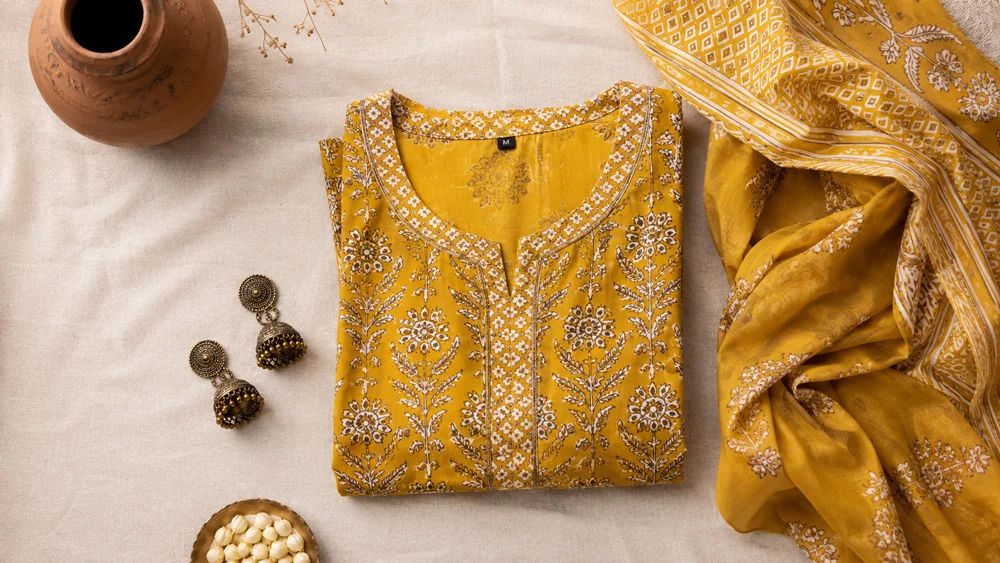
Meesho seller fees look almost too good on paper: zero commission, free registration and no listing charges. Yet many sellers open their first payment statement and find less money than they expected. This guide is part of our Meesho seller hub, where we map the full journey from signup to growth, and here we focus on one question: what does selling on Meesho really cost you per order in 2026-2027?
At Uniqs Studio we shoot catalogues for many first-time marketplace sellers in Delhi NCR, and the same pattern repeats. The Meesho commission rate is not the problem — shipping slabs, return charges and tax deductions are. Satyam has seen sellers price a kurti at ₹299, sell hundreds of units and still end the month with almost nothing. So this guide breaks down every Meesho seller fee, shows you a GST-aware profit calculation, and gives you nine practical rules to protect your margin.
- Meesho charges 0% commission and no registration or listing fee, but forward shipping is deducted on every delivered order.
- Meesho return charges (reverse shipping on customer returns) are the biggest hidden cost for fashion sellers — often more than double the forward shipping.
- 18% GST applies on shipping and service charges; 0.5% TCS (GST) and 0.1% TDS (Section 194-O) are deducted but can be claimed back.
- Payments usually settle around 7 days after delivery, with returns adjusted in later cycles.
- The fastest way to lower your real Meesho seller fees is to cut returns with accurate, honest product images and size details.
What are Meesho seller fees in 2026-2027?
Meesho seller fees in 2026-2027 are mostly logistics and tax deductions, not commission. You pay nothing to register, list or sell, but Meesho deducts forward shipping on delivered orders, reverse shipping on customer returns, 18% GST on those charges, and small TCS and TDS amounts before your payment reaches the bank.
Think of the cost of selling on Meesho in two layers. The first layer is fixed platform costs, which are effectively zero. The second layer is per-order variable costs, which change with weight, delivery zone and whether the buyer keeps the product. Most sellers who struggle on Meesho underestimate the second layer, especially for apparel, where return rates are naturally higher than in home or kitchen categories.
The table below summarises every common Meesho seller charge. Amounts for shipping and returns are indicative ranges reported by sellers in 2026; your own rate card in the Meesho Supplier Panel is the only binding source, so always confirm the live numbers there before you fix your prices.
| Charge | How it works | Typical impact |
|---|---|---|
| Registration & listing | Free supplier account, free catalogue uploads | ₹0 |
| Commission | 0% across categories | ₹0 |
| Forward shipping | By weight slab and zone, deducted on delivered orders | Roughly ₹50–₹90 for a sub-500 g parcel |
| Reverse shipping | Charged when a delivered order is returned by the buyer | Often ₹150+ per return for small parcels |
| RTO (undelivered) | Order comes back without delivery | Usually no reverse fee, but stock and packaging are blocked |
| GST on charges | 18% on shipping and service fees | Claimable as input credit if GST-registered |
| TCS | 0.5% under GST on net taxable sales | Credited to your GST cash ledger |
| TDS | 0.1% under Section 194-O | Adjusted against your income tax |
| Penalties | Late dispatch, cancellations, wrong or defective items | Avoidable with good operations |
Indicative 2026 ranges from seller reports — confirm the live rate card in your Supplier Panel.
Does Meesho really charge 0% commission?
Yes. Meesho keeps a 0% commission model for suppliers, so it does not take a percentage of your selling price. Meesho earns mainly from logistics, advertising and value-added services instead, which is why shipping and returns matter so much more than the Meesho commission rate itself.
The zero Meesho commission fees model is a real advantage for low-price products. On a ₹299 top, even a 10% commission elsewhere would cost about ₹30, so Meesho’s model leaves more room in the price. But the flip side is that a flat shipping charge takes a bigger share of a cheap product than of an expensive one. A ₹65 shipping deduction is about 22% of a ₹299 sale, while it is under 7% of a ₹999 sale.
That is why we tell sellers to stop asking “what is the Meesho commission rate?” and start asking “what share of my price goes to shipping, returns and tax?” Once you think in that way, Meesho seller fees become predictable, and you can design price points, bundles and weight that keep the margin healthy.
Are there any platform or service fees on top?
Some sellers report small platform or service deductions on certain orders, and creator or affiliate commissions can appear under recoveries when a buyer orders through an influencer link. Meesho Ads is optional and billed separately. None of these replace the 0% commission model, but read your payment statement line by line every week so nothing surprises you.
How are Meesho shipping charges calculated?
Meesho shipping charges depend on two things: the weight slab of the packed parcel and the delivery zone (local, regional or national). The charge plus 18% GST is deducted from your settlement on every delivered order, and you cannot choose the courier, so weight control is your main lever.
Meesho assigns the logistics partner, including its own Valmo network, and calculates the slab from the declared and measured weight of your packed parcel. A kurti that weighs 280 g in a light poly mailer may fall into the lowest slab, while the same kurti in a cardboard box with a tag card and thank-you note can cross 500 g and move up a slab on every single order.
| Weight slab | Local | Regional | National |
|---|---|---|---|
| Up to 500 g | ₹27–₹45 | ₹45–₹70 | ₹55–₹90 |
| 500 g – 1 kg | ₹35–₹70 | ₹60–₹95 | ₹80–₹120 |
| 1 – 2 kg | ₹45–₹95 | ₹80–₹135 | ₹100–₹170 |
Indicative Meesho shipping charges reported by sellers in 2026, before 18% GST. Your Supplier Panel shows the exact rate for each SKU.
How do weight discrepancies affect Meesho seller fees?
If the courier’s measured weight is higher than what you declared, the higher slab is charged and the difference shows up as a deduction. Weigh three packed samples of every new SKU on a digital scale, note the heaviest, and declare that. It takes ten minutes and protects you from slab jumps that quietly raise your Meesho seller fees on hundreds of orders.
What are Meesho return charges and RTO charges?
Meesho return charges apply when a buyer receives the order and then returns it — you lose the forward shipping and pay reverse shipping, usually ₹150 or more for a small parcel plus GST. RTO (return to origin) is different: the order never reached the buyer, and sellers usually do not pay reverse shipping on it.
For fashion sellers, customer returns are where Meesho seller fees really bite. Reverse shipping rates reported in 2026 start at around ₹150–₹165 for parcels up to 500 g and climb steeply with weight and courier. Add the forward shipping you already lost, the packaging and the time to re-check and re-list the product, and one return can wipe out the profit of three delivered orders.
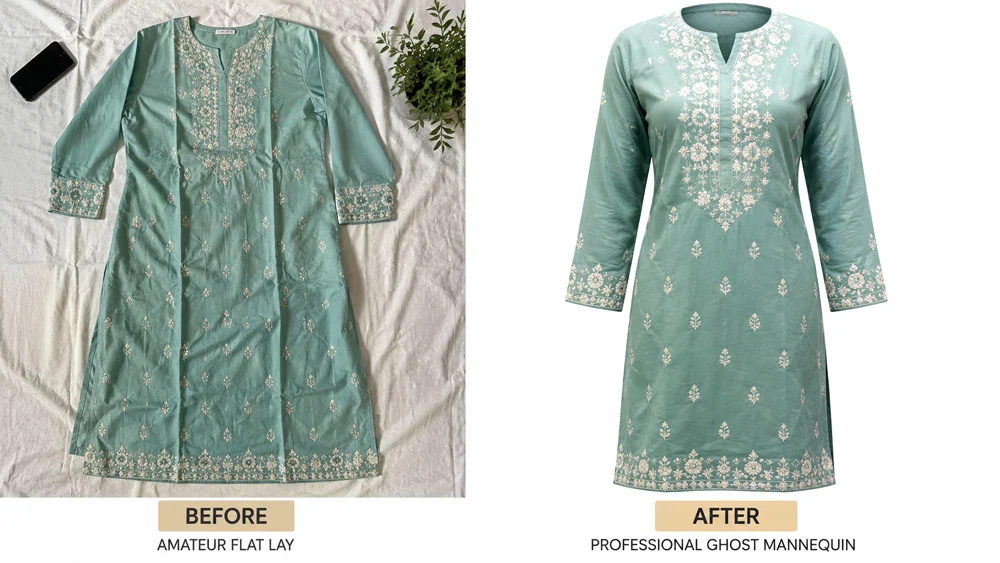
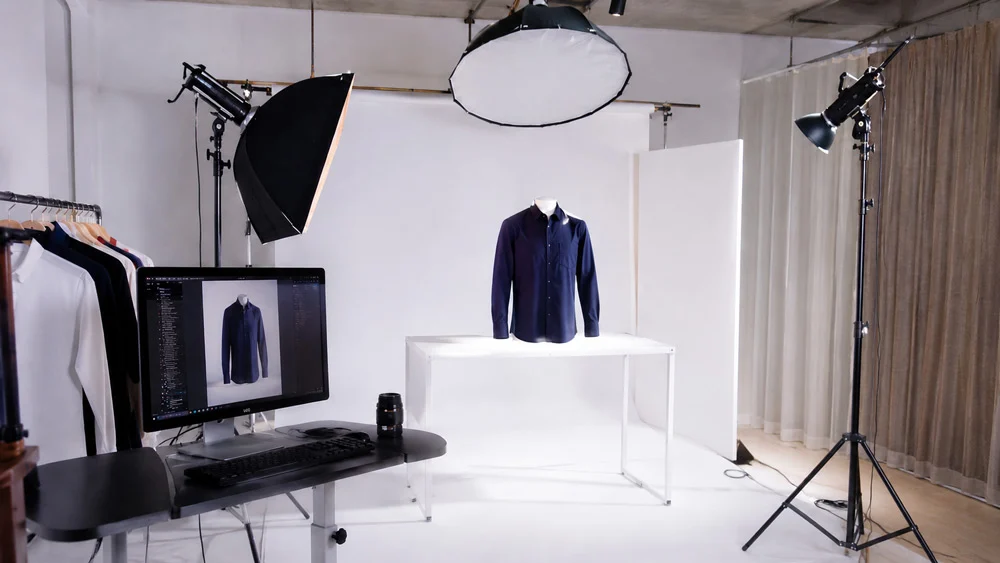
Most apparel returns have the same root causes: colour looks different, fabric looks thicker or shinier in the photo, or size and fit do not match. These are image and information problems, not logistics problems. For kurtas, shirts and dresses, ghost mannequin shots show the garment’s true shape, neckline and length without a model’s styling hiding the fit, which helps buyers order the right product the first time.
How do you claim for wrong or damaged returns?
If a buyer returns a different, used or damaged item, raise a claim from the Supplier Panel within the window shown there, with an unboxing video and clear photos of the returned parcel. Sellers who record a short packing video for every dispatch and an unboxing video for every return win far more claims than those who rely on memory.
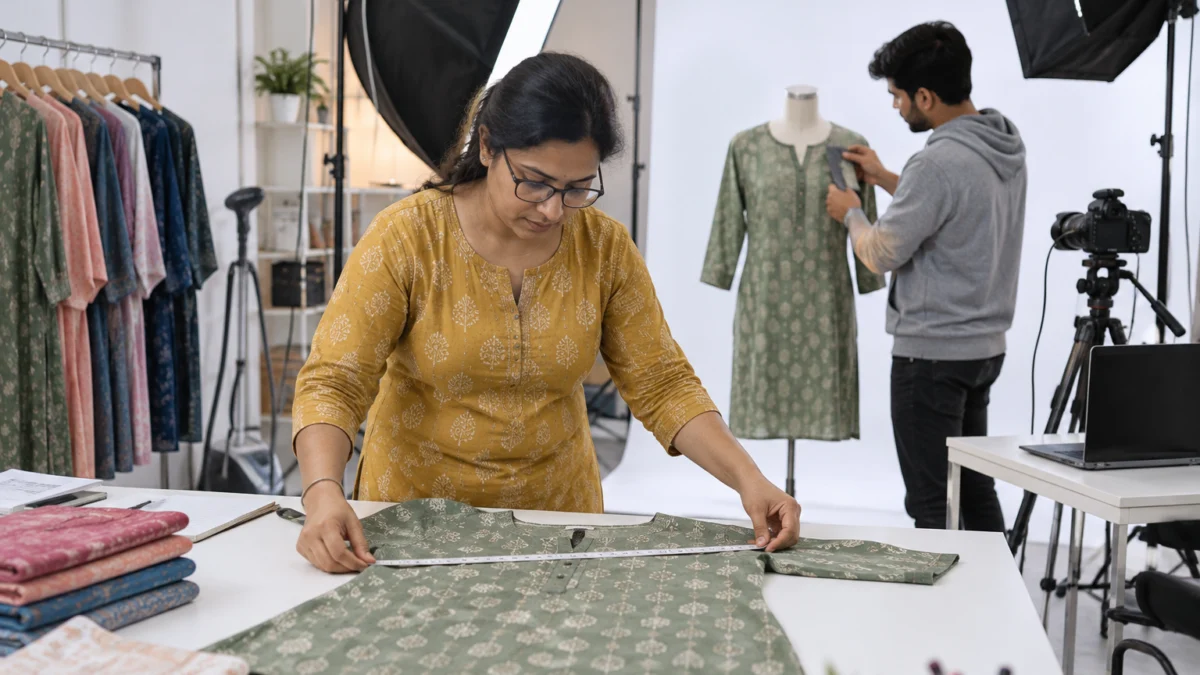
A short model video helps too. When buyers see how a printed kurti moves, falls and fits on a real body, fewer of them are surprised at the door. Here is a short example from our studio.
Which penalties and payment deductions can hit your Meesho settlement?
Apart from shipping and returns, Meesho payment deductions can include penalties for late dispatch, seller-side cancellations, and wrong, defective or poor-quality products. These are policy-based and fully avoidable, so treat every penalty line in your statement as an operations problem to fix that week.
- Late dispatch: orders not handed over within the dispatch SLA can attract a penalty and lower your account rating.
- Seller cancellations: cancelling because of stock-outs hurts both your payout and your visibility. Keep inventory synced daily.
- Wrong or defective product: a mismatch between the catalogue image and the actual product can lead to deductions and catalogue blocks.
- Quality-related returns: repeated “product not as shown” returns can trigger quality checks on your whole catalogue.
- Ads and creator recoveries: optional Meesho Ads spend and affiliate commissions appear as separate lines — budget them deliberately.
The penalty amounts and rules are updated from time to time, so check the policy pages inside your Supplier Panel rather than relying on old forum posts. The good news is that every one of these Meesho seller charges is in your control, unlike the shipping rate card.
How do GST, TCS and TDS work for Meesho sellers?
Meesho seller GST charges work in three parts: 18% GST on shipping and service charges, 0.5% TCS collected under GST on your net taxable sales, and 0.1% TDS under Section 194-O of the Income Tax Act. GST-registered sellers can claim the GST and TCS back; TDS is adjusted when you file your income tax return.
The 18% GST on Meesho’s shipping charges is an input tax credit for a GST-registered seller, so it reduces the output GST you pay on your own sales. The 0.5% TCS appears in your GST cash ledger once Meesho files its return, and you can track it on the official GST portal. The 0.1% TDS shows in your Form 26AS and AIS on the Income Tax e-filing portal.
Sellers on a GST Enrolment ID (non-GST route) cannot claim input credit, so the 18% GST on shipping is a real cost for them. If your monthly sales are growing, discuss GST registration with your CA — the input credit alone can noticeably lower your effective Meesho seller fees. Also confirm your product’s output GST rate by HSN code; most low-price apparel falls in the 5% slab, but your CA should verify it for your items.
When does Meesho pay sellers and how do you read the statement?
Meesho seller payment is usually settled about 7 days after the order is delivered, including cash-on-delivery orders. Returns, claims and penalties are adjusted in later payment cycles, so a weekly statement can show deductions for orders you shipped weeks earlier.
Open the payments section of the Supplier Panel every week and download the order-level report. Match each line to an order ID: selling price, shipping, GST on shipping, TCS, TDS, return or claim adjustments and any recoveries. Sellers who reconcile weekly spot weight-slab errors and wrong deductions early, while those who check once a quarter usually lose the window to dispute them.
- Download the weekly payment report from the Supplier Panel.
- Sort by order ID and flag every return, RTO and penalty line.
- Compare charged weight against your declared weight for each SKU.
- Raise claims for wrong returns while the claim window is open.
- Record TCS and TDS separately so your CA can claim them back.
How do you calculate Meesho seller profit margin per order?
To calculate your Meesho seller profit margin, start from the selling price, subtract shipping with GST, TCS and TDS to get the settlement, then subtract product cost, packaging and net GST payable. Finally, spread the cost of returns across all orders — that last step is the one most sellers skip.
Here is an illustrative example for a GST-registered seller selling a ₹349 cotton kurti (GST-inclusive price, 5% slab assumed) weighing about 350 g, delivered regionally. These are worked numbers to show the method, not Meesho’s official rate card.
| Line item | Amount | Note |
|---|---|---|
| Selling price | ₹349.00 | GST-inclusive |
| Forward shipping | − ₹65.00 | Indicative regional rate |
| GST on shipping (18%) | − ₹11.70 | Claimable as input credit |
| TCS 0.5% + TDS 0.1% | − ₹1.99 | On taxable value, recoverable |
| Bank settlement | ₹270.31 | What arrives about 7 days after delivery |
| Net GST payable | − ₹4.92 | ₹16.62 output GST minus ₹11.70 input credit |
| TCS + TDS recovered later | + ₹1.99 | Via GST ledger and income tax |
| Product cost + packaging | − ₹190.00 | ₹180 product, ₹10 mailer and tag |
| Profit per delivered order | ≈ ₹77 | About 22% of the selling price |
What happens to Meesho seller profit when returns rise?
Now add returns. Assume 10 orders where 2 buyers return the kurti after delivery. Each return costs roughly ₹65 forward shipping plus about ₹160 reverse shipping plus ₹10 packaging — around ₹235. Eight delivered orders earn 8 × ₹77 = ₹616, and two returns cost ₹470, leaving about ₹146 across 10 orders, or under ₹15 per order. A 20% return rate cut the real margin by more than 80%.
This is the single most important lesson about Meesho seller fees: the commission is zero, but returns can make your effective cost of selling on Meesho higher than on a marketplace that charges commission. Bring returns down from 20% to 10% and the same product earns roughly three times more per order.
How can you reduce Meesho seller fees and protect your margin?
You cannot negotiate the Meesho rate card, but you can control weight, returns, penalties and tax credits. These nine rules come from what we see working for sellers who shoot their catalogues with us, and together they can turn a break-even SKU into a profitable one.
- Design for the lowest weight slab. Use light poly mailers, fold garments flat and remove heavy inserts so most SKUs stay under 500 g.
- Declare the heaviest packed weight. Weigh three samples per SKU and declare the highest to avoid discrepancy charges.
- Price for returns, not just delivery. Build your expected return rate into the selling price from day one.
- Show true colour. Colour-accurate images are the cheapest fix for “looks different” returns.
- Measure every size yourself. Publish a size chart in inches from real garment measurements, not a generic template.
- Show fabric and fit up close. Add detail shots of texture, print scale, neckline and hem.
- Add a short model video. Movement answers fit questions that still images cannot.
- Get GST-registered when it makes sense. Input credit on 18% GST lowers your effective fees as volume grows.
- Reconcile every week. Catch wrong deductions and file claims within the window.
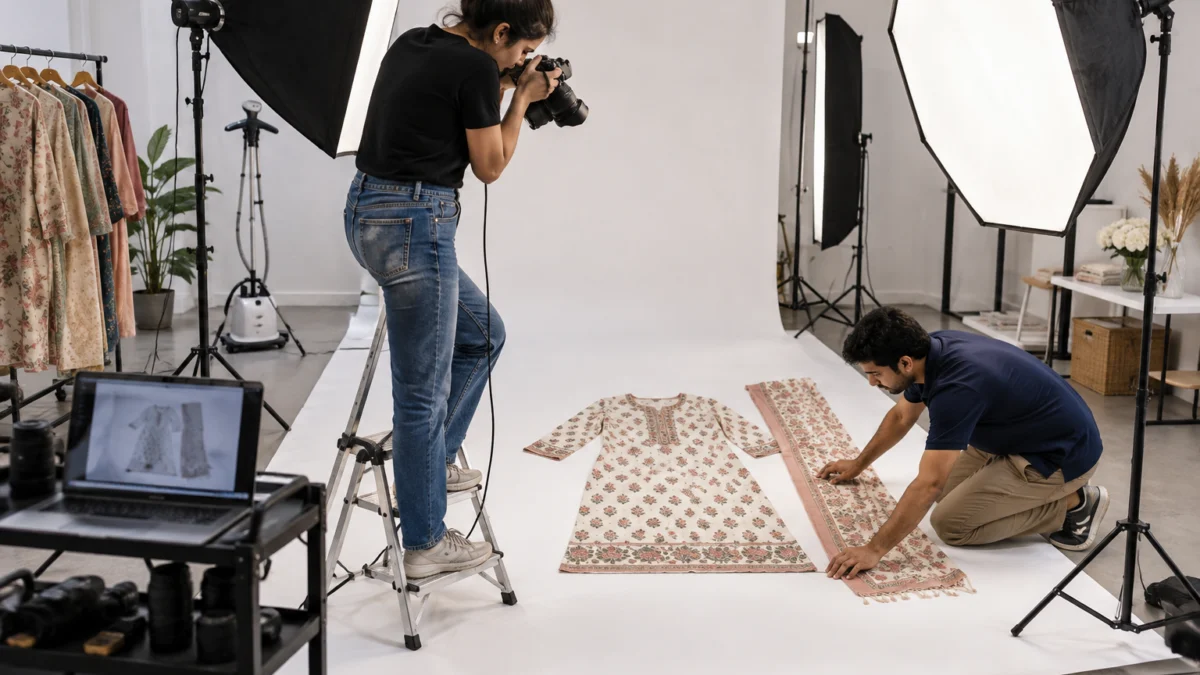
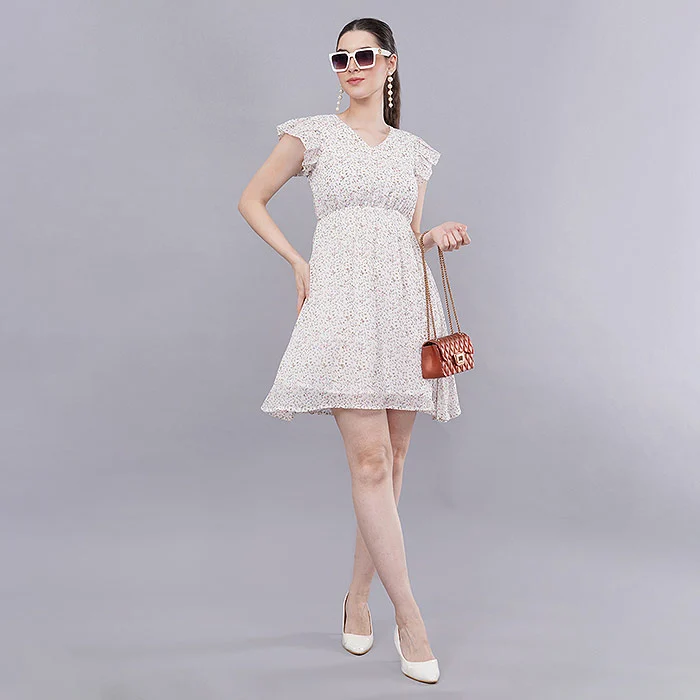
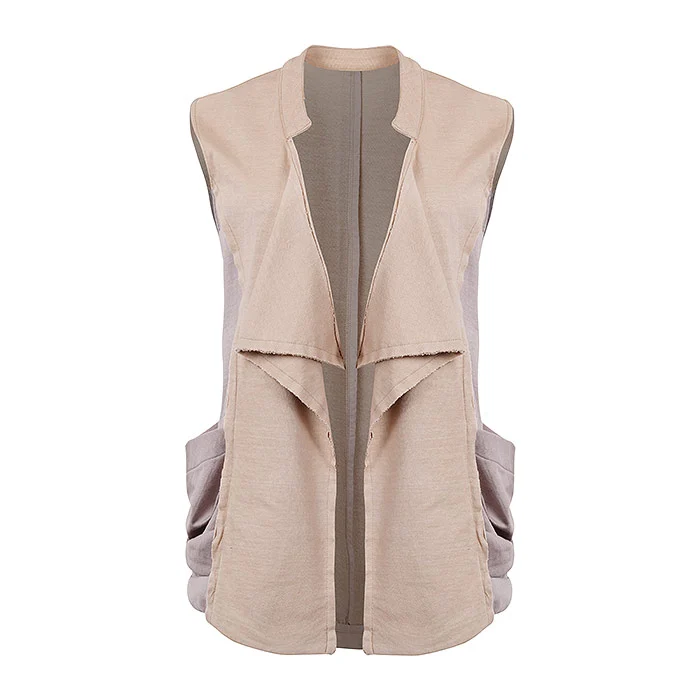
Rules 4 to 7 are where images do the heavy lifting. For kidswear, combo packs and folded basics, flat lay photography shows every piece, colour and print clearly in one frame. For ethnic sets and dresses where drape decides the purchase, on-model fashion shoots show length and fit on a real body, so fewer buyers return the product for being “different from the photo”.
What does a return-proof catalogue shoot cost at Uniqs Studio?
Because profit on Meesho depends on low per-unit costs, sellers often ask what professional images will add per SKU. These are our standard rates for the shoot types that matter most to apparel sellers:
| Shoot type | Images | Turnaround | Price |
|---|---|---|---|
| Ghost mannequin | 1 angle | 3–4 days | ₹250 / image |
| Flat lay | 2–3 angles | 6 days | ₹290 / product |
| Model Photography | 5–6 angles | 4–5 days | ₹400 / product |
| Ecommerce Reels Video | 20–25 seconds | 4–5 days | ₹900 / product |
| Garment Video with Model | 25–30 seconds | 4–5 days | ₹1,200 / garment |
Prices are per product/image as listed; call or WhatsApp +91-8076745824 for bulk catalogue quotes.
Planning a Meesho catalogue? Call +91-8076745824 or WhatsApp +91-8076745824 and share your SKU count — Satyam’s team will suggest the leanest shot list for your category.
How do Meesho seller fees compare with Amazon and Myntra?
Meesho seller fees are usually lower for budget products because there is no commission, while Amazon and Myntra charge category-based commission or referral fees plus closing, fixed and logistics fees. For higher-priced fashion, the gap narrows, and return handling and buyer audience often matter more than the fee table.
If you sell on more than one marketplace, compare the full per-order cost, not just the headline commission. Our guide to Myntra seller fees and commission walks through the same profit method for a fashion-first platform, and our breakdown of Amazon seller fees and FBA charges covers referral and fulfilment costs. Run one SKU through all three and the right channel for each price point becomes obvious.
| Factor | Meesho | Amazon / Myntra |
|---|---|---|
| Commission | 0% | Category-based percentage |
| Best price band | Budget and value products | Mid to premium |
| Biggest hidden cost | Reverse shipping on returns | Commission plus fixed and logistics fees |
| Image expectations | Clean, honest, mobile-friendly | Strict style guides, often on-model |

What are the most common Meesho fee mistakes to avoid?
The most common mistakes are pricing without return costs, ignoring weight slabs, using borrowed or edited supplier photos that misrepresent the product, and never reconciling payments. Each one quietly raises your real Meesho seller fees until a “best-selling” SKU loses money.
- Pricing only for delivered orders. If your margin does not survive a 15–20% return rate, it is not a margin.
- Heavy packaging. A box that pushes a 450 g kurti into the next slab costs you on every order.
- Over-edited or copied images. Filters that brighten colours or images taken from a wholesaler’s catalogue lead to “not as shown” returns and possible catalogue blocks.
- Generic size charts. A copied chart that does not match your garment is a direct path to size returns.
- Not claiming tax credits. Unclaimed GST input credit and TCS are money you already paid.
- Ignoring the statement. Wrong weight or return deductions are only recoverable within the claim window.
What should your Meesho seller fees checklist include?
Before you list a new SKU, run it through a short checklist covering weight, price, returns, tax and images. If the product still makes money after every line, it is ready to go live; if not, fix the price, packaging or images first.
- Packed weight measured and declared at the heaviest sample.
- Shipping slab and zone checked in the Supplier Panel rate card.
- Expected return rate built into the selling price.
- GST on shipping, output GST, TCS and TDS included in the calculation.
- Colour-accurate main image plus detail and back views.
- Size chart measured from your own garment.
- Packing video recorded for dispatch; unboxing video process ready for returns.
- Weekly reconciliation of the payment report on your calendar.
If you are still setting up your account, our Meesho seller registration steps for GST and non-GST suppliers cover the documents and bank details you need before any of these numbers start to matter.
Meesho seller fees: frequently asked questions
These are the questions sellers ask us most often about Meesho seller fees, commission, shipping, returns and payments. Short answers first, so you can act on them quickly.
Meesho charges 0% commission to suppliers. Your main costs are forward shipping on delivered orders, reverse shipping on customer returns, 18% GST on those charges, and small TCS and TDS deductions.
No. Supplier registration, catalogue uploads and listings are free. You only need a GSTIN or GST Enrolment ID, a bank account, PAN and a pickup address.
The seller does. Meesho shipping charges, based on weight slab and delivery zone, are deducted from your settlement for every delivered order, along with 18% GST on the charge.
Sellers usually do not pay reverse shipping on RTO orders that were never delivered. Customer returns after delivery do carry reverse shipping, which is why they cost much more.
Meesho seller payment is usually settled around 7 days after delivery, including cash-on-delivery orders. Returns and claims are adjusted in later cycles.
Keep parcels in the lowest weight slab, declare accurate weight, claim GST input credit, avoid penalties, and cut returns with colour-accurate images, real size charts and short model videos.
What is your next step after understanding Meesho seller fees?
Once you know what Meesho deducts, the next lever is your catalogue. Images decide your click rate, your return rate and therefore your real margin, so the logical next step is to plan photos that win orders without creating returns.
Uniqs Studio has worked with 500+ D2C brands and marketplace sellers over 9+ years from our in-house studio in Kalkaji, New Delhi, and we see the same truth on every platform: cheaper fees never fix a weak catalogue. Write to [email protected] with your category and SKU count if you want a shot list built around your margins.
Next step: read our Meesho product photography rules that win more orders to plan images that sell on Meesho without inviting returns.
Uniqs Studio shoots ghost mannequin, flat lay, on-model images and garment videos for marketplace sellers across Delhi, Gurgaon, Noida, Faridabad and Ghaziabad. Call Satyam on +91-8076745824, WhatsApp +91-8076745824 or email [email protected]. Studio hours: Mon–Sat, 10 am–7 pm.