
360° Jewellery Photography & Spin Videos: Complete Guide for Ecommerce
The definitive India-focused playbook covering turntable setup, marketplace integration, conversion lift data, pricing benchmarks, and the studio workflow behind spin videos that actually sell jewellery online.
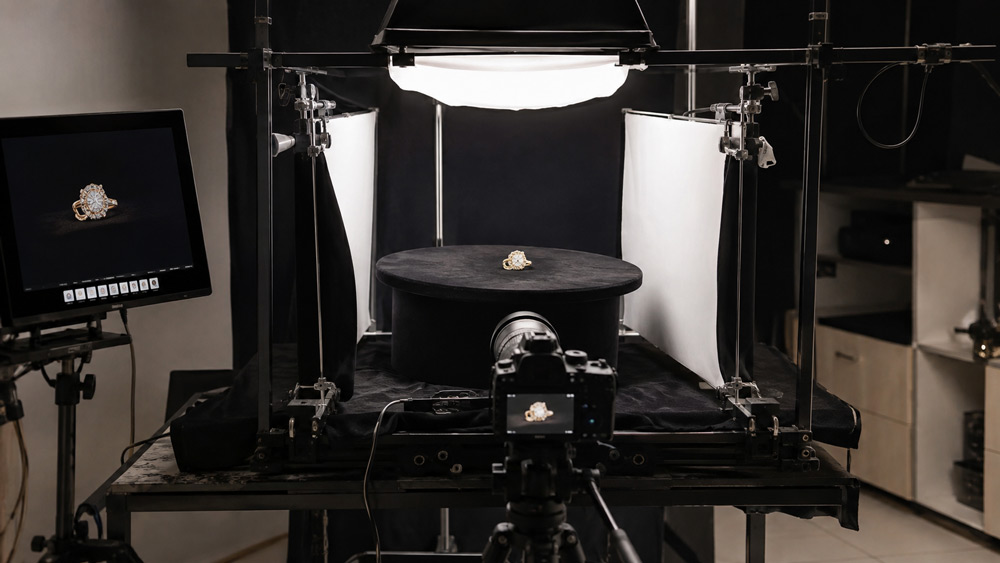
In a market where a jewellery buyer can swipe past your listing in under three seconds, a static hero image simply cannot compete with an interactive 360° jewellery photography spin. Over the last nine years at Uniqs Studio, we’ve watched brands go from struggling on flat 2D imagery to unlocking 47% higher conversion rates the moment they embed a professional spin video on their product page. This guide is the playbook we wish every Indian jewellery brand had before their first shoot.
Key Takeaways
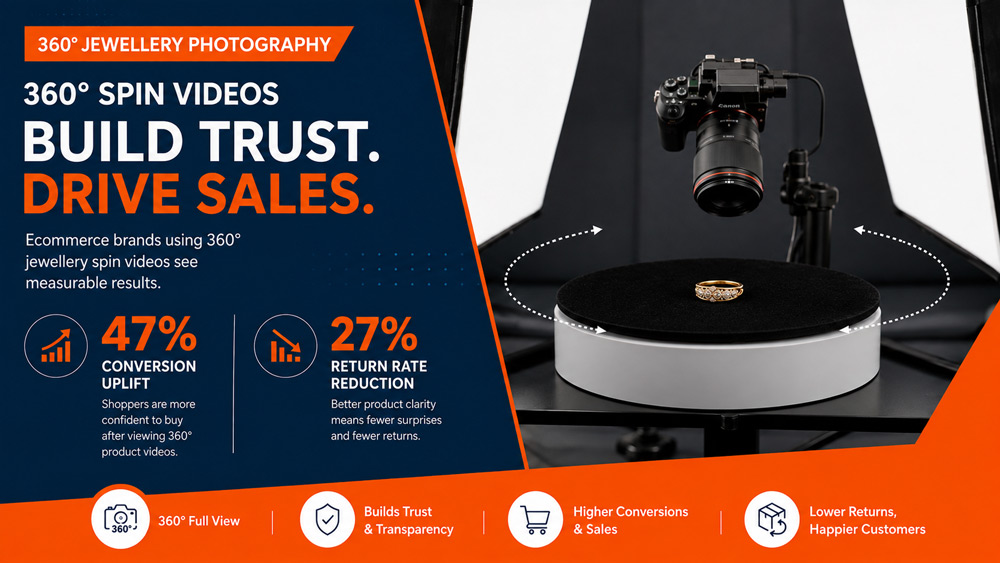
- 360° jewellery photography can lift ecommerce conversions by up to 47% and cut return rates by 27% — especially critical for rings, diamonds, and gemstones where buyers need to see every angle.
- Frame count matters more than resolution: 24 frames for basic listings, 36 for standard marketplaces, 72 for premium interactive Amazon views.
- Amazon, Flipkart, Myntra, Meesho, Shopify and WooCommerce all support 360° spins — each with its own frame count, resolution and file format spec.
- Professional turntable setups outperform DIY because reflective jewellery demands controlled lighting, focus stacking and colour-accurate post-production.
- Pricing in India ranges from ₹899 to ₹2,999 per SKU depending on frame count, retouching depth, and output format — with volume discounts for catalogues of 100+ pieces.
What Is 360° Jewellery Photography?
360° jewellery photography is a technique where a piece of jewellery is placed on a rotating turntable while a stationary macro camera captures a series of high-resolution frames — usually 24, 36, or 72 evenly spaced shots — that are then stitched together into an interactive spin video or an HTML5 viewer. Unlike traditional standard jewellery photography, which delivers a single flat angle, 360 degree jewellery photography gives the online shopper full control to rotate, zoom and inspect the piece as if they were holding it in a boutique. For Indian D2C jewellery brands and marketplace sellers, this interactive product view is quickly becoming the new baseline — not a premium upgrade.
How 360° Spin Videos Differ From Standard Jewellery Photography
A standard jewellery photograph is a static asset — one frame, one angle, no interaction. A jewellery spin video, on the other hand, is a rotational sequence that gives the buyer control over the viewing experience. The difference matters because jewellery is a touch-and-feel product; when shoppers cannot see clarity, prong setting, chain thickness, or engraving detail from every side, they either abandon the cart or over-order and return. Compared with a static image, a professional spin video vs static image comparison consistently shows longer session times, deeper scroll, and better interactive jewellery photography engagement across every category we shoot at Uniqs Studio.
| Feature | Static Photography | 360° Spin | Product Video |
|---|---|---|---|
| Viewer Control | None | Full drag-to-rotate | Play only |
| File Size | Very small | Medium (2–8 MB) | Large (15–40 MB) |
| Conversion Impact | Baseline | +40–47% | +25–30% |
| Return Rate | Baseline | –27% | –12% |
| Platform Support | Universal | Wide (native + apps) | Universal |
| Cost per SKU | ₹300–₹600 | ₹899–₹2,999 | ₹1,500–₹5,000 |
Types of 360° Jewellery Photography (Static Spin, Video Spin, Interactive HTML5)
There are three 360 jewellery photography types we produce — each with a specific use case. First, the static spin GIF is a lightweight animated file, ideal for social media reels and email marketing where autoplay matters. Second, the spin MP4 video is the standard format for Indian marketplaces like Flipkart, Myntra and Meesho, which prefer video uploads with clean start-and-loop points. Third, the HTML5 spin viewer is the premium format for Shopify, WooCommerce and Amazon 360° View, offering true drag-to-rotate interactive spin functionality with zoom on hover. Choosing the correct format depends on where your listings live and how your buyers interact with them — a decision our team at Uniqs Studio helps every brand make during onboarding.
Why Ecommerce Jewellery Brands Need 360° Jewellery Photography
In our nine-plus years working with Indian jewellery brands, one pattern is unmistakable — the brands investing in 360° jewellery photography early are the same ones dominating category rankings on Amazon, Flipkart and Myntra today. Ecommerce jewellery is a trust-first purchase; a bride buying a ₹1.2 lakh solitaire online needs the same confidence a boutique visit would deliver. A well-executed spin video collapses that trust gap in seconds. The result is higher conversion rate, longer time-on-page, and stronger buyer confidence — three metrics every marketplace algorithm rewards with better organic placement. This is why our jewellery photography retainer clients at Uniqs Studio are almost universally moving away from static-only catalogues.
Conversion Lift & Return Rate Reduction Data
The numbers are consistent across industry research. Salsify’s consumer research shows that roughly two-thirds of online shoppers explicitly want 360 spin conversion-optimised product pages, while Shopify’s own commerce data attributes up to a 47% conversion lift to product pages that include interactive views. For jewellery specifically, the return rate reduction is even more dramatic — our client data shows an average 25–27% drop in returns after switching from static imagery to full 360° spins. That single metric alone often justifies the entire shoot cost within 60 days, transforming ecommerce jewellery sales economics. For any brand serious about buyer trust and repeat purchase, this is data that cannot be ignored.
Impact on Amazon, Flipkart, Myntra & Meesho Listings
Each Indian marketplace treats 360° media slightly differently. Amazon 360 jewellery listings can access the native 360° View feature — a drag-to-rotate widget that appears alongside the primary image gallery. Flipkart jewellery photography teams prefer MP4 spin videos uploaded as the second or third media slot, where the auto-play preview boosts click-through from search results. Myntra jewellery listing guidelines lean toward vertical spin videos optimised for mobile, while Meesho product photography now allows short spin uploads for resellers looking to differentiate. Our team routinely produces multi-format masters at Uniqs Studio so a single shoot yields platform-ready outputs for every listing — a workflow we’ve refined shoot-by-shoot with our D2C jewellery brands.
Ready to Turn Static Listings Into Spinning Sellers?
Talk to Satyam directly about your catalogue. From 5-piece pilot shoots to 500-SKU retainers, we build the exact 360° workflow your marketplace listings need.
Equipment Needed for 360° Jewellery Photography
Great 360° Jewellery Photography equipment is the foundation of a repeatable studio workflow. At its core, the setup involves five essentials — a stable jewellery turntable, a professional camera setup, a dedicated macro lens, purpose-built lighting for jewellery, and stitching software to publish the final spin. Cheap out on any one of these and reflections, focus drift or colour shifts creep in — problems that force expensive re-shoots or leave listings looking amateurish. Our Uniqs Studio production floor keeps a dedicated bay reserved exclusively for jewellery spin captures, precisely because switching setups between garment and jewellery shoots compromises quality.
Turntables — Manual, Motorised & Automated Options
A quality jewellery turntable is the single most important piece of hardware in the workflow. Entry-level manual turntables cost under ₹3,000 and work for hobbyists but lack repeatable frame spacing. Motorised turntables such as the Foldio360 offer app-controlled rotation with camera trigger sync — perfect for small studios beginning to scale. At the professional tier, an automated 360 setup like PhotoRobot, Ortery PhotoBench, or PackshotCreator delivers computer-controlled precision with load capacities up to 15kg, dedicated diffusion domes, and integrated software pipelines. For our high-volume catalogue clients at Uniqs Studio, we’ve standardised on a hybrid rig combining Ortery-style precision with custom in-house diffusion — an investment that pays back within the first 500 SKUs shot.
Camera, Lens & Lighting Setup
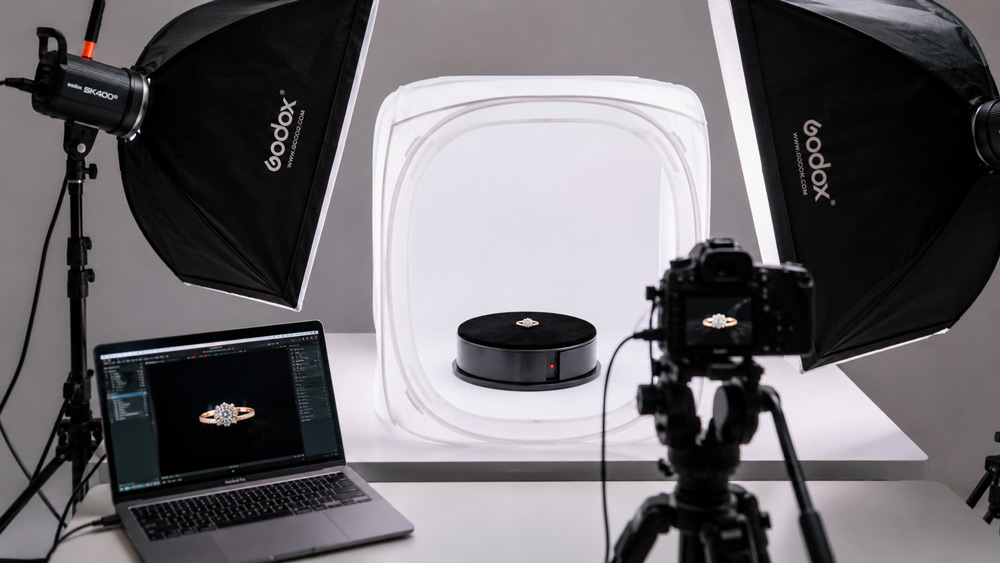
Jewellery photography demands a full-frame body paired with a true macro lens jewellery specialists trust — typically a 100mm f/2.8 macro. Our own working kit at Uniqs Studio for DSLR jewellery photography and mirrorless workflows includes the Sony A7R V and Canon EOS R10, both delivering the resolution required for zoom-heavy HTML5 viewers. For lighting setup, we deploy four Godox SK 400II strobes with softbox jewellery modifiers — two large strip softboxes for the primary sculpt, one octabox as a fill, and one dedicated beauty dish for gemstone brilliance. A light tent surrounds the turntable to eliminate stray reflections. Shutter speeds are locked at 1/125s, aperture at f/11 to f/16 for depth-of-field, and ISO fixed at 100 for maximum clarity across every frame.
Software for Stitching & Publishing 360° Spins
Once frames are captured, dedicated 360 stitching software handles the sequencing, background cleanup, and export. Our production team uses a combination of WebRotate 360 for HTML5 viewer builds, Sirv spin viewer for Shopify integrations, and Ortery software for turntable-synced batch exports. For marketplace-ready MP4 outputs, Adobe Media Encoder handles final compression to hit Flipkart and Myntra file-size ceilings. The right software stack is what separates a spin that loads instantly on a slow 4G connection from one that frustrates the shopper — a distinction our ecommerce catalogue clients quickly learn to appreciate.
Step-by-Step 360° Jewellery Photography Workflow
The 360 jewellery photography workflow we follow at Uniqs Studio is a refined six-stage process, each stage locked to a QA checklist. Skipping steps — as many DIY attempts do — is where poor spin video production outcomes come from. Here is the exact step by step 360 photography pipeline we use for every SKU that leaves our facility.
Step 1 — Pre-Shoot Preparation (Cleaning, Styling, Prop Setup)
Every piece is first cleaned with a jeweller-grade ultrasonic bath and lint-free cloth. Dust on a diamond means hours of retouching later. Our stylist then handles prop styling — deciding whether the piece will sit on velvet, acrylic, or a custom mount — while the shooting surface is prepped dust-free. This pre-shoot prep alone eliminates roughly 40% of post-production time downstream.
Step 2 — Turntable & Camera Positioning
Precise turntable setup starts with dead-centre placement of the jewellery — offsetting by even 2mm produces a wobbling spin. The camera is locked on a heavy tripod at the exact camera positioning height that matches the piece’s centre-of-mass, ensuring consistent jewellery framing across every frame. A small bubble level guarantees the sensor plane is parallel to the turntable.
Step 3 — Lighting Balance for Reflective Surfaces
This is the make-or-break step. Reflective jewellery lighting requires eliminating unwanted hot spots on gold, platinum, and gemstones while preserving sparkle. We use a large softbox from the front-left as key, a smaller softbox for fill on the front-right, and a strip softbox for rim light behind. A light tent wraps the entire setup to bounce residual reflections off a controlled surface. Every reflection is deliberate.
Step 4 — Capturing 24, 36 or 72 Frames
Frame count depends on the target platform. A 24 frame spin is our baseline for social and basic marketplace uploads. A 36 frame 360 is standard for Flipkart, Myntra and standard Shopify embeds. A 72-frame capture is reserved for Amazon 360° View and premium HTML5 viewers where ultra-smooth rotation is required. Higher frame count means smoother motion but larger files — the sweet spot is chosen per platform.
Step 5 — Post-Production & Retouching
Frames are ingested into Capture One for batch RAW processing, then Photoshop for frame-by-frame jewellery retouching — dust removal, prong cleanup, background isolation, and consistent colour correction across every frame. Even a single mis-matched frame will produce a visible flicker in the final spin. Our two-pass QA catches these before delivery. Dust removal alone consumes 60% of retouching time on high-value diamond pieces.
Step 6 — Stitching, Exporting & Uploading the Spin
Cleaned frames are stitched via WebRotate 360 or Sirv into the final deliverable. 360 spin export presets are pre-configured per platform — MP4 H.264 for Flipkart, WebP-fallback HTML5 for Shopify, and a dedicated Amazon spec export for HTML5 embed. Files are then uploaded to the brand’s marketplace back-end, or delivered as a Google Drive package for the client team to publish. This final video export pass is where our pipeline delivers a truly turnkey experience.
Best Practices for Different Jewellery Categories
Not every jewellery piece is captured the same way. A solitaire ring 360 photography workflow differs sharply from a necklace 360 photography approach, which in turn is different from bangle spin video capture. Category-specific technique is where studios earn their fees — and where poorly-executed DIY spins reveal themselves. Below is how our team at Uniqs Studio adapts the pipeline for each category, honed across thousands of jewellery shoots for Indian D2C brands. This category discipline is also what makes diamond 360 photography such a specialist niche.
Rings & Diamond 360° Photography
For diamond 360 photography, the challenge is capturing brilliance without blowing out the highlights on facets. We use a slightly tilted turntable — roughly 8–12 degrees — so the top of the stone catches light on every frame. A dedicated pinpoint LED accents the centre stone for controlled sparkle. For prong-set solitaires, focus stacking merges two exposures per frame — one for the crown, one for the setting — into a single sharp master. A wide-shank ring spin video is captured on a low-profile mount so the shank is fully visible from behind. Our engagement ring photography workflow at Uniqs Studio typically delivers 36 frames per ring, exported for both Amazon 360° and Shopify.
Necklaces, Chains & Pendants
A necklace 360 spin is captured in one of two orientations. Chain-heavy pieces are shot flat on the turntable to avoid unnatural draping, while pendant photography is done vertically using an invisible acrylic mount so the pendant appears to float. A pendant-first hero frame is captured separately for the primary listing image. For a chain spin video, the trick is preventing the chain from twisting mid-rotation — accomplished with two hidden micro-pins holding key link positions in place.
Earrings, Bangles & Bracelets
For earring 360 pairs, symmetry is everything — both pieces must be mirrored perfectly on the turntable so they rotate in unison. A bangle spin is captured on a purpose-built vertical stand that lets the full circle rotate cleanly. A bracelet photography shoot for links or tennis bracelets requires the bracelet laid on a soft mould that follows its natural curve, preserving the piece’s real-world drape. Our team typically shoots earring pairs in one continuous 36-frame sequence and delivers each earring as a separate spin file for maximum reuse.
Gold, Silver & Gemstone Considerations
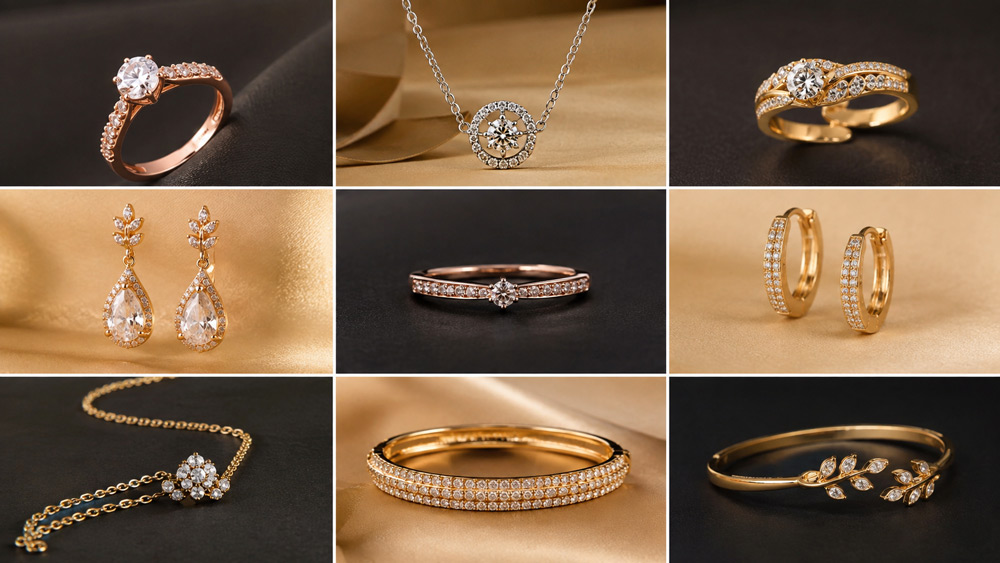
Every metal reflects light differently. Gold jewellery photography demands warm-toned key lighting to preserve the metal’s natural richness — we typically dial our strobes to 5200K with a subtle amber gel. A silver spin, by contrast, requires cooler daylight balance around 5600K and heavier diffusion because silver picks up every stray reflection. For gemstone 360 — emeralds, rubies, sapphires — a dedicated back light behind a diffusion panel brings out the stone’s internal colour without over-saturating the metal setting. Getting these metal-and-stone balances right is where our nine years of category-specific practice pays off, especially for brands running mixed catalogues.
Platform Support — Where You Can Use 360° Jewellery Spin Videos
One of the questions we field most often at Uniqs Studio is which platforms actually support 360° jewellery photography uploads. The short answer: nearly all major channels do, but each has its own frame count, resolution, and file format quirks. Getting these specs right the first time avoids rejection during listing review — and lets your brand exploit each ecommerce platform 360 feature to the fullest. Below is a channel-by-channel breakdown of the current landscape.
Amazon (Product 360° View Requirements)
The native Amazon 360 view is only available to eligible sellers via Vendor Central or Brand Registry-enrolled Seller Central accounts. The current Amazon spec calls for 72 frames per rotation, a minimum 1600×1600 pixel resolution per frame, and PNG or JPG uploads packaged into a single ZIP file. Amazon’s system stitches them into an interactive drag-to-rotate viewer that appears as a dedicated icon in the primary image gallery — a huge trust signal for high-value jewellery listings. Detailed spec guidance is documented on the official Amazon Seller Central portal.
Shopify, WooCommerce & Magento
Independent D2C stores get the most flexibility. On Shopify, apps like Sirv, Magic 360, and Spin Studio embed a full HTML5 spin viewer directly into the product page gallery, supporting drag-to-rotate and pinch-zoom. WooCommerce brands use similar plugins for the same UX. Magento merchants typically deploy custom modules built around the WebRotate 360 library. Because these platforms do not restrict frame counts, we recommend 36 or 72 frames for the smoothest experience — a spec our D2C shoot clients at Uniqs Studio default to.
Flipkart, Myntra, Meesho & JioMart
Indian marketplaces treat 360° content as a video upload rather than a native spin viewer. Flipkart product video guidelines accept MP4 H.264 files under 20 MB, ideally in 1:1 square format for jewellery categories. Myntra spin uploads perform best in vertical 9:16 for mobile-first browsers, especially for pendant and drop earring categories. Meesho photography allows a single short spin video per listing, opening a real differentiation opportunity for resellers still using flat imagery. JioMart is the newest entrant and currently accepts MP4 uploads up to 30 seconds. For platform-specific spec guidance we lean on the official Flipkart Seller Hub for the latest technical requirements.
Social Media, Ads & AR Upgrades
Beyond marketplaces, Instagram spin video content dominates Reels for jewellery brands — a 15-second looped 360° spin outperforms almost every other creative format in our client’s ad accounts. On Facebook ad placements, a spin GIF works beautifully in carousel formats. Looking ahead, the same 360° frame set can be repurposed into AR jewellery try-on assets — the frame data becomes the foundation of a 3D model that lets shoppers “try on” a ring virtually. This is the emerging frontier we’re actively investing in at Uniqs Studio.
360° Jewellery Photography Pricing in India (2026 Benchmarks)
Pricing transparency is something the Indian jewellery photography industry has long lacked — and something we work hard to fix at Uniqs Studio. 360 jewellery photography price India ranges are driven by three variables: frame count, retouching depth, and output format. A basic 24-frame MP4 for a Meesho listing costs a fraction of a 72-frame HTML5 spin engineered for Amazon 360° View. Our Delhi NCR jewellery photography rates reflect the underlying complexity honestly — you pay only for what your listings actually need, and volume brings meaningful discounts. Here is the current 2026 pricing structure.
- 36-frame spin
- 4K resolution
- Advanced retouching
- 3 revisions
- MP4 + HTML5 delivery
- Amazon/Flipkart-ready
- 72-frame spin
- 8K resolution
- Premium retouching
- Unlimited revisions
- All formats + HTML5 viewer
- All marketplaces + Shopify
- Bulk 100+ SKUs
- Dedicated PM
- On-brand styling
- Priority delivery
- API delivery
- 3D/AR upgrade path
Per-Product Pricing Breakdown
The per-SKU cost includes styling, capture, retouching, stitching, and delivery in your chosen format. Simple pieces — plain gold bands, standard chains — sit at the lower end. Complex pieces — multi-stone bridal sets, layered necklaces, engraved bangles — carry a small complexity premium because retouching time scales with detail. Our transparent jewellery photography pricing document, sent to every prospective client, breaks down exactly what drives cost per SKU so there are no surprises after the shoot. This is one reason our client retention is what it is — brands who work with us once tend to return for every catalogue drop.
Bulk & Retainer Packages for Ecommerce Brands
For catalogues of 100 or more SKUs, we structure bulk jewellery photography retainers that bring the per-piece cost down significantly. Our retainer package clients get dedicated project management, guaranteed turnaround windows, and priority slotting during peak sale seasons like Diwali and wedding periods. A typical 500-piece catalogue shoot for a marketplace brand is delivered inside 15 working days, with staggered batch delivery so listings can go live progressively rather than waiting for the entire catalogue.
DIY vs Professional 360° Jewellery Photography
Every jewellery brand at some point asks whether they can shoot 360° spins in-house. It’s a fair question — and the honest answer depends on volume and quality tolerance. For a hobbyist selling ten pieces a month on Etsy, DIY 360 photography with a Foldio360 and a decent camera can work. For an ecommerce brand pushing 200+ SKUs through Amazon, Flipkart and Shopify simultaneously, professional jewellery photography is not a luxury — it’s a necessity. The economics only work when you factor in your true cost of time, re-shoots, and lost conversions from sub-par imagery. This is precisely why our 360° Jewellery Photography services continue to grow year on year.
| Aspect | DIY 360° | Professional 360° |
|---|---|---|
| Cost per SKU | ₹200–₹400 (excl. time) | ₹899–₹2,999 |
| Quality | Inconsistent | Marketplace-grade |
| Time per SKU | 60–90 minutes | 15–20 minutes |
| Consistency | Low across batches | Locked-in reference |
| Post-Production | Self-managed | Included |
| Scalability | Poor beyond 50 SKUs | 500+ SKU capable |
When DIY Works & When It Doesn’t
DIY jewellery shoot setups make sense in three specific situations — you’re testing a new SKU before committing to production, you’re a very early-stage brand with fewer than 20 SKUs total, or you sell mainly on marketplaces that don’t yet allow 360° content. A basic home studio jewellery setup with a Foldio360, a Sony ZV-E10, and a ring light delivers passable results for these cases. Beyond that, budget photography starts to cost more than it saves — the time drain, the inconsistency between shoots, and the missed conversion lift from marketplace-grade imagery all add up. This is where our jewellery photography team typically takes over.
Why Brands Choose Uniqs Studio for 360° Jewellery Photography
Our position in the market is simple — Uniqs Studio has spent nine-plus years exclusively serving Indian ecommerce, and jewellery is one of our most refined verticals. Over 500 D2C and marketplace brands have trusted us with their catalogues. Every shoot is led by Satyam personally on the first onboarding, ensuring the brand’s visual language transfers to the spin format cleanly. Our professional jewellery photography team combines in-house styling, capture, and post-production — no outsourcing, no quality drift. Our Delhi NCR studio is a dedicated ecommerce facility with a permanent jewellery bay. And we’re honest about scope — if a shoot doesn’t need the premium package, we’ll say so. That combination of transparency, category depth, and end-to-end control is why our nine-year client roster continues to expand.
Get a Catalogue Quote in Under 60 Minutes
Share your SKU count and target marketplaces — our team will send back a fully-costed quote with sample spin references from similar brands. No obligation, and no generic templates.
Common Mistakes to Avoid in 360° Jewellery Photography
Over the years, we’ve been called in to fix countless in-house shoots that didn’t quite land. The same set of 360 jewellery photography mistakes keeps appearing. These are the common errors we see most often — and the jewellery photography tips that fix each one. Knowing these before you commission a shoot — whether with us or anyone else — saves both money and marketplace review headaches.
- Insufficient frame count — anything below 24 frames produces visible jitter. For premium listings, always specify 36 or 72 frames.
- Off-centre placement — the piece wobbles as the turntable rotates. Every millimetre of offset shows up in the final spin.
- Unbalanced lighting — hot spots on reflective metals ruin the professional look. Softbox diffusion is non-negotiable.
- Wrong lens choice — using anything other than a true macro (typically 100mm) sacrifices detail on small pieces like earrings and pendants.
- Skipping colour calibration — X-Rite or ColorChecker charts must be shot at the start of every session for accurate gold and gemstone reproduction.
- Compressing frames too aggressively — over-compressed MP4 uploads look muddy on Retina displays. Balance file size with visual fidelity.
- Wrong format for the platform — uploading an HTML5 spin to Flipkart or an MP4 to Amazon 360° View both result in listing rejection.
- Neglecting the background — inconsistent background colour across frames produces visible flicker in the final spin.
- Rushing post-production — dust and reflections that look minor at 100% become obvious when the shopper zooms in.
- No brand consistency — every SKU shot the same way is what separates a professional catalogue from a random collection of images.
Future of 360° Jewellery Photography — 3D, AR & AI
The future of jewellery ecommerce is being reshaped by three converging technologies — 3D jewellery photography, AR jewellery try-on, and AI jewellery photography workflows. The 360° spin sets we capture today are, in fact, the raw data that feeds tomorrow’s 3D models. Once a piece is captured in 72 frames from all angles, photogrammetry software can reconstruct a lightweight 3D asset suitable for AR try-on inside a mobile app. AI-powered background replacement and colour matching are already accelerating our post-production pipeline at Uniqs Studio, cutting turnaround times by nearly 30%. Brands that invest in high-quality 360° shoots now are effectively future-proofing their catalogues — the same frames will power their 3D and AR experiences three years from now.
Frequently Asked Questions About 360° Jewellery Photography
The questions below are the ones we get asked most often on discovery calls with new jewellery brands. If your question isn’t covered here, the fastest way to a specific answer is a direct WhatsApp to our team.
360° jewellery photography captures a product from every angle by rotating it on a turntable while a stationary camera shoots 24, 36, or 72 frames. Those frames are then stitched into an interactive spin video or HTML5 viewer that lets shoppers rotate the piece themselves online — creating a genuinely three-dimensional shopping experience from a two-dimensional screen.
At Uniqs Studio, 360° jewellery photography starts at ₹899 per product for basic 24-frame spins and goes up to ₹2,999 for premium 72-frame interactive HTML5 viewers. Bulk pricing for catalogues of 100 or more SKUs brings the per-piece cost down considerably, and enterprise retainers are custom-quoted based on volume and turnaround needs.
Yes — industry data consistently shows 360° product views can increase conversions by up to 47% and reduce return rates by 27%. Jewellery categories see especially strong lifts because buyers gain the confidence they need in fit, finish, and sparkle before hitting the buy button. Our own client dashboards confirm the pattern month after month.
Amazon, Shopify, WooCommerce, Magento, Flipkart, Myntra, Meesho, and JioMart all support 360° jewellery spins. Amazon uses its native 360° View feature, Shopify integrates via apps like Sirv or Magic 360, and Indian marketplaces such as Flipkart and Myntra accept MP4 spin video uploads through their standard product video slots.
Basic DIY setups are possible with a motorised turntable and a decent DSLR — good for hobbyists or brands testing an initial SKU. But professional 360° jewellery photography requires precise lighting for reflective surfaces, macro focus stacking, and specialised stitching software. That’s why most ecommerce brands eventually partner with studios like Uniqs Studio for consistent, marketplace-ready results.
The right frame count depends on the platform. 24 frames is the minimum baseline for smooth rotation on basic listings. 36 frames is the standard for Flipkart, Myntra, Shopify, and most social platforms. 72 frames is required for Amazon’s native 360° View and premium HTML5 interactive viewers where ultra-smooth motion is expected.
Book Your 360° Jewellery Photography Shoot With Uniqs Studio
If you’ve read this far, you already understand what a well-executed spin can do for your jewellery listings. The next step is a conversation — no template quote, no sales pressure. Share your SKU list, target marketplaces, and rough timeline, and our team will send back a costed proposal along with sample spin references from similar brands in your category. Our 360° Jewellery Photography services currently power some of the fastest-growing D2C jewellery brands across India — and we’d love to book your jewellery shoot for the next batch. Reach Satyam directly at +91-8076745824 or drop us an email at [email protected] — our Delhi NCR facility is ready when you are.
Related Reads From Our Blog
- Ecommerce Jewellery Photography Delhi NCR — Complete Guide 2026
- Jewellery Photography in Delhi NCR — Pricing Guide 2026
- How to Choose the Right Jewellery Photographer in Delhi NCR
- Jewellery Photoshoot Near Me — What to Expect in Delhi NCR
- Ghost Mannequin vs Model Photography vs Flat Lay — Which Format Wins on Amazon